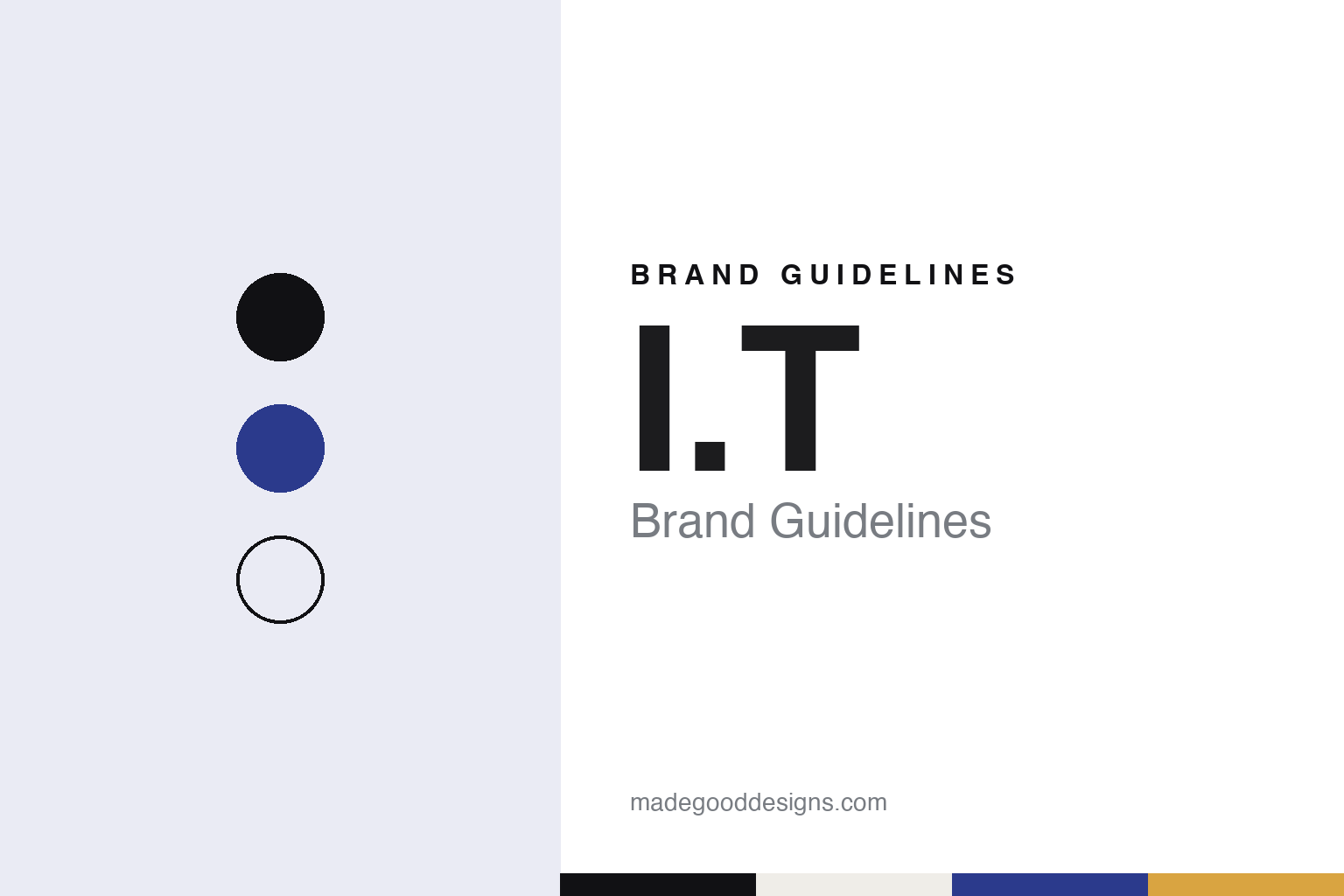
I.T Brand Guidelines
The Hong Kong multi-brand fashion group that began in a 200 sq ft shop.
Aa
Two constants: a black, blue and concrete palette and a geometric grotesque register. Abstract homage — not an I.T product or mark; no garment, logo or shop sign is reproduced.
A 200 sq ft shop
Two brothers and labels hard to find in Hong Kong.
I.T is a Hong Kong fashion retail group. English Wikipedia says it was founded in November 1988 by the brothers Sham Kar Wai and Sham Kin Wai, as a distributor of hard-to-find labels, and that it later developed fashion brands of its own. The company tells the same story on its website: it says it all began in 1988 with a small, 200-square-foot shop stocking brands that were not readily available elsewhere in Hong Kong.
Chinese Wikipedia adds detail. It says the original shop, in Causeway Bay, traded as “Green Peace” and sold Dr. Martens shoes and Levi’s 501 jeans alongside European labels then rare in Hong Kong; that the business opened a flagship in the same district in 1993; and that in 1997 the shops were renamed I.T, which it says stood for “Income Team.” The same article dates the group’s listing on the Hong Kong stock exchange to March 2005, and says that in 2011 the group opened I.T Hysan One, a four-storey flagship on Hysan Avenue in Causeway Bay with floors given over to several of its own brands. English Wikipedia gives the company’s head office as Wong Chuk Hang, on the south side of Hong Kong Island, with its registered office in Bermuda.
The company describes a multi-brand, multi-layer model: multi-brand stores aimed at clearly defined groups of shoppers, single-brand shops, international brands it licenses, and house brands it develops itself. It says new and little-known labels are given space in its multi-brand stores, and those that sell can move on to free-standing shops of their own.
The two founders split the work. Wikipedia lists Sham Kar Wai as chairman and chief executive and Sham Kin Wai as chief creative officer, and FashionUnited still described Sham Kar Wai as the group’s founder and chairman in October 2026.
Colour
Upper case, lower case and the shop-in-shop.
The group’s store names carry its segmentation in their typography. Wikipedia explains that stores called I.T, in capitals, sell the more expensive Japanese and European labels, while i.t, in lower case, sells younger brands. The company adds two more multi-brand formats: ete! for footwear and accessories, and double-park for streetwear and the lifestyle around it.
House brands sit inside and beside those stores. Hong Kong outlet HK01 named izzue, 5cm and CHOCOOLATE among them in 2017. Inside Retail Asia reported in February 2019 that izzue was founded in 1999, had more than 90 stores in Greater China, Singapore, Canada and the UK, and had staged an on-schedule show with menswear and womenswear at London Fashion Week; the same report said the group showcased more than 300 international brands and ten in-house labels. In December 2020 the magazine listed Kurt Geiger and Camper among the international brands I.T held local licences for.
Stores grew into destinations. In December 2018 Inside Retail Asia reported the opening of a 12,000-square-foot I.T Blue Block at Festival Walk in Kowloon Tong, built around a “travelling” design concept, with areas for fashion, food and drink, homeware, footwear and outdoor gear; the format had started at Hysan Place a year earlier. In September 2024 the Shanghai municipal government’s English site reported an i.t blue block flagship of nearly 3,000 square metres on Middle Huaihai Road in Xintiandi, with nearly 50 brands including Kangol, Fred Perry and Danton.
The group also bought a Japanese label outright. In February 2011, Hypebeast reported, citing WWD, I.T acquired about 90 per cent of Nowhere Co., the Tokyo company behind A Bathing Ape; Wikipedia gives the stake as 90.27 per cent.
Typography
Shop signs, own brands and owners.
Hong Kong and Taiwanese retailers and fashion chains present themselves in at least two languages at once. A shop sign, a website header or a stock-exchange filing will often pair an English name with a Chinese one, and the two are not always translations: Baleno writes its Chinese name as 班尼路, and Bossini’s holding company appears in Chinese as 堡獅龍. Logos and colour schemes are rarely set out in public brand rules, so what can be documented is how each company writes its own name, in which case and in which script.
The formats vary widely. This group runs from mall fashion stores and multi-brand boutiques to cosmetics and drugstore chains, electrical and camera retailers and online marketplaces. Many sell through a mix of shops they run themselves, franchised or consignment counters and online stores on large platforms, and several have left markets where they once traded.
Ownership is just as varied. Some chains are family businesses that grew into listed companies; some sit inside larger groups whose main trade is something else, such as a textile maker that owns a clothing brand; and some have been taken private after years on the stock exchange. Filings with the Hong Kong stock exchange and Taiwan’s exchanges record many of those changes with dates, and they are used here alongside dated reports in the trade and business press.
Collections and own brands are given as the companies name them, from children’s and sports lines to streetwear labels, and corporate pages on founders and owners are treated as the company’s own account. This guide sets out what can be checked about each chain — who founded it, who owns it and how it presents its name — and marks clearly what rests only on the company’s word.
Aa
A geometric grotesque for a store name that switches case. (Specimen set in Space Grotesk, a sans STAND-IN; NOT the I.T logo.)
I.T
Listed in 2005, private again in 2021.
The group left the stock market in 2021. On 7 December 2020 Inside Retail Asia reported that I.T planned to delist, with a buy-out offer from Sham Kar Wai and the private-equity firm CVC; if shareholders approved, it reported, the founder’s stake would fall to 50.65 per cent, with CVC holding the rest. The law firm Clifford Chance, which advised CVC, said in June 2021 that the privatisation, carried out by a scheme of arrangement, became effective on 28 April 2021; Chinese Wikipedia, citing RTHK, gives 30 April 2021 as the date the listing was withdrawn.
The deal also divided the business. Clifford Chance said the transaction created a standalone business holding A Bathing Ape, AAPE by A Bathing Ape and related sub-brands, owned by the offeror group, while the founders would separately own and operate the other I.T operations.
The group has since added licences. In October 2026 FashionUnited reported that I.T Group had acquired the existing Marc Jacobs Greater China operating business and signed a long-term licensing agreement with the brand’s owners, WHP Global and G-III Apparel Group. The same report described I.T Group as an omnichannel retailer with more than 280 points of sale and an e-commerce platform across Greater China, running retail concepts including I.T, i.t and EXI.T, with a digital platform carrying more than 400 labels.
For a design guide, I.T shows how a retailer can make its own name do segmentation work: the same two letters, in capitals or lower case, mark two different shops, and the store becomes the frame for other people’s labels. Compare G2000, a Hong Kong chain built on its own single label, and Baleno, another Hong Kong clothing name. For this guide we use shopfront black, a block blue, concrete and a brass accent with a sans, an unofficial interpretation; no product or logo is reproduced.
Explore & save
Keep I.T’s identity on hand — save it to a board in the Made Good inspiration library.
I.T identity set
Pin the I.T black, blue and concrete palette and the geometric grotesque register to your own board.
Source & notes
Frequently Asked Questions
What font can I use to match the I.T look?
This guide describes I.T’s type as “A geometric grotesque for a store name that switches case”. Its type specimen is set in Space Grotesk from Google Fonts as a stand-in; Space Grotesk is not I.T’s own lettering.
What colours are in the I.T palette?
This guide’s I.T palette is Shopfront black #111114, Block blue #2B3A8C, Concrete #9A9690, Brass #D9A441 and Gallery white #EFEDE8. The tones are the guide’s own unofficial interpretation, not official I.T hex codes.
When was I.T founded?
I.T was founded in November 1988, in Hong Kong. I.T is known for I.T and i.t stores, izzue, 5cm.
Who founded I.T?
I.T was founded by Sham Kar Wai and Sham Kin Wai in November 1988.