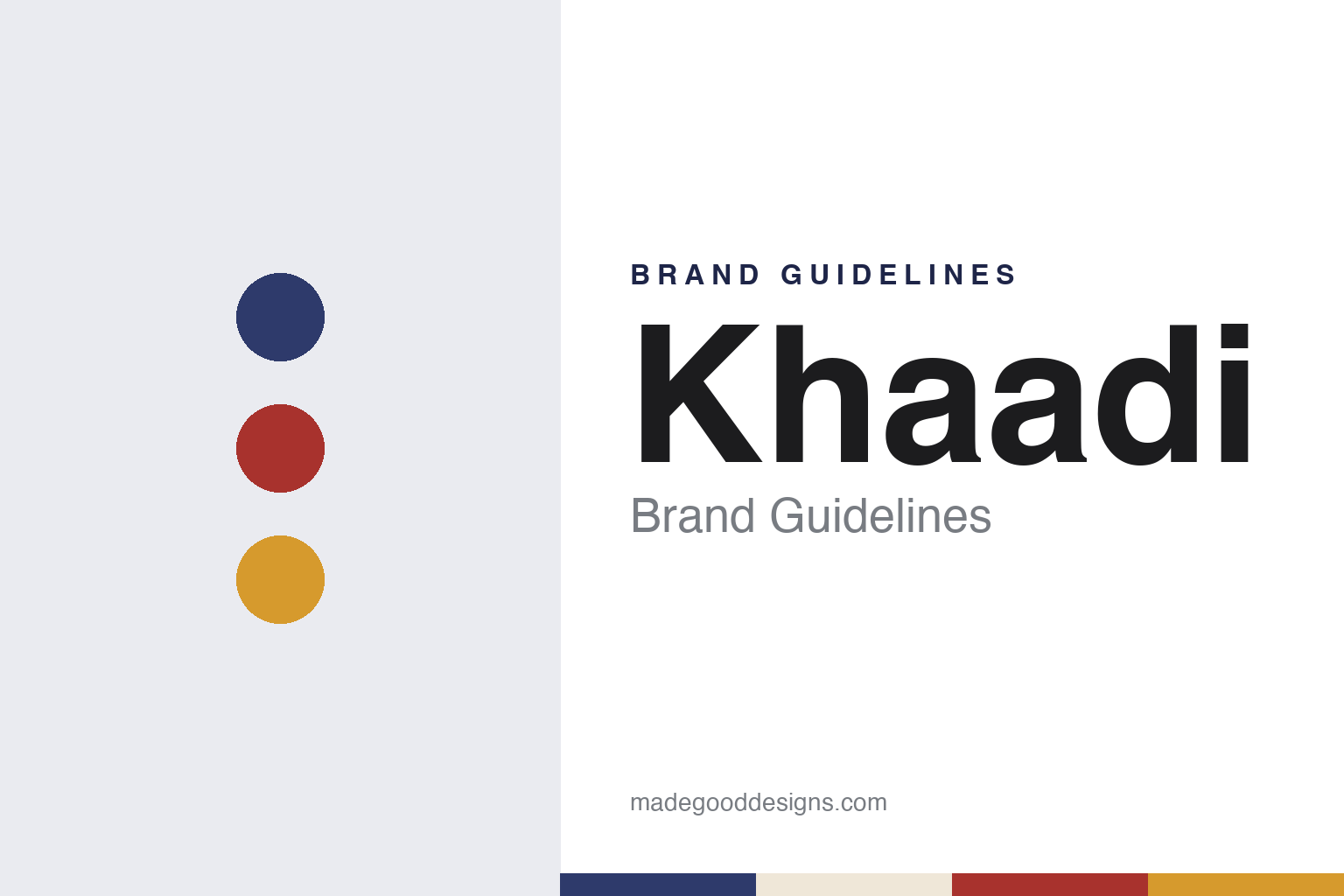
Khaadi Brand Guidelines
The Karachi handloom label that kept the weaver’s hand in its logo.
Aa
Two constants: an indigo, ecru and madder palette and a geometric sans register. Abstract homage — not a Khaadi product or mark; no garment, logo or shop sign is reproduced.
From the handloom
A textile graduate, a few looms and a small shop in Zamzama.
Khaadi is a Pakistani fashion and lifestyle retailer based in Karachi. It was set up in 1998 by Shamoon Sultan, a textile-design graduate of the Indus Valley School of Art and Architecture in Karachi who had worked for the textile designer Noorjehan Bilgrami before going out on his own, according to an interview he gave Aurora in October 2015 and a profile published by Profit by Pakistan Today in September 2017. Profit reported that in early 1998 he set up handlooms at a factory in Karachi’s SITE industrial area to make hand-woven khaddar cloth for a retail brand of his own.
The first shop opened in December 1999: a 400-square-foot store in the Zamzama commercial area of Karachi, selling mainly fabric, menswear and a few simple kurtis for women, Sultan told Aurora. In the early days, he said, the shop sold out within two weeks and had to close until more cloth was made; for a time it opened for two hours each evening to sell what the looms had produced the day before.
The name points straight back to that workshop. English Wikipedia derives it from khaddi, the word for a handloom, and the company’s own description, quoted by Profit in May 2022, gives Khaadi as meaning “handlooms” in the local language.
The range soon reached beyond hand-woven cloth. Modern Retail, citing the company’s website, reported in July 2024 that Khaadi had added women’s ready-to-wear by 2002 and kids, home and accessories lines in the 2010s. In his 2015 interview Sultan described a business split between prêt, unstitched fabric and Khaas, the higher-end line, with separate teams for prêt and unstitched; he said smaller cities bought more unstitched cloth while prêt sold more in the large cities. Profit wrote in 2017 that the company sold both ready-made garments and unstitched fabric, including lawn.
Colour
From one Karachi shop to malls at home and abroad.
Khaadi grew through its own shops. Profit wrote in 2017 that it spread first within Karachi, then to Lahore and Islamabad, and then to eight other Pakistani cities. Sultan told Aurora in 2015 that Khaadi had 40 stores in 11 cities at the time, and that a store it had opened at Dolmen Mall Clifton about four years earlier was four times the size of its usual shop. Profit counted 54 stores in 2017 — 42 in Pakistan, eight in the United Arab Emirates and four in the United Kingdom — and described a 22,000-square-foot flagship at Dolmen City Mall in Clifton, Karachi.
The move abroad began in the Gulf. Khaadi opened in Dubai in 2010, followed by Abu Dhabi, and began opening stores in the United Kingdom in 2013, according to Profit; Modern Retail listed UK branches in Birmingham, Bradford, London and Manchester. By May 2022, Profit reported, Khaadi had 62 stores in 25 Pakistani cities and 14 abroad, in Qatar, the UAE, Bahrain and the United Kingdom.
The United States came next. In February 2024 Khaadi opened its first US store at Tysons Corner Center in Virginia, near Washington, followed by a distribution centre in the Washington area for its online business and a second US store in June 2024 at the Galleria mall in Houston, Modern Retail reported, citing the real-estate brokerage Cushman & Wakefield. The same report put the chain at more than 50 stores in all.
Ownership has stayed close to the founder. Profit reported in May 2022 that Khaadi Corporation Limited was a single-member private limited company, with Shamoon Sultan as founder, chief executive and owner of all of its capital. That month the International Finance Corporation, a member of the World Bank Group, announced that it would invest in Khaadi Corporation for a minority stake; its announcement of 27 May 2022 described the investment in the future tense and gave no completion date.
Typography
Design and documentation.
Pakistani and Bangladeshi fashion and retail brands present themselves through a few recurring touchpoints: the shop sign over a mall unit, the logo on a carrier bag, the seasonal look-book and the corporate page that names a founder or a parent company. Some marks point back to craft — Khaadi, for example, says the hands in its logo symbolise its heritage in handloom craft — while others set a short name in plain capitals, as Sapphire does.
The formats vary widely. Some of the brands in this group began as a single shop and grew into mall flagships at home and abroad; others are the retail arms of textile mills, and can draw on a parent’s own spinning, weaving and printing before cloth reaches a store, as Sapphire describes. Alongside them sit supermarket chains, craft-led lifestyle stores and online marketplaces, each with its own way of showing a name on a shopfront, a shelf or a screen.
Collections are named in the companies’ own terms. Lawn, prêt and unstitched fabric appear again and again in their catalogues, and the balance between them has shifted: Profit by Pakistan Today reported in 2017, from Pakistan Bureau of Statistics data, that ready-made clothes took 13 percent of household clothing spending in 2002 and 33 percent in 2016, while unstitched cloth and accessories fell from more than 68 percent to 50 percent.
Ownership is set out plainly in each guide: family-owned, founder-owned, mill-owned or group-owned, with dates where a dated source gives them. Each guide separates what independent press and official filings record from what the company says about itself, and the palettes and type pairings shown are an unofficial interpretation rather than a reproduction of any brand’s colours or marks.
Aa
A geometric sans for a mark that keeps the weaver’s hand. (Specimen set in Jost, a sans STAND-IN; NOT the Khaadi logo.)
The joined hands
A logo that still carries the weaver’s hand.
Khaadi’s mark has drawn on its handloom start. The fingers in the original logo stood for the weavers’ hands and the work behind each product, English Wikipedia says, citing Aurora. In December 2021 Aurora reported a refresh of the logo by Khaadi’s creative team working with an international design and branding agency, which the magazine did not name. “The two hands that symbolised our heritage in handloom craft are now joined together and connected with the brand logo,” the company’s corporate-communications manager told the magazine.
The refresh also brought the word back. A couple of years earlier, Aurora reported, Khaadi had taken the brand name out of its logo; the 2021 version restored it, which the team linked to name recognition in smaller cities beyond Karachi, Lahore and Islamabad. The company framed the change around what it called four “root strengths” — colour, design, fashion and retail experience — and introduced it with a winter campaign titled “Wear Yourself,” alongside a western line of dresses, T-shirts and kurtis, according to the same report.
The shops carry the identity too. English Wikipedia describes the Experience Hub, a Karachi space of about 2,970 square metres that opened in December 2021 as a store with its own café. In its own words, quoted by Modern Retail in 2024, the company describes the brand through vibrant colours, intricate craftsmanship and a connection to Pakistani culture and heritage. A logo gallery on English Wikipedia shows versions dated 1999, 2010, 2013, 2018 and 2021.
For a design guide, Khaadi shows how a retail mark can keep a craft origin — the weaver’s hand — in view as a business moves from a single hand-woven shop to mall flagships and stores abroad. Compare Sapphire, the retail brand of a Lahore textile group, and Gul Ahmed, another Karachi name in Pakistani textile retail. For this guide we use an indigo, a handloom ecru and a madder red with a sans, an unofficial interpretation; no product or logo is reproduced.
Explore & save
Keep Khaadi’s identity on hand — save it to a board in the Made Good inspiration library.
Khaadi identity set
Pin the Khaadi indigo, ecru and madder palette and the geometric sans register to your own board.
Source & notes
Frequently Asked Questions
What font can I use to match the Khaadi look?
This guide describes Khaadi’s type as “A geometric sans for a mark that keeps the weaver’s hand”. Its type specimen is set in Jost from Google Fonts as a stand-in; Jost is not Khaadi’s own lettering.
What colours are in the Khaadi palette?
This guide’s Khaadi palette is Handloom indigo #2E3A6B, Khaddar ecru #EFE7D8, Madder red #A8322D, Turmeric #D69A2D and Loom charcoal #22201E. The tones are the guide’s own unofficial interpretation, not official Khaadi hex codes.
When was Khaadi founded?
Khaadi was founded in 1998 (first shop December 1999), in Karachi, Pakistan.
Who founded Khaadi?
Khaadi was founded by Shamoon Sultan in 1998 (first shop December 1999).