Jumia Brand Guidelines
The Lagos-born marketplace listed in New York in 2019.
Aa
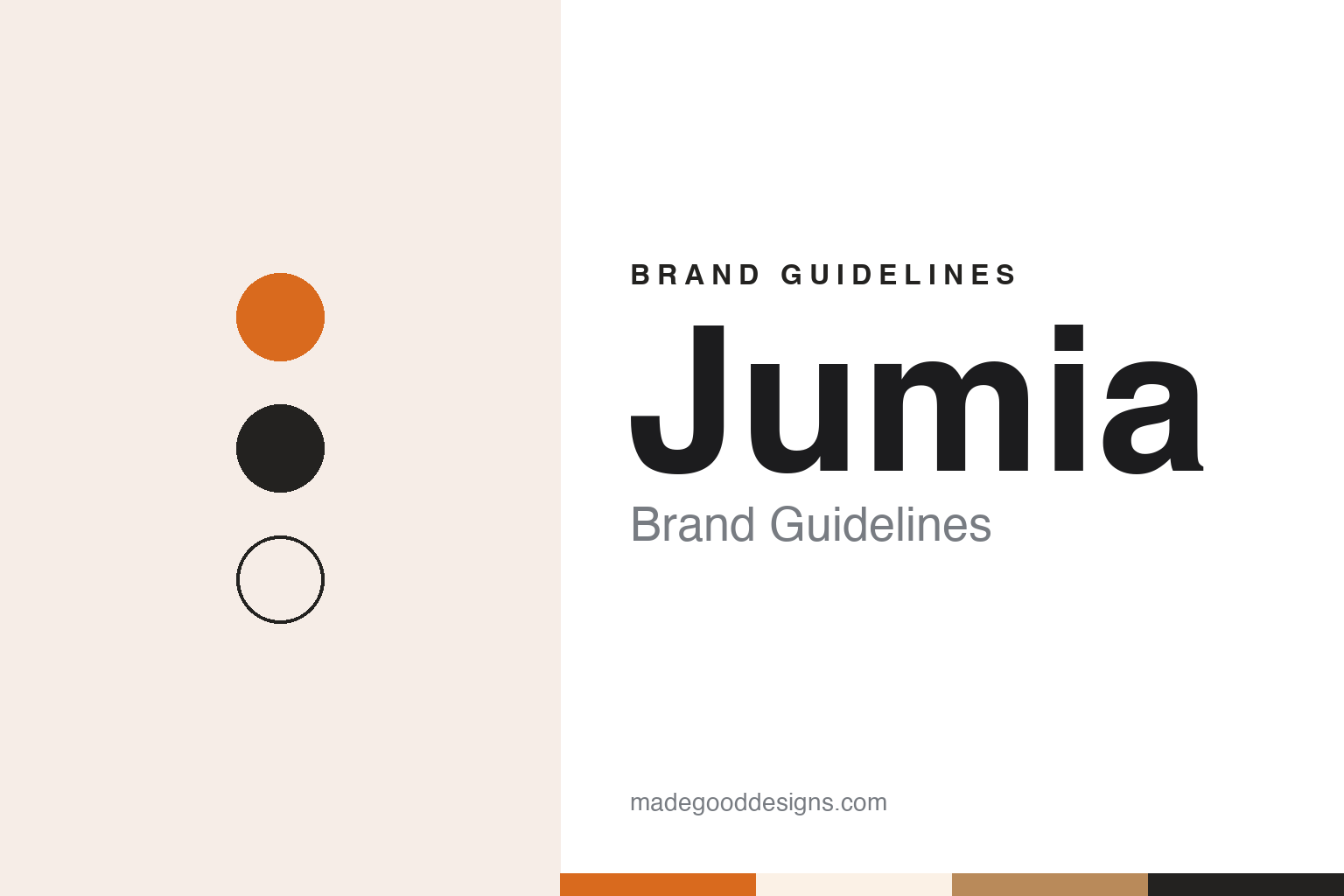
Two constants: a warm orange, charcoal and cream palette and a rounded sans register. Abstract homage — not a Jumia asset or mark; no logo, app screen or parcel is reproduced.
Kasuwa
Four founders, one Lagos website.
Jumia began in Lagos in 2012. English Wikipedia names four founders: Jérémy Hodara and Sacha Poignonnec, former McKinsey consultants, together with Tunde Kehinde and Raphael Kofi Afaedor. It says the shop originally went online as Kasuwa, the Hausa word for “market,” with backing from the German start-up builder Rocket Internet and the telecoms groups MTN and Millicom, and was then renamed Jumia. TechCrunch, reporting in April 2019, also described the company as founded in Lagos in 2012 with Rocket Internet backing, and said Kehinde and Afaedor left in 2015 to start businesses in payments and logistics.
Expansion came quickly. According to the country table in English Wikipedia, the Nigerian site opened in June 2012, sites in Egypt, Morocco and South Africa followed in July 2012, Kenya and Côte d’Ivoire in May 2013, Ghana in 2014 and Uganda in 2016. Each country kept its own national web address, such as jumia.com.ng in Nigeria, jumia.com.eg in Egypt and jumia.co.ke in Kenya. In South Africa the group traded under a different name, Zando, as an online fashion shop.
New services were added under the same name. In June 2013 the group launched Jumia Travel, for hotel bookings, and Jumia Food, for meal delivery, Wikipedia says; a classifieds service, Jumia Deals, followed, and in 2017 a payment service, JumiaPay, and a bill-payment app, Jumia One. At the end of 2015, Wikipedia says, citing Techpoint Africa, Juliet Anammah became chief executive of Jumia Nigeria so that the founders could run the group as a whole.
Colour
A listing, then a narrower map.
On 12 April 2019 Jumia listed on the New York Stock Exchange under the ticker JMIA, TechCrunch reported, in an offering of American depositary shares. At that time, the report said, it ran several online lines in 14 African countries, among them Jumia Food, Jumia Flights and Jumia Deals. The parent company, Jumia Technologies AG, is incorporated in Germany, the same report noted, while the business operates only in Africa.
TechCrunch also described the machinery Jumia had built from Nigeria outward: the JumiaPay payment platform, a delivery fleet of trucks and motorbikes that had become a common sight on the streets of Lagos, and a fulfilment product, Jumia Services, offered to other sellers. Local merchants could use Jumia’s payment, delivery and data tools to sell online through the marketplace; Juliet Anammah had told TechCrunch that more than 80,000 active sellers were doing so. By company data quoted in the same report, Jumia processed more than 13 million packages in 2018, and its filing counted 5,128 employees in Africa. Anammah named smartphones, washing machines, fashion and televisions among the goods shoppers bought most often.
The years after the listing brought a narrower map. English Wikipedia records that Jumia suspended its e-commerce business in Cameroon in November 2019 and closed in Tanzania on 27 November 2019, while keeping classifieds there; in December 2019 its travel site passed to Travelstart under a distribution agreement. In December 2023, Wikipedia says, citing Reuters, the company announced it would stop food delivery in seven markets.
The founders stepped back in 2022. On 7 November 2022 Hodara and Poignonnec left their roles as co-chief executives, TechCrunch reported, and the supervisory board named Francis Dufay, with Jumia since 2014 and formerly chief executive in Côte d’Ivoire, as acting chief executive, with Antoine Maillet-Mezeray as executive vice president for finance and operations. At that point the group was active in 11 countries with a marketplace, JumiaPay and a logistics business, the report said. Wikipedia, citing TechCrunch, says Dufay was confirmed as chief executive in February 2023. The supervisory board was then chaired by Jonathan Klein.
Alongside the closures came local partnerships. English Wikipedia records an agreement with Egypt Post in December 2020 to develop e-commerce deliveries in Egypt, a technology centre opened in Egypt in 2021, and a February 2022 tie-up with LocQar, a smart-locker company, to bring collection points closer to shoppers in Ghana.
Typography
Retail and e-commerce in three countries.
Retailers in Kenya, Nigeria and Egypt present themselves first through the street: the shop sign over a supermarket entrance, the printed carrier bag, the livery on a delivery van or motorbike box. Many of these businesses publish their own histories on corporate pages, and those pages often record brand decisions as plainly as store openings: a change of trading name, a new pair of house colours, a new store format. This guide treats those pages as the companies’ own accounts and sets them beside dated reports in the business press.
The formats vary widely. Some chains began as a single family shop in a market town and grew into national supermarket networks, adding smaller convenience formats along the way. Others are discount grocers built around compact neighbourhood stores, electronics and appliance chains with showrooms, or online marketplaces whose shop front is an app and whose brand travels on parcels rather than signs. Several former chains in this group no longer trade, and their names now survive mainly in press archives.
Ownership is just as varied, and it shapes how a brand is run. Family-owned firms sit beside companies listed on the Nairobi Securities Exchange or abroad, and beside chains in which private-equity funds and development-finance investors hold large or controlling stakes. Mergers sometimes bring two store networks under one name; takeovers and receiverships end others. These are described here as dated facts, with owners named only in their business roles.
Each guide sets out who founded the business, who owns it now and which own brands, loyalty schemes and services it names itself, from loyalty cards to delivery apps. Where a company describes its own colours or formats, that is given as its claim. The palettes and typefaces shown are our own unofficial interpretation, not the companies’ marks.
Aa
A rounded sans for a marketplace name carried across many national sites. (Specimen set in Rubik, a sans STAND-IN; NOT the Jumia logo.)
Jumia
Two pillars, eight countries.
The narrowing continued under Dufay. In October 2024 The Punch reported that Jumia would close Zando in South Africa and its Tunisian business by the end of that year, as part of a refocus on markets such as Nigeria; the same report said it was stepping back from everyday grocery and food delivery. English Wikipedia, citing Techpoint Africa, says Jumia left Algeria in February 2026.
Today the group website describes Jumia as active in eight countries and built around two pillars, Jumia Marketplace, which offers goods from outside sellers across many categories, and Jumia Logistics, which handles delivery. It describes Pickup Stations where customers collect their orders. In an October 2025 report on rural shopping in Nigeria, the company says more than half of its Nigerian orders now come from secondary cities and remote areas, served through over 350 Pickup Stations and 67 logistics partners; a similar company report on rural e-commerce in Kenya followed in November 2025.
For a design guide, Jumia shows how one marketplace name can be carried across national websites, apps and delivery fleets while the group behind it grows and then contracts. Compare Konga, which competed with Jumia in Nigeria from the same year, and Jiji, another online marketplace trading in Nigeria. For this guide we use a warm orange, a deep charcoal and a soft cream with a sans, an unofficial interpretation; no product or logo is reproduced.
Explore & save
Keep Jumia’s identity on hand — save it to a board in the Made Good inspiration library.
Jumia identity set
Pin the Jumia warm orange, charcoal and cream palette and the rounded sans register to your own board.
Source & notes
Frequently Asked Questions
What font can I use to match the Jumia look?
This guide describes Jumia’s type as “A rounded sans for a marketplace name carried across many national sites”. Its type specimen is set in Rubik from Google Fonts as a stand-in; Rubik is not Jumia’s own lettering.
What colours are in the Jumia palette?
This guide’s Jumia palette is Market orange #D96A1E, Charcoal #232220, Cream #FBF1E6, Parcel tan #B98A5A and Paper #FAF8F5. The tones are the guide’s own unofficial interpretation, not official Jumia hex codes.
When was Jumia founded?
Jumia was founded in 2012, in Lagos, Nigeria.
Who founded Jumia?
Jumia was founded by Jérémy Hodara, Sacha Poignonnec, Tunde Kehinde and Raphael Kofi Afaedor in 2012.