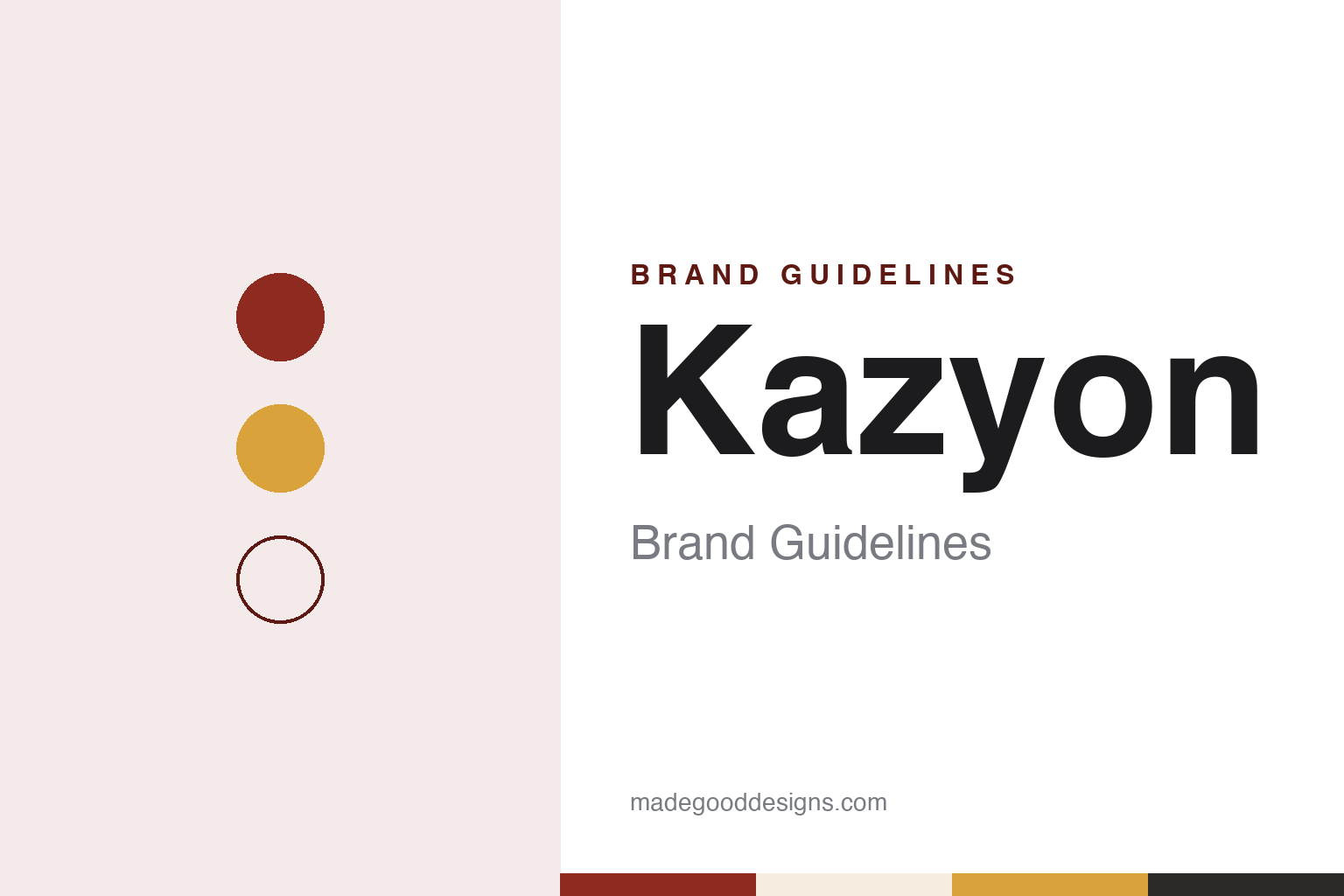
Kazyon Brand Guidelines
The Egyptian neighbourhood discounter founded in 2014.
Aa
Two constants: a brick red, mustard and cream palette and a compact grotesque register. Abstract homage — not a Kazyon store, product or mark; no logo or sign is reproduced.
A discounter from 2014
Small stores, food and household goods.
Kazyon is an Egyptian discount grocery chain. It was founded in 2014 by Hassan Heikal, a former chief executive of the investment bank EFG Hermes, the Cairo business newsletter Enterprise reported in February 2024, and it sells a range of food and household products through small neighbourhood stores. Heikal is the chain’s chairman. Its parent company, Kazyon Ltd, is based in the United Kingdom, as Enterprise and Retail Insight Network both reported in February 2024.
The chain’s growth can be traced through dated counts from outside the company. The German trade consultancy Discount Retail Consulting wrote in August 2023 that Kazyon opened its 200th store on 5 July 2017, and that it reported about 450 stores across 17 governorates in 2021 and 2022. The Dutch development bank FMO counted 648 stores, more than 3,500 employees and four distribution centres as of February 2023, Africa Private Equity News reported in June 2023. By August 2023, Discount Retail Consulting gave more than 600 stores across 18 governorates and more than 4,000 employees.
Discount Retail Consulting describes Kazyon as a small-format discounter: a modern supermarket chain built on compact stores in city neighbourhoods rather than large out-of-town halls. In its April 2023 investment announcement, as reported by Africa Private Equity News, the investor Development Partners International (DPI) described a focused range of products sold through neighbourhood stores, supplied through centralised distribution centres across Egypt, and a customer loyalty scheme; those details are the investor’s and the company’s own description.
The same name is used for the whole business, from the stores in Egypt to the UK holding company and the stores it later opened in Morocco, so for a design reader the brand is carried by one short word repeated across hundreds of neighbourhood shops in several countries.
Colour
Founder, fund managers and development banks.
Kazyon’s ownership has widened in a few dated rounds. Discount Retail Consulting noted in August 2023 that Heikal and a DPI partner had both been directors of Kazyon’s UK parent since May 2022, and DPI says its own initial investment was made in 2022.
In April 2023 DPI announced a further equity investment in Kazyon Ltd, alongside co-investors including British International Investment (BII), the UK’s development finance institution, and South Suez, Africa Private Equity News reported on 27 April 2023. In June 2023 the same publication reported that FMO had signed an equity participation in the chain, alongside DPI, BII, the International Finance Corporation (IFC), South Suez and Sango Capital.
When the company announced its Saudi deal in February 2024, it listed its shareholders, as quoted by Enterprise: besides Heikal and DPI, a global sovereign wealth fund, several development finance institutions, FIM Capital, Sango Capital and regional family offices. The sovereign fund was not named. Heikal said that deal had been funded by introducing that fund into Kazyon’s capital structure.
In January 2026 DPI announced a follow-on investment in Kazyon, Africa Private Equity News reported on 22 January 2026, and Discount Retail Consulting covered the same announcement the next day. In its statement DPI said the chain then operated 1,600 stores across three countries and employed more than 11,000 people, and referred to a portfolio of private-label brands; those figures are DPI’s, and the brands were not named.
The result is a company that is privately held but well documented: a founder-chairman, a lead private-equity investor and several development-finance institutions, each of whose involvement has been reported with a date.
Typography
How the region’s retailers present themselves.
Retailers in Kenya, Nigeria and Egypt present themselves first through the street: the shop sign over a supermarket entrance, the printed carrier bag, the livery on a delivery van or motorbike box. Many of these businesses publish their own histories on corporate pages, and those pages often record brand decisions as plainly as store openings: a change of trading name, a new pair of house colours, a new store format. This guide treats those pages as the companies’ own accounts and sets them beside dated reports in the business press.
The formats vary widely. Some chains began as a single family shop in a market town and grew into national supermarket networks, adding smaller convenience formats along the way. Others are discount grocers built around compact neighbourhood stores, electronics and appliance chains with showrooms, or online marketplaces whose shop front is an app and whose brand travels on parcels rather than signs. Several former chains in this group no longer trade, and their names now survive mainly in press archives.
Ownership is just as varied, and it shapes how a brand is run. Family-owned firms sit beside companies listed on the Nairobi Securities Exchange or abroad, and beside chains in which private-equity funds and development-finance investors hold large or controlling stakes. Mergers sometimes bring two store networks under one name; takeovers and receiverships end others. These are described here as dated facts, with owners named only in their business roles.
Each guide sets out who founded the business, who owns it now and which own brands, loyalty schemes and services it names itself, from loyalty cards to delivery apps. Where a company describes its own colours or formats, that is given as its claim. The palettes and typefaces shown are our own unofficial interpretation, not the companies’ marks.
Aa
A compact grotesque for a shop-front register. (Specimen set in Archivo, a sans STAND-IN; NOT the Kazyon logo.)
Kazyon
From Cairo neighbourhoods to Casablanca and Makkah province.
Kazyon began trading outside Egypt in October 2023, when it opened in Morocco, Enterprise reported. A 2024 report from the African Marketing Confederation said the chain then had 12 Moroccan stores, mostly in Casablanca, and that the company employed around 7,000 people across its business. The same report described the stated approach as a network of consistent, recognisable neighbourhood stores, in the company’s own words. DPI later described the Moroccan business as a greenfield entry, built from new stores rather than bought.
Saudi Arabia followed by acquisition. In February 2024 Kazyon Ltd acquired a 50 per cent stake in Dukan, a Saudi discount grocery retailer, through a capital increase, Enterprise reported on 6 February 2024. Retail Insight Network reported the next day that Dukan, which it also called Al Dukan, was founded in 2013, operated more than 100 stores across three cities in Makkah province and employed about 500 people, selling basic groceries and private-label products. At the time Kazyon gave its own network as more than 1,000 stores across Egypt, Morocco and Saudi Arabia, the same report said.
Little has been published about Kazyon’s visual identity. The company has not set out its logo, typeface or colour rules in any source used here, and its signs and packs are not described in the press reports. For that reason the palette and type in this guide are an interpretation, chosen for the kind of business the sources describe — a dense network of small shops selling everyday goods — rather than taken from the chain itself.
For a design guide, Kazyon shows how a young discount chain can be documented almost entirely through dated store counts and ownership filings rather than through its own story. Compare B.TECH, another Egyptian retailer backed by DPI, and Carrefour, whose franchise also trades in Egypt. For this guide we use a brick red, a mustard and a warm cream with a sans, an unofficial interpretation; no product or logo is reproduced.
Explore & save
Keep Kazyon’s identity on hand — save it to a board in the Made Good inspiration library.
Kazyon identity set
Pin the Kazyon brick red, mustard and cream palette and the compact grotesque register to your own board.
Source & notes
Frequently Asked Questions
What font can I use to match the Kazyon look?
This guide describes Kazyon’s type as “A compact grotesque for a shop-front register”. Its type specimen is set in Archivo from Google Fonts as a stand-in; Archivo is not Kazyon’s own lettering.
What colours are in the Kazyon palette?
This guide’s Kazyon palette is Brick red #8E2A1F, Deep brick #5E1A12, Mustard #D9A23A, Cream #F4EDE0 and Ink #2B2A26. The tones are the guide’s own unofficial interpretation, not official Kazyon hex codes.
When was Kazyon founded?
Kazyon was founded in 2014, in Egypt. This guide lists Kazyon Ltd, United Kingdom as its owner.
Who founded Kazyon?
Kazyon was founded by Hassan Heikal in 2014. This guide lists Kazyon Ltd, United Kingdom as its owner.
Who owns Kazyon?
Kazyon is owned by Kazyon Ltd, United Kingdom. This guide dates Kazyon to 2014, in Egypt.