B.TECH Brand Guidelines
The Egyptian appliance chain that began as Olympic Stores.
Aa
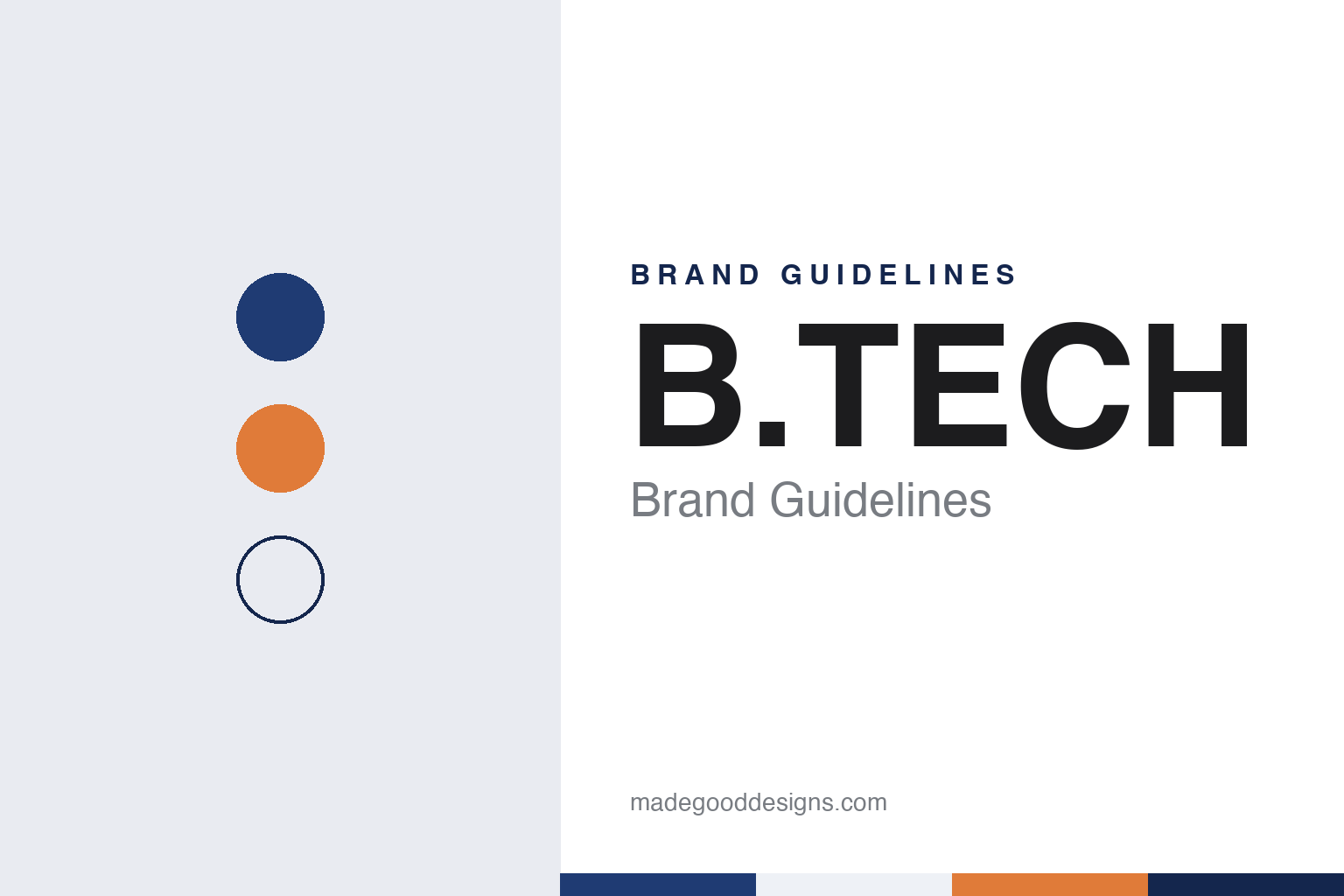
Two constants: a deep navy, orange and cool white palette and a geometric sans register. Abstract homage — not a B.TECH store, product or mark; no logo or sign is reproduced.
Olympic Stores
A retail arm grown out of a family appliance business.
B.TECH is an Egyptian retailer of consumer electronics and home appliances. It was established in 1997, as the Cairo business site Amwal Al Ghad reported in July 2016 and The National in October 2022, and its founder, chairman and chief executive is Mahmoud Khattab. The company writes its name in capitals, B.TECH, on its website; some newspapers write it as BTech or B.Tech.
Khattab set out the early history himself in a November 2023 interview with the Cairo newsletter Enterprise. He joined his family’s business, Olympic Electric, while still at university, and later worked on its role as an authorised reseller of Philips appliances before setting up its marketing department. In 1997, he said, he led the launch of Olympic Stores, a chain for home appliances, and in 2001 the business was renamed B.TECH. Before that he had also run Wall and Floor, a company he founded to make and export silk and wool carpets and curtains.
In the same interview Khattab described the problem the chain was set up to solve: suppliers had no organised retail network in which to show their products. He also described instalment plans shaped around a customer’s income and outgoings as part of the offer from the start. Those are his own accounts of the company’s origins.
The renaming matters for anyone studying the identity. Olympic Stores carried the family company’s name; B.TECH gave the retail chain a short, separate name of its own, written with a full stop between the initial and the word, which it has kept for a quarter of a century.
Colour
A founder’s holding company and two outside investors.
B.TECH’s outside ownership has a clear, dated record. In July 2016 the company signed a strategic partnership with Development Partners International (DPI), a UK-based private equity firm that invests in Africa, Amwal Al Ghad reported on 23 July 2016. The National later reported that DPI’s fund African Development Partners II had acquired the stake that month, and DPI’s own 2022 announcement says the investment was made through that second fund, in partnership with Khattab and his management team. DPI’s chief executive linked the deal to a shift in the country from traditional shops towards organised retail and to the formation of new households buying durable goods.
In October 2022 DPI sold that holding. The buyer was the Saudi Egyptian Investment Company (SEIC), a wholly owned subsidiary of Saudi Arabia’s Public Investment Fund, which acquired a 34 per cent stake for an undisclosed sum, The National reported on 3 October 2022; DPI’s own announcement, reported the same day by Africa Private Equity News, described a significant minority stake. Khattab told The National that SEIC would appoint two members of the company’s board. The newspaper noted that the purchase was one of SEIC’s early investments in Egypt, after the company had bought minority stakes in four companies listed on the Egyptian Exchange in August 2022. The remaining 66 per cent was owned by the Khattab family’s BT Holding, the newspaper reported.
At that point B.TECH had 143 stores across Egypt, The National reported, and Khattab said in DPI’s announcement that the store footprint had doubled since 2016. The company also expanded online over the same period. In his 2023 interview with Enterprise, Khattab said he had been chairman and chief executive for 26 years.
Taken together, the record shows a founder who has led the business since its launch, a family holding company with the majority of the shares, and two successive minority investors whose entry and exit were both reported with dates.
Typography
How the region’s retailers present themselves.
Retailers in Kenya, Nigeria and Egypt present themselves first through the street: the shop sign over a supermarket entrance, the printed carrier bag, the livery on a delivery van or motorbike box. Many of these businesses publish their own histories on corporate pages, and those pages often record brand decisions as plainly as store openings: a change of trading name, a new pair of house colours, a new store format. This guide treats those pages as the companies’ own accounts and sets them beside dated reports in the business press.
The formats vary widely. Some chains began as a single family shop in a market town and grew into national supermarket networks, adding smaller convenience formats along the way. Others are discount grocers built around compact neighbourhood stores, electronics and appliance chains with showrooms, or online marketplaces whose shop front is an app and whose brand travels on parcels rather than signs. Several former chains in this group no longer trade, and their names now survive mainly in press archives.
Ownership is just as varied, and it shapes how a brand is run. Family-owned firms sit beside companies listed on the Nairobi Securities Exchange or abroad, and beside chains in which private-equity funds and development-finance investors hold large or controlling stakes. Mergers sometimes bring two store networks under one name; takeovers and receiverships end others. These are described here as dated facts, with owners named only in their business roles.
Each guide sets out who founded the business, who owns it now and which own brands, loyalty schemes and services it names itself, from loyalty cards to delivery apps. Where a company describes its own colours or formats, that is given as its claim. The palettes and typefaces shown are our own unofficial interpretation, not the companies’ marks.
Aa
A geometric sans for a showroom-and-app register. (Specimen set in Manrope, a sans STAND-IN; NOT the B.TECH logo.)
B.TECH
Stores, an online shop, MiniCash and deel.
B.TECH’s range runs across the main categories of an electronics and appliance retailer. Its English website, checked in November 2026, sorts products into large and small home appliances, televisions, mobile phones and tablets, laptops and computers, and air conditioners, and carries pages for its branches, a buying-advice blog and a “Sell with B.TECH” section for outside sellers. The site is published in Arabic and English, lists the appliance and electronics brands it stocks in a brand shop, and gives a single short telephone hotline number for orders and service.
The company has built services around those stores. It provides consumer financing through its MiniCash service, and in August 2022 it launched deel, a business-to-business marketplace app for small and medium-sized businesses offering product listing, inventory management, delivery, marketing tools, analytics and training courses, The National reported in October 2022. Khattab told Enterprise in 2023 that the group works across retail, consumer finance, technology and logistics.
Little has been published about B.TECH’s visual identity. None of the sources used here sets out its logo, typeface or colour rules, so the palette and type in this guide are our own interpretation, chosen for a business that sells televisions, phones and kitchen appliances through both shops and an app, not taken from the company. The name itself — capital letters, a full stop and a short word — is the part of the identity the sources do document, through the company’s own spelling.
For a design guide, B.TECH shows how a retail chain can keep one short name steady while it adds an online shop, a finance service and a trade marketplace around it. Compare Kazyon, another Egyptian chain backed by DPI, and Jumia, a pan-African online marketplace. For this guide we use a deep navy, a signal orange and a cool white with a sans, an unofficial interpretation; no product or logo is reproduced.
Explore & save
Keep B.TECH’s identity on hand — save it to a board in the Made Good inspiration library.
B.TECH identity set
Pin the B.TECH deep navy, orange and cool white palette and the geometric sans register to your own board.
Source & notes
Frequently Asked Questions
What font can I use to match the B.TECH look?
This guide describes B.TECH’s type as “A geometric sans for a showroom-and-app register”. Its type specimen is set in Manrope from Google Fonts as a stand-in; Manrope is not B.TECH’s own lettering.
What colours are in the B.TECH palette?
This guide’s B.TECH palette is Deep navy #1F3B73, Night blue #14264D, Signal orange #E07B39, Cool white #EEF1F6 and Graphite #2E3138. The tones are the guide’s own unofficial interpretation, not official B.TECH hex codes.
When was B.TECH founded?
B.TECH was founded in 1997 (as Olympic Stores), in Egypt.
Who founded B.TECH?
B.TECH was founded by Mahmoud Khattab in 1997 (as Olympic Stores).
Who owns B.TECH?
B.TECH is owned by BT Holding (Khattab family); Saudi Egyptian Investment Company (2022).