Konga Brand Guidelines
The Lagos marketplace merged with Yudala under Zinox in 2018.
Aa
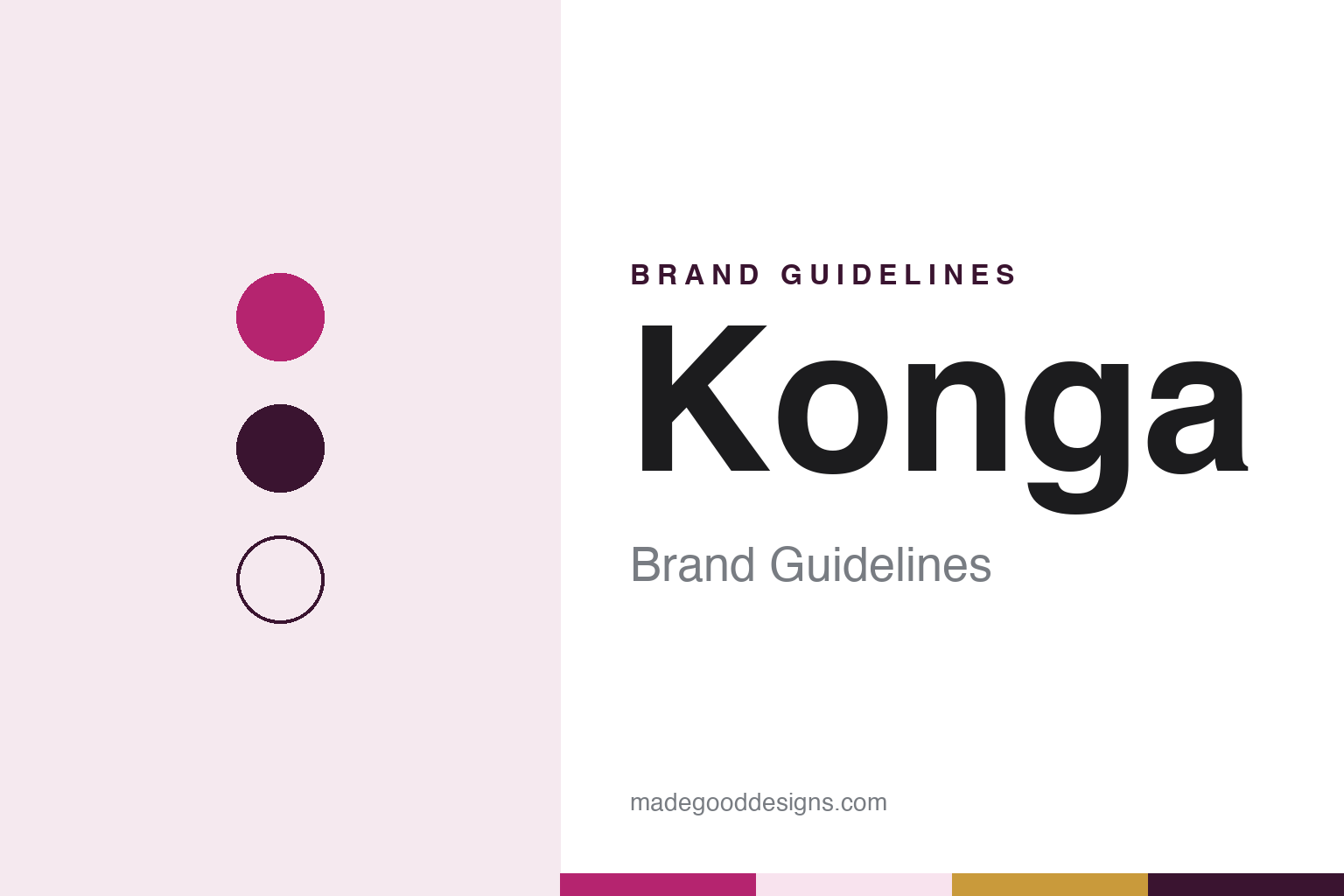
Two constants: a fuchsia, plum and blush palette and a rounded sans register. Abstract homage — not a Konga asset or mark; no logo, app screen or store sign is reproduced.
Konga.com
A Lagos online shop that opened to the country.
Konga was founded in Lagos in July 2012 by Sim Shagaya, according to English Wikipedia, which gives a starting staff of 20. Nairametrics, in an August 2019 profile, says Shagaya had earlier built several online ventures, including the deals site DealDey, launched in 2011, before starting Konga in 2012. The site began as an online shop for Lagos only, selling baby, beauty and personal-care goods, Wikipedia says, and opened to the whole of Nigeria in December 2012, adding categories through 2012 and 2013.
Its main rival arrived at the same moment. Jumia, backed by Rocket Internet, also launched in Lagos in 2012, and TechCrunch wrote in November 2022 that Jumia faced heavy competition from Konga in its early years as the contest for Nigerian online shoppers picked up. Konga’s own backers were the Swedish investment group Kinnevik and the South African group Naspers, which, English Wikipedia says, took part in its funding rounds in 2013 and 2014.
Konga changed its model early. In 2013 it tested “Konga Mall,” which opened the site to outside retailers, and in 2014 it relaunched the service as Marketplace, Wikipedia says, moving away from selling only stock it bought itself. By the end of 2014, Wikipedia says, citing Forbes, the Marketplace listed about 8,000 merchants. Naspers, which is listed, disclosed that it held 40.22 percent of Konga after the October 2014 funding round, according to the same article. Its November sale, called Yakata, became a fixture of the Nigerian shopping year: Shagaya told Nairametrics that the site’s servers crashed at 8am on the morning of the 2013 Black Friday event, and Wikipedia says the site was offline for 45 minutes that day.
Colour
Payments, delivery and a new owner.
Payments and delivery followed. In 2015 Konga launched KongaPay, a payment service built with Nigerian banks, Wikipedia says, after acquiring the assets and mobile-money licence of Internet Nigeria Limited in June that year; Nairametrics describes KongaPay as Shagaya’s effort to move shoppers from paying cash on delivery to paying upfront. Wikipedia describes how it worked: a shopper with a bank account and a registered mobile number received an authorisation code on that phone, with no need to enter card details, and banks including Access Bank, Zenith Bank, First Bank and GTB were connected to it. The company also ran its own logistics arm, KOS-Express, and later added a self-fulfil option under which sellers shipped orders through couriers whose terms Konga negotiated.
Shagaya stepped down as chief executive in the mid-2010s and later left the board, Nairametrics reported in 2019; he went on to found the education platform uLesson.
The business then shrank. Wikipedia, citing Techpoint, says that in late 2017 Konga cut more than half of its staff and stopped offering payment on delivery. The decisive change came two months later, in February 2018. ThisDay reported on 3 February 2018 that the Zinox Group, a Nigerian information-technology group and computer maker chaired by Leo Stan Ekeh, had concluded its acquisition of Konga. The deal covered the Konga.com platform, the KOS-Express logistics business and KongaPay, the report said, and a Zinox spokesman confirmed it. The paper also noted that Zinox had earlier run an online shop of its own, BuyRight Africa, which had struggled for lack of card and electronic-payment systems, and the report gave KongaPay more than 100,000 subscribers at the time of the sale. A company-placed Nairametrics feature from 2021 says Naspers and Kinnevik chose to sell rather than keep funding the business. In March 2018, Wikipedia says, Olusiji Ijogun, a former UAC Foods and Unilever executive, became Konga’s chairman.
Zinox then folded in a second business. BusinessDay reported on 16 April 2018 that Konga and Yudala, an online retailer with physical stores founded by Nnamdi Ekeh, would merge with effect from 1 May 2018, both trading under the Konga name. The merged company had two chief executives: Nick Imudia for online and Nnamdi Ekeh for the stores. The merger was presented as letting customers order online, pay, and collect from their nearest Konga store.
Typography
Retail and e-commerce in three countries.
Retailers in Kenya, Nigeria and Egypt present themselves first through the street: the shop sign over a supermarket entrance, the printed carrier bag, the livery on a delivery van or motorbike box. Many of these businesses publish their own histories on corporate pages, and those pages often record brand decisions as plainly as store openings: a change of trading name, a new pair of house colours, a new store format. This guide treats those pages as the companies’ own accounts and sets them beside dated reports in the business press.
The formats vary widely. Some chains began as a single family shop in a market town and grew into national supermarket networks, adding smaller convenience formats along the way. Others are discount grocers built around compact neighbourhood stores, electronics and appliance chains with showrooms, or online marketplaces whose shop front is an app and whose brand travels on parcels rather than signs. Several former chains in this group no longer trade, and their names now survive mainly in press archives.
Ownership is just as varied, and it shapes how a brand is run. Family-owned firms sit beside companies listed on the Nairobi Securities Exchange or abroad, and beside chains in which private-equity funds and development-finance investors hold large or controlling stakes. Mergers sometimes bring two store networks under one name; takeovers and receiverships end others. These are described here as dated facts, with owners named only in their business roles.
Each guide sets out who founded the business, who owns it now and which own brands, loyalty schemes and services it names itself, from loyalty cards to delivery apps. Where a company describes its own colours or formats, that is given as its claim. The palettes and typefaces shown are our own unofficial interpretation, not the companies’ marks.
Aa
A rounded sans for a marketplace that also runs shops. (Specimen set in Nunito, a sans STAND-IN; NOT the Konga logo.)
Konga
Online, in store and in pink.
The merger also changed how Konga looked. A company-placed feature published by Nairametrics in June 2021 says that when the two combined, Yudala gave up its name while Konga gave up its blue for Yudala’s fuchsia pink.
Today Konga is a group of businesses under one name. English Wikipedia gives its headquarters as Gbagada in Lagos, its owner as Konga Holdings, its chairman as Leo Stan Ekeh and its chief executive as Nnamdi Ekeh. In July 2025 the company marked its 13th anniversary with a month-long sale and named eight units, among them KongaPay, Konga Logistics, Konga Retail and Konga Travel and Tours, alongside a media arm running Konga TV and FM. The Yakata sale continues: ThisDay reported in December 2025 that the year’s event, due to end on 30 November, had been extended to 6 December 2025.
For a design guide, Konga shows how a web shop can take on a second company’s colour and stores while keeping its own name. Compare Jumia, its Lagos contemporary from 2012, and Jiji, another online marketplace trading in Nigeria. For this guide we use a fuchsia, a deep plum and a pale blush with a sans, an unofficial interpretation; no product or logo is reproduced.
Explore & save
Keep Konga’s identity on hand — save it to a board in the Made Good inspiration library.
Konga identity set
Pin the Konga fuchsia, plum and blush palette and the rounded sans register to your own board.
Source & notes
Frequently Asked Questions
What font can I use to match the Konga look?
This guide describes Konga’s type as “A rounded sans for a marketplace that also runs shops”. Its type specimen is set in Nunito from Google Fonts as a stand-in; Nunito is not Konga’s own lettering.
What colours are in the Konga palette?
This guide’s Konga palette is Market fuchsia #B5246F, Plum #3A1430, Blush #F8E3EE, Sale gold #C99A3B and Paper #FBF7F9. The tones are the guide’s own unofficial interpretation, not official Konga hex codes.
When was Konga founded?
Konga was founded in July 2012, in Lagos, Nigeria.
Who founded Konga?
Konga was founded by Sim Shagaya in July 2012.