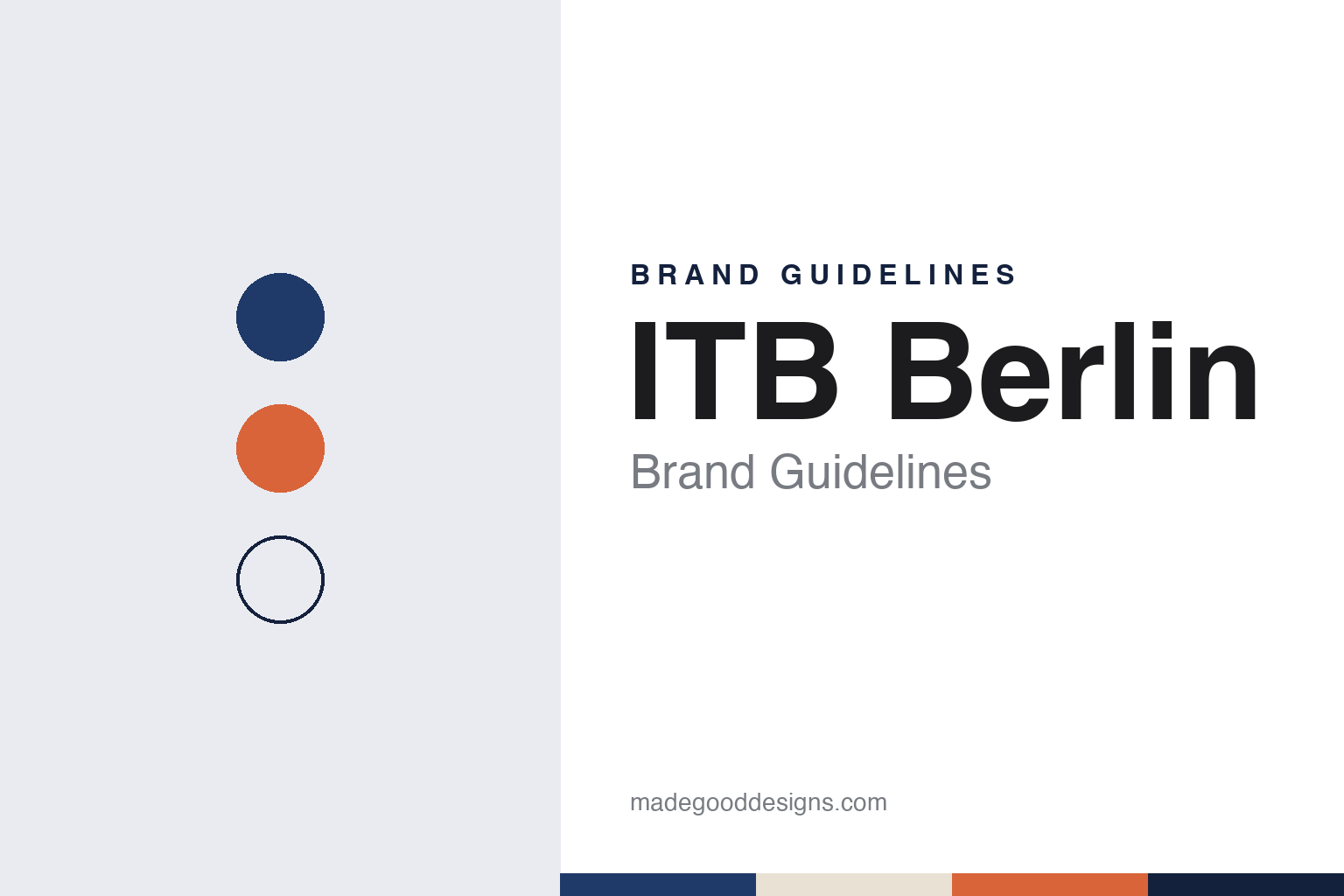
ITB Berlin Brand Guidelines
The Berlin travel trade show that began with nine exhibitors in 1966.
Aa
Two constants: an ITB Berlin navy, sand and orange palette and a grotesque sans register. Abstract homage — not an ITB Berlin or Messe Berlin asset; no logo, key visual or hall sign is reproduced.
Nine exhibitors
A small import fair that turned into a travel market.
ITB Berlin was first held in 1966 on the exhibition grounds in Berlin. The organiser’s own history says nine exhibitors from five countries took part: Egypt, Brazil, the Federal Republic of Germany, Guinea and Iraq. TravelMole, looking back in February 2026, described that debut as a small overseas import trade fair on about 580 square metres of floor space, with around 250 visitors, and its picture caption calls the event the first International Tourism Trade Fair. CBI, writing in March 2016 for the fair’s 50th edition, credited Manfred Busche with starting it “in a small setting.”
Growth came quickly. By 1968, the organiser says, there were 65 exhibitors from 35 countries, and in 1969 more than 100 exhibitors and a new advisory board. In 1972 the exhibition space was tripled, a step the organiser’s history treats as the fair’s breakthrough, and TravelMole repeats that reading. For the tenth edition in 1976 ITB Berlin held a two-day trade congress for the first time, with 6,000 trade visitors from 89 countries, both sources say.
The 1980s widened the programme. A special exhibition called “Anders Reisen” (“Travelling Differently”) opened in 1984 and gave the fair a forum for alternative tourism. At the 20th edition in 1986 the People’s Republic of China was represented for the first time, and the organiser counts 2,241 exhibitors that year. In 1988 a forum for universities and technical colleges was added, linking the trade with academic research. In 1990, after German reunification, suppliers from East Germany were officially represented for the first time, an event both the organiser and TravelMole single out.
The fair has kept to the same season. Writing for the Deutsches Historisches Museum’s journal in March 2017, the historian Hasso Spode noted that the ITB travel show had been held every March in Berlin for more than half a century.
Colour
Halls, a convention and a host country.
Over the following decades the show added new segments. In 2000 travel technology and the mobile internet were given their own exhibition area. In 2004 the ITB Berlin Convention was introduced as a conference running alongside the exhibition, and in 2010 an LGBTQ+ travel section was added. In 2014 Messe Berlin opened the CityCube as an extension of the exhibition halls, which the organiser and TravelMole both connect with room for more exhibitors. The 50th edition followed in 2016, with an anniversary campaign that, the organiser says, sent 50 Berliners to 50 destinations around the world.
The 2020 edition did not take place; the organiser launched an ITB Virtual Convention instead. In 2021 the show was held online as ITB Berlin NOW. It returned as an in-person event in 2023, and from that year, the organiser says, ITB Berlin was once again a trade-only (B2B) show, with no public days.
The 60th-anniversary edition ran from 3 to 5 March 2026 as a B2B event, TTR Weekly reported on 2 March 2026, under the motto “Discover the stories behind 60 years of legacy.” Messe Berlin chief executive Mario Tobias presented the edition at the opening press conference. The official host country was Angola, exhibiting in Hall 21; TravelMole noted that it was the third African host country to date. The same report said travel technology occupied more than six halls and that the ITB Buyers Circle brought senior buyers from 63 countries.
The organiser says the 2026 edition gathered 5,601 exhibitors from 166 countries and nearly 97,000 attendees over three trade-visitor days. The ITB Berlin Convention ran under the heading “Leading Tourism into Balance,” with about 200 sessions in 17 theme tracks and more than 400 speakers, according to the organiser’s closing report of 5 March 2026.
Typography
How travel fairs present themselves.
Travel and tourism trade fairs tend to present themselves through a short name, often an acronym paired with a city. ITB Berlin, WTM London, ITB Asia and WTM Africa each use three letters and a place, and when an organiser takes a show abroad the letters usually stay while the place name changes.
Most of these fairs are built for the trade: tour operators, travel agents, hotel and airline buyers, travel technology providers and, at some shows, the meetings industry. Some have opened their halls to the public on certain days. ITB Berlin, for example, counted private visitors alongside trade visitors in 2016, CBI reported, and became a trade-only show again in 2023, according to its organiser. WTM London describes itself as a business-to-business exhibition for travel professionals.
Behind the names stand exhibition companies rather than the destinations themselves. Messe Berlin runs ITB Berlin and its sister shows, and RX runs World Travel Market and its regional events. Inside the halls, many exhibitors appear on national stands, as CBI described at ITB Berlin in 2016, and much of the business happens in pre-arranged meetings: ITB Berlin’s Buyers Circle and WTM London’s Meridian Club both group senior buyers, and RX reported more than 40,000 confirmed business meetings at WTM London in 2025.
Visually, the pattern is a name and wordmark kept from year to year, with each edition adding its own motto or theme. ITB Berlin marked its 60th edition in 2026 with an anniversary motto and named Angola as its host country; WTM London introduces new areas such as TrendFest under the same name. This guide describes those identities plainly and sets out what each organiser and independent source documents, with the palette and typefaces offered as our own unofficial interpretation.
Aa
A grotesque sans — an unofficial reading of trade-show signage. (Specimen set in Archivo, a sans STAND-IN; NOT the ITB Berlin logo.)
ITB Berlin
One show name, several editions abroad.
ITB Berlin is organised by Messe Berlin, the trade-fair company owned by the city, which also runs events such as the Green Week, Fruit Logistica and InnoTrans. In July 2024 Messe Berlin presented a new brand design by the Berlin agency kleiner + bold: the logo still refers to the Brandenburg Gate, its six columns serve as the key visual, and blue tones remain the dominant colour, joined by a range of contrasting fresh colours. The company said its own events, ITB among them, would carry the company logo more visibly as part of that relaunch.
The ITB name has since travelled. ITB Asia was launched in Singapore in 2008, ITB China held its first edition in 2017, and ITB India joined the group in 2021, the organiser says. The newest member, ITB Americas, took place for the first time in Guadalajara, Mexico, in November 2026. TravelMole described the portfolio in 2026 as five events in Europe, Asia and America. Each edition keeps the three letters and adds a place name, so the Berlin show is consistently written as “ITB Berlin” rather than “ITB” alone.
The show also publishes year-round under the ITB 360° name, with articles, podcasts and reports between editions, and its website carries the strapline “Travel & Tourism in Motion.” Edition by edition, the visual material changes with each anniversary motto and host country, while the ITB Berlin name, the March season and the hall-based layout on the Messe Berlin grounds stay the same.
For a design guide, ITB Berlin shows how a trade show can keep one short name across six decades while each edition brings its own motto and host country. Compare World Travel Market, the November travel show in London, and ITB Asia, its Singapore sister. For this guide we use a navy, a warm sand and an orange with a sans, an unofficial interpretation; no product or logo is reproduced.
Explore & save
Keep ITB Berlin’s identity on hand — save it to a board in the Made Good inspiration library.
ITB Berlin identity set
Pin the ITB Berlin navy, sand and orange palette and the grotesque sans register to your own board.
Source & notes
Frequently Asked Questions
What font can I use to match the ITB Berlin look?
This guide describes ITB Berlin’s type as “A grotesque sans — an unofficial reading of trade-show signage”. Its type specimen is set in Archivo from Google Fonts as a stand-in; Archivo is not ITB Berlin’s own lettering.
What colours are in the ITB Berlin palette?
This guide’s ITB Berlin palette is Hall-sign navy #1F3A68, Night ink #14213D, Atlas sand #E9E1D3, Postmark orange #D9643A and Paper #F7F5F0. The tones are the guide’s own unofficial interpretation, not official ITB Berlin hex codes.