FITUR Brand Guidelines
Madrid’s January tourism fair at IFEMA, since 1981.
Aa
Two constants: a terracotta, sand and teal palette and a bold grotesque sans register. Abstract homage — not a FITUR asset; no logo, key visual or stand design is reproduced.
Feria Internacional de Turismo
From the Palacio de Cristal to the Juan Carlos I fair park.
FITUR is an acronym of Feria Internacional de Turismo, the International Tourism Fair held each year in Madrid. Spanish Wikipedia describes it as an annual event at IFEMA, the city’s trade-fair institution, running for five days in January or February. Today the fair is organised by IFEMA MADRID, the name the institution now uses, and in recent editions it has been held every January, with trade days in the first half of the week and the halls open to the general public at the weekend.
The fair began in 1981. A 40-year retrospective broadcast by the Canary Islands public broadcaster RTVC in January 2026 places that first edition in the winter of 1981 in the Palacio de Cristal of the Casa de Campo, Madrid’s old fairground west of the city centre, and says it drew about 3,000 trade visitors. The sources give different exhibitor counts for that debut: RTVC gives 252 exhibitors, while Spanish Wikipedia gives 1,500 exhibitors from 37 countries. RTVC adds that the fair grew about tenfold in its first six years, and that in 1996 it launched its own digital platform.
The address changed at the start of the 1990s. According to RTVC, FITUR moved in 1992 to the Parque Ferial Juan Carlos I, the IFEMA fair park in the Campo de las Naciones district in the north-east of Madrid, near Barajas airport, which has been its home ever since. The fair now fills a run of numbered halls there; the 2026 edition, by the organiser’s count, occupied nine of them.
Growth came through specialist sections as well as more floor space. RTVC dates Fitur Congresos, a section for the meetings and conference trade, to 2000 (Spanish Wikipedia gives 2001), and says that by 2001 the fair counted 170 countries and more than 8,000 participating companies. After 2008, RTVC reports, the organiser added themed areas such as Fitur Tech and Fitur Green, on travel technology and sustainability.
Colour
Partner countries, sections and the numbers the organiser gives.
The modern fair is a cluster of named sections under one roof. The organiser’s FITUR pages list, among others, Fitur LGBT+, Fitur Screen for film and screen tourism, Fitur Lingua for language travel and FITUR Cruises, alongside areas for sports travel, travel technology and talent. Each section takes the FITUR name followed by a single word, so the parent wordmark stays in front and the sub-brands read as a family.
Each edition also names a partner country (“país socio”). Expansión reported in January 2018 that India was the partner of that year’s fair, the 38th edition, held from 17 to 21 January 2018. On IFEMA’s figures as reported by Expansión, about 251,000 people attended in 2018, including 140,120 trade visitors on the three professional days, with more than 10,000 companies and organisations from 165 countries on more than 65,000 square metres of net floor space and 816 stands. The same report noted a new space that year, Fitur Festivales.
The 46th edition ran from 21 to 25 January 2026, with Mexico as partner country. Revista Mercado, reporting the organiser’s advance figures in January 2026, said the fair would bring together more than 10,000 companies from 161 countries, with 111 official national representations and 967 main exhibitors across nine halls. It also described a new knowledge centre in hall 12, with eight auditoriums and more than 200 sessions, and an enlarged travel technology area. In its closing report IFEMA said attendance passed 255,000, with about 155,000 visitors on the professional days and about 100,000 members of the public at the weekend. RTVC’s retrospective puts attendance at the January 2020 edition at about a quarter of a million.
Typography
How travel trade fairs present themselves.
Travel and tourism trade fairs tend to present themselves through a short name, often an acronym paired with a city. ITB Berlin, WTM London, ITB Asia and WTM Africa each use three letters and a place, and when an organiser takes a show abroad the letters usually stay while the place name changes.
Most of these fairs are built for the trade: tour operators, travel agents, hotel and airline buyers, travel technology providers and, at some shows, the meetings industry. Some have opened their halls to the public on certain days. ITB Berlin, for example, counted private visitors alongside trade visitors in 2016, CBI reported, and became a trade-only show again in 2023, according to its organiser. WTM London describes itself as a business-to-business exhibition for travel professionals.
Behind the names stand exhibition companies rather than the destinations themselves. Messe Berlin runs ITB Berlin and its sister shows, and RX runs World Travel Market and its regional events. Inside the halls, many exhibitors appear on national stands, as CBI described at ITB Berlin in 2016, and much of the business happens in pre-arranged meetings: ITB Berlin’s Buyers Circle and WTM London’s Meridian Club both group senior buyers, and RX reported more than 40,000 confirmed business meetings at WTM London in 2025.
Visually, the pattern is a name and wordmark kept from year to year, with each edition adding its own motto or theme. ITB Berlin marked its 60th edition in 2026 with an anniversary motto and named Angola as its host country; WTM London introduces new areas such as TrendFest under the same name. This guide describes those identities plainly and sets out what each organiser and independent source documents, with the palette and typefaces offered as our own unofficial interpretation.
Aa
A bold grotesque sans for a fair name built on capitals. (Specimen set in Archivo, a sans STAND-IN; NOT the FITUR logo.)
FITUR
A five-letter acronym that carries a family of sections.
The identity starts with the name. FITUR is written in capitals as a five-letter acronym, and the organiser hangs every section off it: Fitur Screen, Fitur Lingua, FITUR Cruises and the rest keep the parent name first and add one plain word. That habit makes the acronym the constant across a fair that changes partner country, conference programme and floor plan from year to year.
The second constant is the calendar. In recent editions FITUR has been held every January in the same Madrid fair park, so the edition year does a lot of the work: “FITUR 2018” and “FITUR 2026” are read as dated chapters of one fair. The partner country gives each edition its own accent, while the halls are arranged as national, regional and company pavilions under the shared FITUR name.
The third constant is the organiser. The fair is tied to IFEMA’s Madrid fair park, its home since 1992, and today it is presented by IFEMA MADRID, whose name sits beside the FITUR wordmark rather than replacing it.
For anyone designing in this register, the lesson is to treat the acronym as a fixed core and let everything else move: the partner country, the edition year and each section name can change colour or image around it, while the five capitals and the Madrid venue stay put. A bold sans with firm capitals suits that job, because the name has to read at hall-sign scale as well as on a lanyard or a programme cover.
For a design guide, FITUR shows how a short acronym, a fixed month and a single venue can hold together a fair that adds new sections almost every year. Compare it with ITB Berlin and the organiser’s own IFEMA guide. For this guide we use terracotta, sand and a deep teal with a sans, an unofficial interpretation; no product or logo is reproduced.
Explore & save
Keep FITUR’s identity on hand — save it to a board in the Made Good inspiration library.
FITUR identity set
Pin the FITUR terracotta, sand and teal palette and the bold grotesque sans register to your own board.
Source & notes
Frequently Asked Questions
What font can I use to match the FITUR look?
This guide describes FITUR’s type as “A bold grotesque sans for a fair name built on capitals”. Its type specimen is set in Archivo from Google Fonts as a stand-in; Archivo is not FITUR’s own lettering.
What colours are in the FITUR palette?
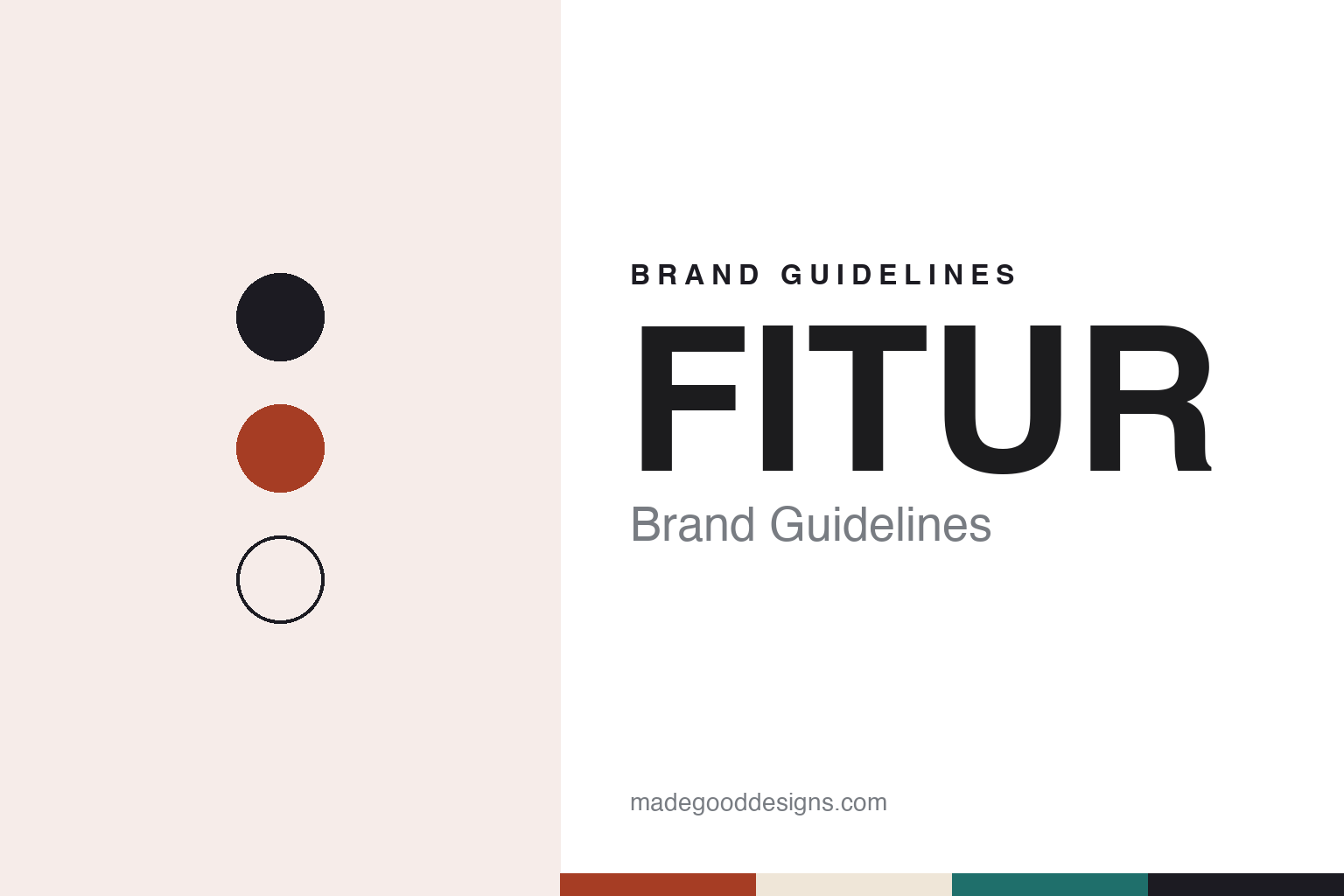
This guide’s FITUR palette is Madrid terracotta #A63D24, Ink #1C1B22, Sand #EFE6D8, Pavilion teal #1F6F6B and Paper #FAF7F2. The tones are the guide’s own unofficial interpretation, not official FITUR hex codes.