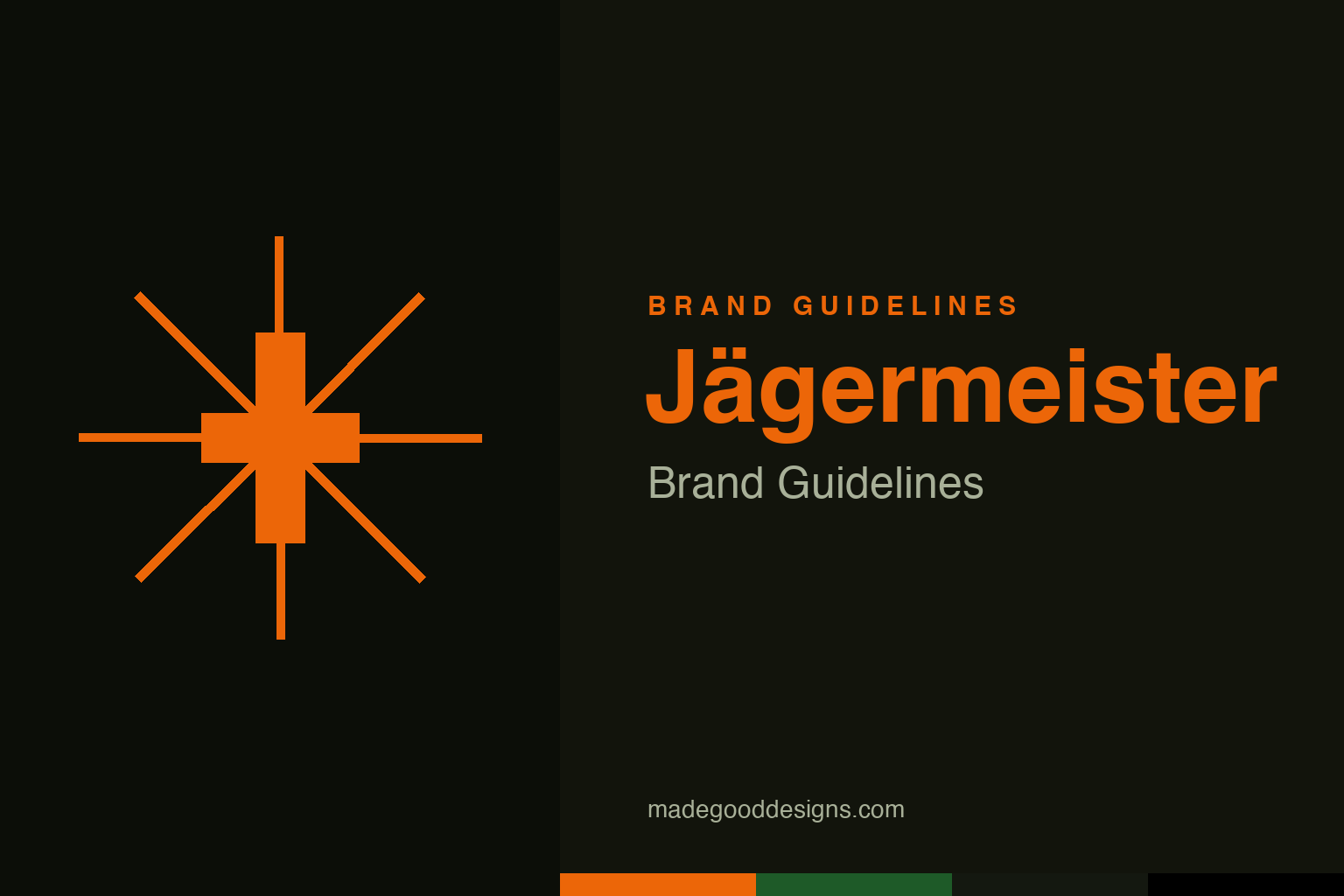
Jägermeister Brand Guidelines
A glowing cross between a stag’s antlers — a saint’s vision turned into a party icon.
An abstract radiant cross — the St Hubertus idea, not the stag. Deliberately not the Jägermeister mark.
A saint’s vision on a bottle
Jägermeister’s logo comes from a Christian legend.
Jägermeister’s striking emblem — a stag’s head with a glowing Christian cross floating between its antlers — is drawn from religious legend. It references Saint Hubertus (and the similar tale of Saint Eustace), the patron saint of hunters, who according to the story was out hunting when he saw a radiant crucifix appear between the antlers of a stag — a vision that converted him. It’s a genuinely unusual and evocative image for a drinks brand: mysterious, a little Gothic, steeped in old-world European folklore. The name fits it perfectly — “Jägermeister” means “master hunter” or “hunt-master” (it was also a German professional/official title). Our homage keeps an abstract radiant cross, not the stag head.
A herbal digestif with a hunting theme
Everything about Jägermeister ties back to the hunt.
The whole brand is built around its hunting theme and its origins as a traditional German herbal digestif. Created by Curt Mast — a keen hunter — in 1934 (first sold 1935) in Wolfenbüttel, Germany, it’s a dark, complex liqueur made from a secret blend of dozens of herbs, roots and spices, historically enjoyed as an after-dinner drink. The stag-and-cross emblem, the deep-green bottle, the old-fashioned typography and even a verse about hunting on the label all reinforce a sense of tradition, ritual and European heritage. (A small note for accuracy: the “1878” sometimes seen on the bottle refers to the founding of the Mast family business, not the liqueur, which is a 1930s creation.) It’s a richly coherent identity rooted in a specific culture and craft.
From digestif to party shot
Jägermeister pulled off a remarkable reinvention.
Here’s the fascinating twist. This traditional, slightly stuffy German herbal digestif — a drink your grandfather might have sipped after dinner — managed to reinvent itself, especially in export markets like the United States, as a party and nightlife icon: the ice-cold shot, the “Jägerbomb,” a fixture of bars and clubs and a favourite of a young, hard-partying crowd. That’s a genuinely impressive act of repositioning without changing the actual product or its distinctive branding. The mysterious stag, the dark bottle and the herbal formula stayed exactly the same; what changed was the context and marketing, which recast old-world tradition as edgy, cult and cool. It’s a case study in how a brand’s meaning can be dramatically shifted by where and how it’s served, even as its identity holds firm.
Distinctiveness as an asset
Jägermeister’s oddness is its greatest strength.
The deepest lesson of Jägermeister is the power of being distinctive and unafraid of it. In a drinks market full of interchangeable clear spirits and glossy modern branding, Jägermeister is defiantly weird: a glowing cross between a stag’s antlers, a saint’s conversion legend, a secret 56-herb recipe, a Gothic green bottle. Most brands would have sanded off those strange edges to seem more accessible; Jägermeister leaned into them, and that uncompromising oddity is exactly what makes it unforgettable and cult-followed.
It’s a valuable counter-lesson to the instinct to smooth everything out. Distinctiveness — a genuinely unusual symbol, a rich backstory, a strong point of view — is one of the most valuable and defensible things a brand can have, precisely because it can’t be easily copied or confused. Jägermeister’s stag is the opposite of a safe, generic mark, and that’s the point: it commits fully to a specific, strange, evocative world, and invites you into it. The brand proves that in a crowded category, being memorable beats being tasteful, and that a weird, meaningful symbol — a saint’s vision on a liquor bottle — can carry a brand from the after-dinner table to the centre of the party and back, without ever needing to explain itself.
Type & the wordmark
Old-world, heritage lettering.
Jägermeister’s wordmark has an old-world, traditional character that reinforces its heritage — formal and a little Gothic. The specimen below stands in with a classic serif.
Meister since 1878
Formal, heritage, old-world — type with the weight of German tradition. (Specimen set in Newsreader, a neutral stand-in.)
Orange & green
Signal orange on a hunter’s-green dark. Click a swatch to copy the hex.
Jägermeister pairs a signature orange (around #EC6608) with deep green and black. There’s no single official public hex, so treat the orange as a faithful reconstruction. Lead with the orange below.
Explore & save
Keep the stag idea on hand — save the radiant-cross homage and the palette to a board.
Jägermeister identity set
Pin the radiant-cross homage, the orange-and-green palette and the reinvention story to your own board.