James Northcote spent a long career making pictures that other people turned into prints. His Shakespeare scenes, animal pictures and portraits were engraved in mezzotint and line, and at the end of his life he designed a book of fables by cutting figures out of old prints and pasting them into new arrangements. That makes him a useful case study for anyone who designs images that must work at more than one size and in more than one medium: a strong light source, a clear silhouette and a single dramatic moment.
The public-domain images here come from the Art Institute of Chicago and The Met; find more in the MGD museum inspiration collection.
Who was James Northcote?
Northcote was born in Plymouth on 22 October 1746, the son of a watchmaker, according to the Oxford Dictionary of National Biography and the older Dictionary of National Biography; Tate gives the same date. He was apprenticed to his father’s trade but drew in his spare time. Both dictionaries record that in May 1771 he went to London with letters of introduction to Joshua Reynolds, who took him into his studio, and the Government Art Collection confirms that he entered the Royal Academy Schools and worked as Reynolds’s assistant.
Both dictionaries say he left Reynolds’s house in May 1776. He travelled to Italy in 1777, and the Government Art Collection and both dictionaries record his election to academies in Florence, Rome and Cortona and his return to England in 1780.
He was elected an Associate of the Royal Academy in 1786 and a full Academician in 1787 (the Oxford Dictionary of National Biography gives 10 February, the Dictionary of National Biography 13 February). He died in London on 13 July 1831, according to Tate and both dictionaries.
Key works by James Northcote
Shakespeare scenes for Boydell, from 1786
The publisher John Boydell commissioned paintings of Shakespeare scenes and sold engravings after them. Both dictionaries name Northcote among the painters; the Dictionary of National Biography counts nine pictures by him. The Murder of the Princes in the Tower, now at Petworth House according to the Oxford Dictionary of National Biography, was engraved by Francis Legat in 1790, according to the Shakespeare in the Royal Collection project; Harvard Art Museums also hold a Legat impression. The Hood Museum of Art at Dartmouth holds William Skelton’s engraving after Northcote’s King Richard the Third, its plate inscribed as published by John and Josiah Boydell in 1795.
Prince Arthur and Hubert
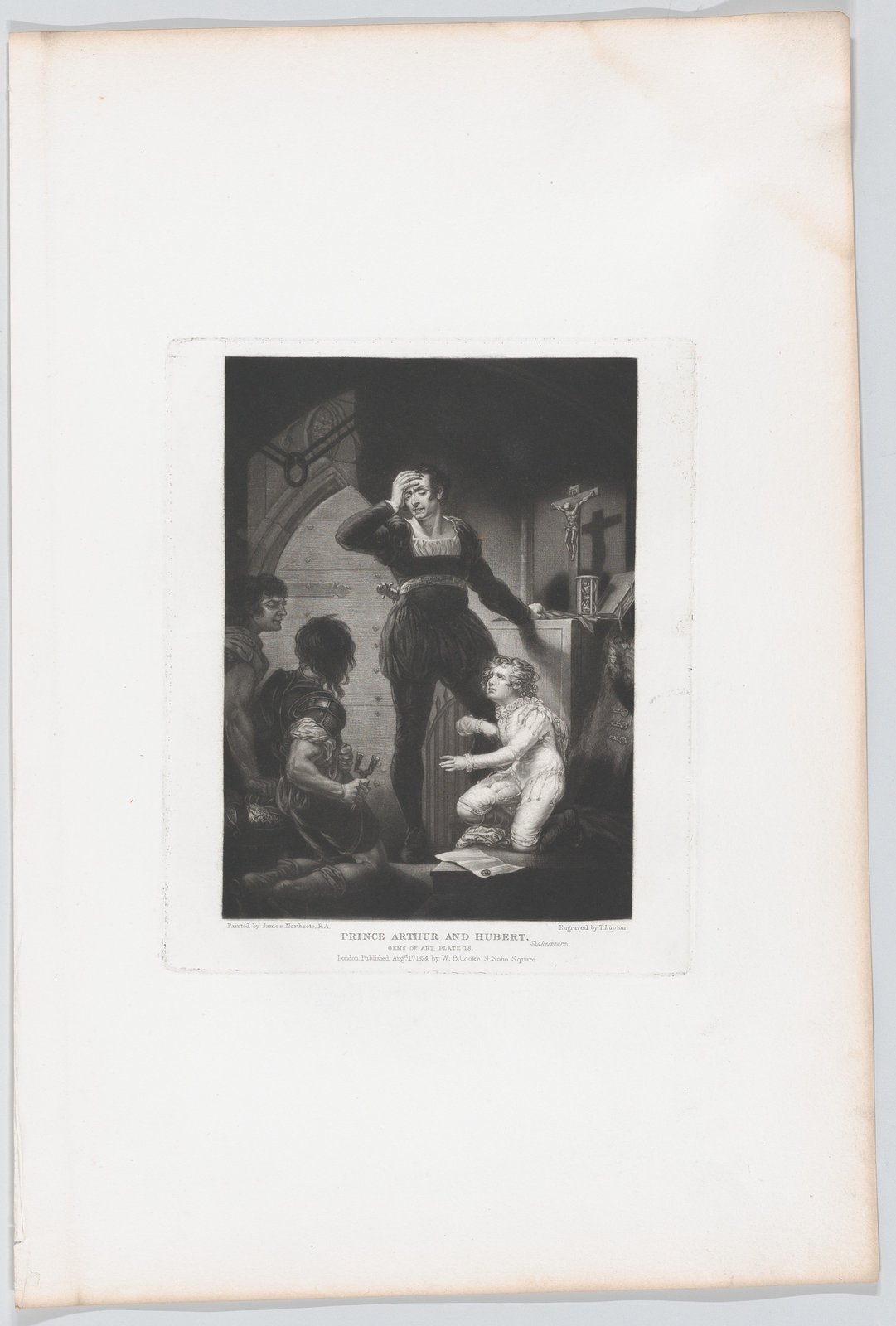
The Dictionary of National Biography singles out Prince Arthur and Hubert, from King John, as one of his especially popular Shakespeare pictures. The Met holds a mezzotint of the subject by Thomas Goff Lupton, after Northcote, dated 1823–24, shown below.
Portraits and animals
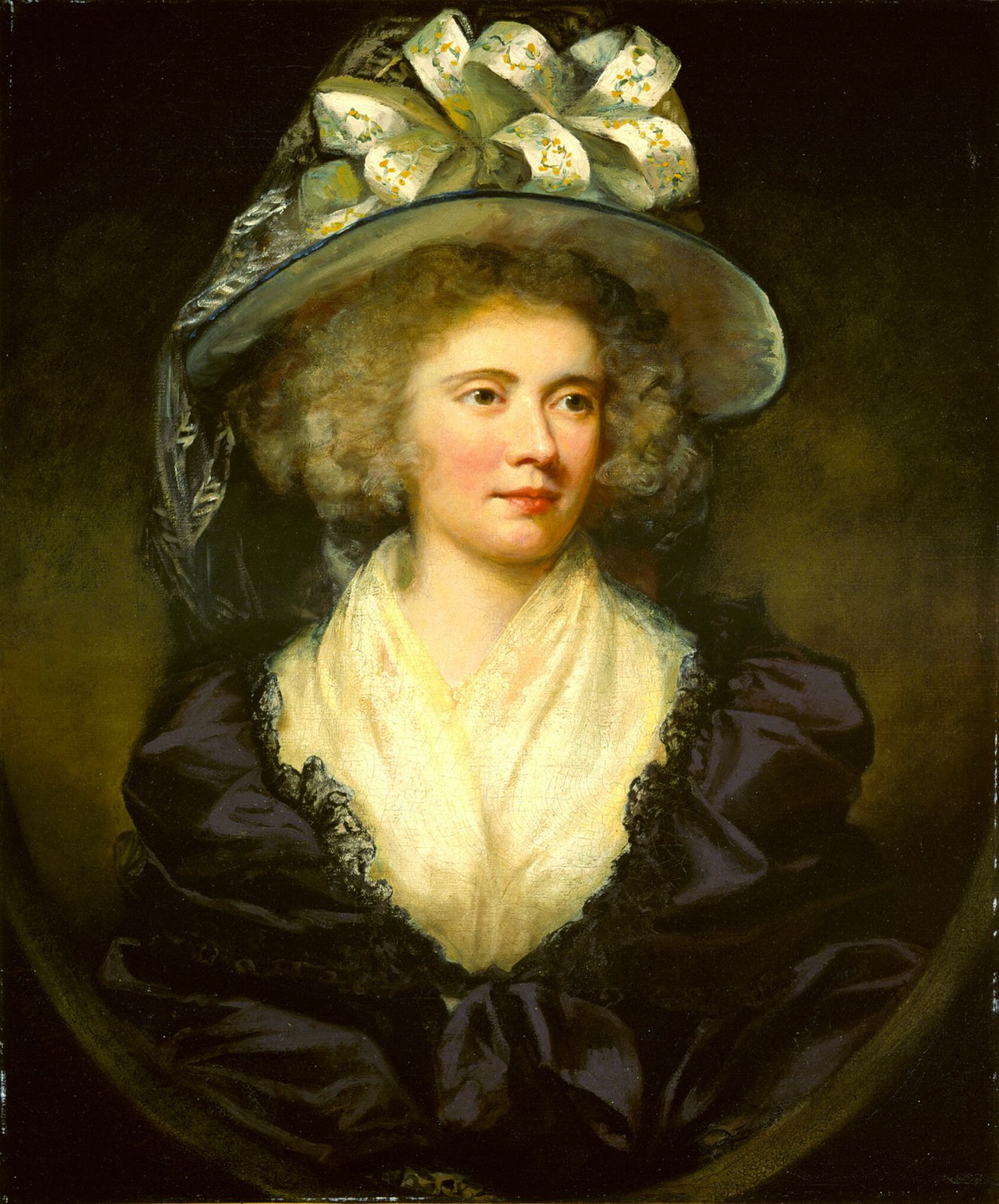
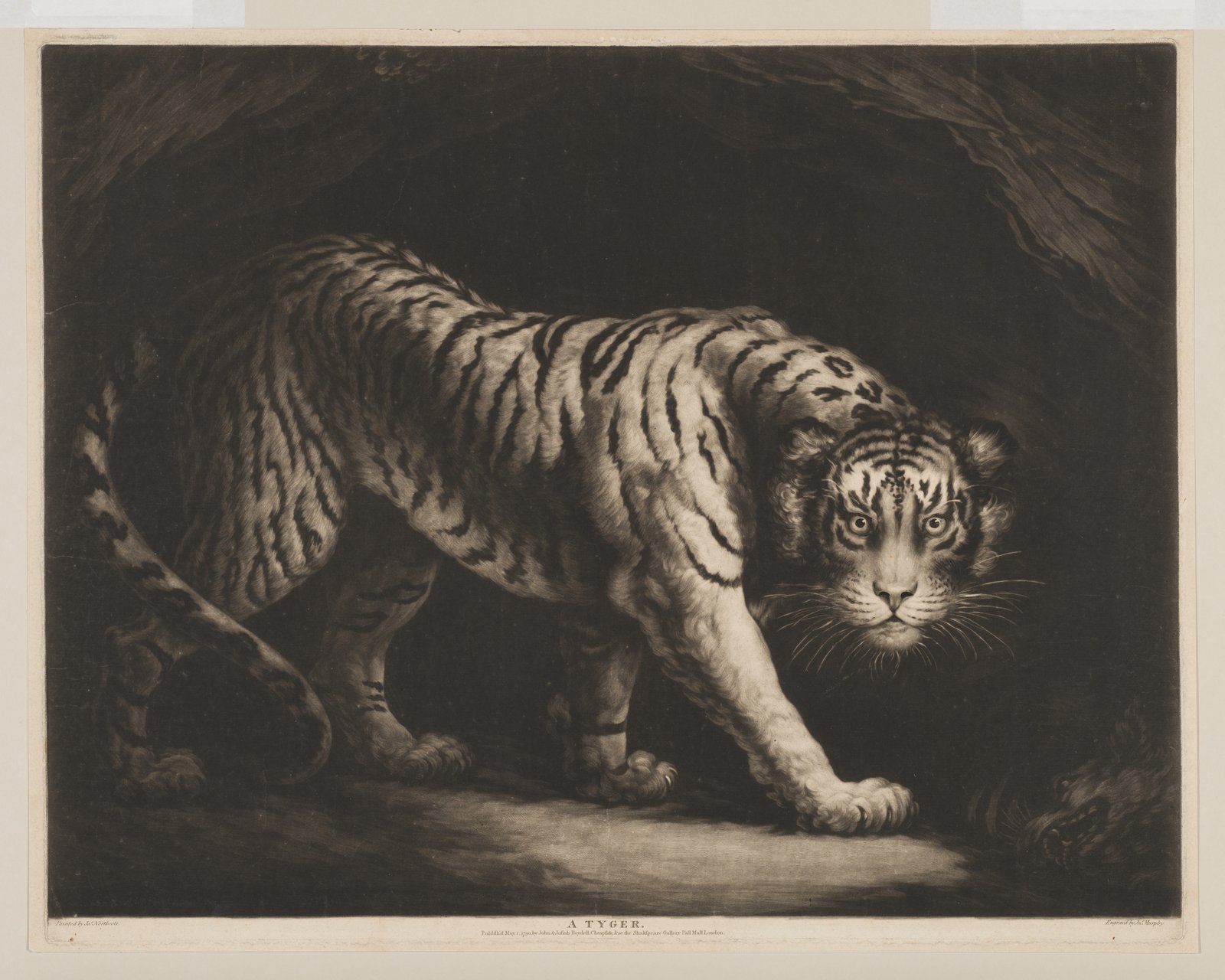
Portraiture remained his staple, according to the Oxford Dictionary of National Biography, which names sitters including Samuel Taylor Coleridge (1804) and the infant John Ruskin (1822); the Art Institute’s Mrs. Allan Maconochie (1789) shows his half-length format. Both dictionaries note his animal pictures, which the Oxford Dictionary of National Biography dates from the 1790s. The Met’s mezzotint A Tyger (1790), by John Murphy after Northcote and published by John and Josiah Boydell, is one of these.
Books, 1813–1830
Both dictionaries date his Memoirs of Sir Joshua Reynolds to 1813. One Hundred Fables, Original and Selected appeared in 1828, the date of The Met’s copy, and The Life of Titian in 1830, the year William Hazlitt published Conversations of James Northcote; both dictionaries and 1830 library copies on the Internet Archive agree.
What to look at: composition, light and colour
One light, one moment. In A Tyger the animal steps out of a cave towards you, and the only bright passage is the pale fur of its face and forelegs. In the Lupton print, light falls on the boy kneeling in white and the anguished face above him; the soldiers at the left sit in half-shadow. This is stage lighting: the brightest area marks the story.
Gesture you can read from across a room. Hubert’s hand pressed to his brow and the boy’s raised hands make the emotional exchange legible even at postage-stamp size, which is what a print sold in a folio needed. The Shakespeare in the Royal Collection project makes a related point about the Princes in the Tower: Northcote made the princes younger than their historical counterparts to sharpen the contrast between innocence and threat.
The painted oval. Mrs. Allan Maconochie sits inside a feigned oval frame painted on the canvas. The broad hat and ribbon bow form a crown at the top, the white fichu makes a bright inverted triangle at the centre, and the dark dress anchors the base. The oval keeps the eye moving round the face.
Palette. Measured from the museum’s scan of the portrait, the dominant ground is a deep umber, #211705, with olive browns around #463810 and #5c5321, a pale cream highlight around #f4e39d and a warmer gold near #dbaf63. Measured from the museum’s scan of this impression of A Tyger, the range runs from a warm charcoal, #37332f, through a mid brown, #65594c, to a paper-toned highlight, #d7cab8. Both are low-chroma schemes where value contrast, not hue, does the work. You can sample them yourself with the image colour picker.
Technique: from studio assistant to print designer
The Oxford Dictionary of National Biography says that as a pupil he painted drapery and incidental details in Reynolds’s portraits; in Italy, the Dictionary of National Biography adds, he paid special attention to Titian.
His paintings reached most buyers as reproductions. The Oxford Dictionary of National Biography notes that a large number of his paintings were engraved, and that in 1823 he gave the Royal Academy a volume of 190 prints after his work. The mezzotints above show why his compositions suited that trade: mezzotint builds tone from dark to light, so a picture designed around a dark ground and a few bright areas translates naturally.
The Fables are the most surprising part of his method. The Dictionary of National Biography describes Northcote cutting figures out of prints and pasting them together to form his designs, which he passed to William Harvey to draw on the wood blocks for engraving; the Oxford Dictionary of National Biography likewise says the woodcuts were based on old prints onto which Northcote pasted his own designs. The Met’s collection includes an 1828 volume of proof illustrations to the Fables credited to Harvey, with ornamental letters and vignettes.
How designers can borrow from James Northcote
- Design for the reproduction. If an image will be shrunk to a thumbnail, printed in one colour or turned into an icon, compose it as Northcote composed for mezzotint: dark field, one bright focal area, a clear outline.
- Light the story, not the scene. Give the figure or object that carries the message the highest value contrast.
- Use a frame inside the frame. A painted oval, a vignette or a soft-edged mask is an easy way to give a portrait or product shot a period feel and to steer the eye to the centre.
- Collage first, then redraw. Northcote’s pasted-up Fables designs are an early version of the mood-board-to-illustration workflow. Assemble reference by cutting and arranging, then hand it to an illustrator or redraw it in one consistent line.
- Build value-led palettes. Start with a near-black, a mid brown and a cream, then add one accent. The museum’s engraving theme page gathers prints that work the same way.
For his teacher’s approach to portraits and the Royal Academy, read our guide to Joshua Reynolds. The Oxford Dictionary of National Biography notes that Northcote’s ten-picture moral series Diligence and Dissipation (1796) followed the model of William Hogarth’s modern moral subjects; our guide to William Hogarth covers that tradition.
Where to see his work
The Art Institute of Chicago holds Mrs. Allan Maconochie; The Met holds the mezzotints shown here and copies of the Fables. Tate lists A Young Lady Playing the Harp, probably exhibited in 1814, on display at Tate Britain, and the Government Art Collection holds several of his portraits.
Frequently asked questions
Who was James Northcote?
An English portrait and history painter (1746–1831) from Plymouth who worked in Joshua Reynolds’s studio from 1771 to 1776 and became a Royal Academician in 1787.
What did James Northcote paint for the Boydell Shakespeare Gallery?
Shakespeare scenes including The Murder of the Princes in the Tower and Prince Arthur and Hubert. The Dictionary of National Biography counts nine pictures by him for the scheme, and engravings after them were published by John and Josiah Boydell.
Did James Northcote write books?
Yes. He published Memoirs of Sir Joshua Reynolds (1813), One Hundred Fables, Original and Selected (1828) and The Life of Titian (1830). William Hazlitt’s Conversations of James Northcote appeared in 1830.
Are James Northcote’s works in the public domain?
His own works are old enough to be public domain in the US. The images in this guide are ones the Art Institute of Chicago and The Met flag as public domain; always check each museum’s rights statement for the specific scan you use.