Joachim Beuckelaer painted abundance. Fish, poultry, cabbages, jugs and pans crowd the front of his pictures, while a tiny religious scene plays out through an arch or a doorway at the back. That double structure, loud foreground and quiet background, is the main thing to look at in his work, and it is surprisingly close to how a designer builds hierarchy on a poster or a product page. He also painted portraits, and one of them, now at the Art Institute of Chicago, is a compact study in restrained colour and lettering. For more cleared images from museum collections, browse the MGD museum inspiration collection.
Who was Joachim Beuckelaer?
Beuckelaer was born in Antwerp, and museum records place his birth in the early to mid-1530s: the Metropolitan Museum of Art gives 1533, while the National Gallery, London, and the Art Institute of Chicago give about 1535. His death is dated to about 1574 by the Art Institute and the Kunsthistorisches Museum in Vienna, and to 1575 by the National Gallery and the Rijksmuseum.
He trained in the workshop of Pieter Aertsen, his uncle, a link recorded by the National Gallery, the Kunsthistorisches Museum and the art historian Margreet Wolters in the Journal of Historians of Netherlandish Art (2012). The Met describes the large market scene as a new kind of everyday-life picture initiated by the two painters in Antwerp; our guide to Pieter Aertsen covers the uncle’s side of the story. Beuckelaer became an independent master in 1560, according to the National Gallery, and Wolters specifies that he enrolled in Antwerp’s Guild of St Luke that year.
Because he followed his uncle’s manner so closely, attributions between the two can be difficult, as the Kunsthistorisches Museum notes. Signed and dated works are therefore the firmest anchors for his career.
Key works by Joachim Beuckelaer
- Adoration of the Shepherds, 1560. The Metropolitan Museum of Art. A pen and brown ink drawing with gray wash on brown paper, squared in red chalk for transfer, according to the Met. Wolters identifies it as his earliest known dated work.
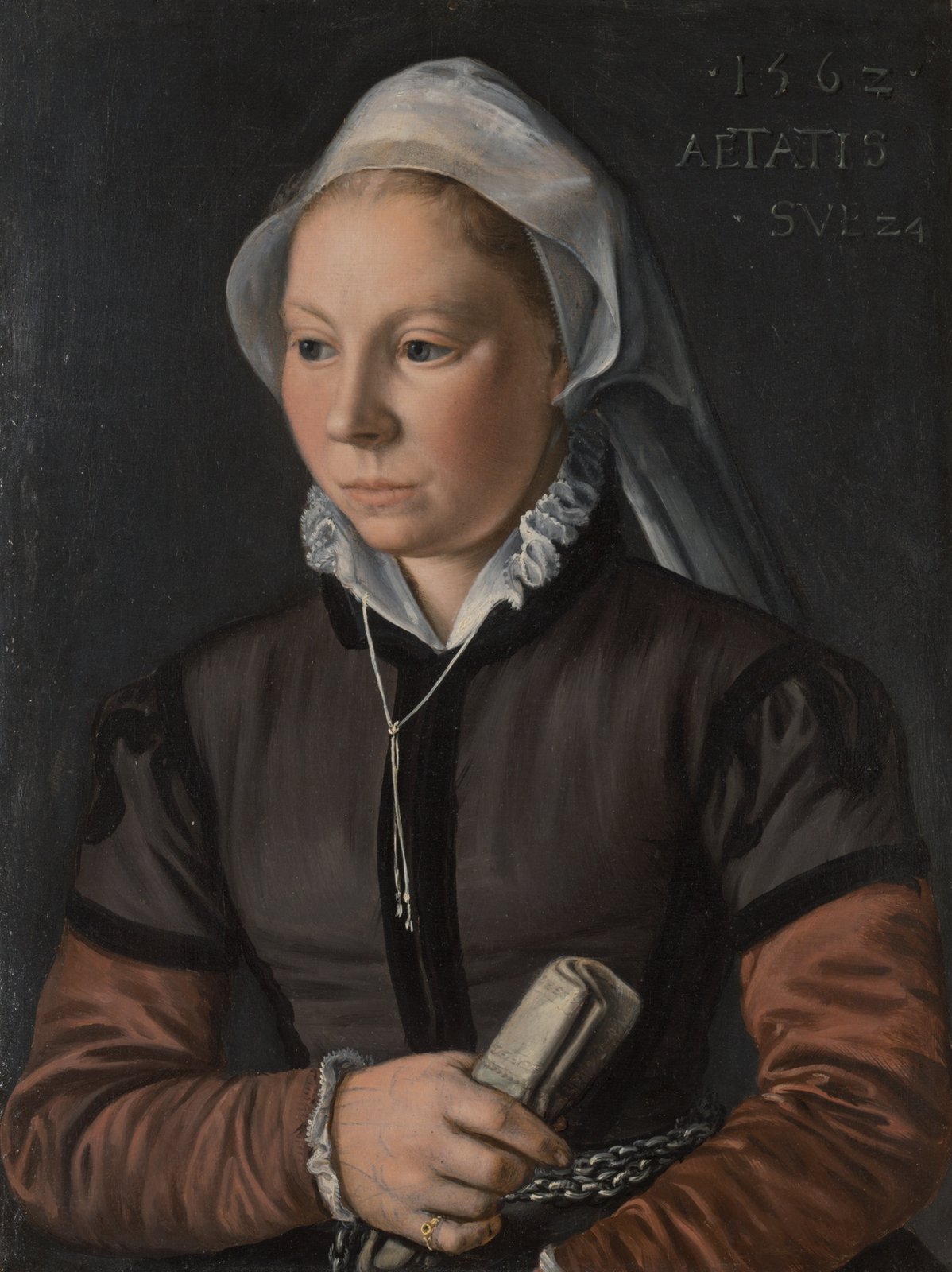
- Portrait of a Young Woman, 1562. Art Institute of Chicago. Oil on panel, inscribed with the year and the sitter’s age, 24.
- The Well-Stocked Kitchen, with Jesus in the House of Martha and Mary in the Background, 1566. Rijksmuseum, Amsterdam. Oil on panel, 171 by 250 cm. Kitchen maids prepare poultry among game, vegetables and tableware, while the biblical visit appears small behind them.
- Market Peasants, 1567. Kunsthistorisches Museum, Vienna. Oil on oak, with his ligated IB monogram and the date painted on a butter churn, according to the museum.
- Fish Market, 1568. The Metropolitan Museum of Art. Oil on Baltic oak, 128.6 by 174.9 cm.
- The Four Elements, 1569–70. National Gallery, London. Four large canvases, Earth, Water, Air and Fire, that present the elements as food. Water is signed and dated 1569 on the edge of the table.
What to look at: the double composition
A crowded foreground
The front third of a Beuckelaer is packed. In The Four Elements: Water, the National Gallery lists cod, carp, pike, tench, herring and a ray heaped in baskets and on platters, with mussel shells on the floor. In the Rijksmuseum kitchen, poultry, game, fruit, jugs and plates fill almost every surface. Objects overlap and tip toward the viewer, so the eye has nowhere to rest.
A tiny story behind
Then the picture opens up. Through an arch in Water, fishermen haul nets from a boat while a figure waits on the shore: the miraculous draught of fishes, with the risen Christ, according to the National Gallery. In the Rijksmuseum painting, Christ’s visit to Martha and Mary sits small in the background, and the museum reads the contrast as a warning against giving in to earthly temptations. The religious subject is the title, yet it occupies a fraction of the surface.
Figures who look out
In Water, the two fishmongers ignore their customers and look straight at the viewer. That direct gaze is a hinge. It pulls you into the foreground before the deep space releases you toward the background story.
Local setting
The National Gallery identifies the street behind the fishmongers in Water as sixteenth-century Antwerp, including the Rode Poort, or Red Gate. Biblical scenes are staged in a city his viewers would have known.
The portrait: palette, lettering and restraint
The Chicago Portrait of a Young Woman shows another side of his work. The sitter is set against an almost black ground, in a dark bodice with rust-coloured sleeves, a white headdress and a small ruff. She holds a pair of gloves, and a chain runs across her waist. In the upper right, painted capitals read “.1562./ AETATIS / . SVE 24”, the Latin formula for “in her 24th year”, as recorded in the museum’s inscription field.
Measured from the museum’s scan of this impression with a median-cut quantize, the main colours are a near-black background around #262626, the bodice at #35302c, the rust sleeves at #734b39, a warm flesh mid-tone at #b59078 and the headdress highlight at #a79b90. These describe the digital scan, not the original pigments. The palette is almost all warm darks, with light kept for the face, the headdress and the hands. You can sample your own swatches from the scan with our image colour picker and build them into a scheme with the colour palette generator.
The inscription is the design detail to study. Spaced Roman capitals with dots as separators sit in the dark field, balancing the figure’s weight to the left. It works much like a dateline or caption set into the negative space of a photograph.
Technique: drawings, underdrawing and panel
Wolters’s study of his working process traces how compositions moved from drawing to painting. She describes his drawings, dated from 1560 to around 1565–67, as pen and ink with washes, some squared in red chalk, and notes oil sketches in the Louvre on reddish-brown prepared paper. Infrared reflectography of his panels reveals underdrawings in a dry medium beneath the paint. She also argues that he learned in Aertsen’s workshop to reuse models for recurring motifs, which helps explain how the same baskets and vessels can return from picture to picture.
The Chicago portrait, the Rijksmuseum kitchen and the Met’s Fish Market are painted on panel, the last on Baltic oak. The Four Elements: Water, by contrast, is oil on canvas, according to the National Gallery, and measures 158.1 by 214.9 cm.
His heaped displays are part of the story of food painting in the Low Countries; our guide to still life painting follows the genre further.
How designers can borrow from Joachim Beuckelaer today
- Build hierarchy in depth, not just size. Put the loud, detailed material up front and let a small, important element sit deep in the composition. On a poster or landing page, a quiet focal point surrounded by space reads as deliberate.
- Use a gaze as a hinge. A figure looking at the viewer pulls attention to the foreground. Place it where you want the eye to land first.
- Frame the second story. Beuckelaer uses arches and doorways to open a window onto the background scene. In layout, a framed inset or a cut-out shape can do the same job for secondary content.
- Let abundance tip forward. For food and retail imagery, objects that overlap and spill toward the edge of the frame feel generous. Keep a calm background so the eye can recover.
- Work in warm darks. The portrait’s palette suits packaging and editorial work that needs warmth without brightness. Save the lightest tone for the one thing that matters.
- Set type into the dark. Spaced capitals in a dark corner of an image make a quiet, classical caption.
Frequently asked questions
What is Joachim Beuckelaer known for?
He is known for large market and kitchen scenes from Antwerp in the 1560s, with heaps of food in the foreground and a small biblical episode in the background, as in The Four Elements at the National Gallery, London.
How was Joachim Beuckelaer related to Pieter Aertsen?
Aertsen was his uncle and teacher. Beuckelaer trained in his workshop and became an independent master in Antwerp in 1560.
When did Joachim Beuckelaer live?
He was born in Antwerp in the early to mid-1530s and died around 1574 or 1575. Museums give slightly different dates: the Met gives 1533 for his birth, and the National Gallery gives about 1535.
Can I use images of Beuckelaer’s paintings?
The Art Institute of Chicago flags its Portrait of a Young Woman as public domain, and that is the image shown here. Check each museum’s own rights statement before reusing any other image.