John Crome spent almost his whole life in and around Norwich, and he drew the same ground again and again: a lane under old trees, a heath with a windmill on the skyline, the backs of mill buildings on the river. He trained as a coach and sign painter, taught drawing for a living and became the central figure of the group now called the Norwich School. For designers his etchings may be the more useful study: small, black and white and made almost entirely of texture, they are a clear model for anyone who works in line.
Who was John Crome?
Crome was born in Norwich in 1768 and died there in 1821. The Oxford Companion to British History calls his father an innkeeper and the Government Art Collection a publican and weaver. According to the Government Art Collection, he was apprenticed in 1783 to the house, coach and sign painter Francis Whisler (the collection spells the name Whistler) and finished his articles in 1790. Writing in Country Life in 2021, Huon Mallalieu notes that the trade taught him not only to paint but to mix pigments that would last.
He earned much of his living by teaching. The Oxford Companion says he became drawing master at the local grammar school in 1801, and Country Life adds private pupils such as the daughters of the Gurney family, who took him on summer tours. Mallalieu also describes the collection of Thomas Harvey of Catton, a local patron whose pictures included Dutch landscapes by Meindert Hobbema. The Oxford Companion and Country Life both stress how much his landscapes owe to the Dutch masters.
In 1803 Crome and others formed the Norwich Society at his house in Norwich. Tate describes it as a discussion group at first, which became an exhibiting society in 1805, when John Sell Cotman joined. Crome was elected its president in 1808, according to both the Government Art Collection and the Oxford Companion. He travelled abroad once, to Paris, to see the art gathered there under Napoleon: the Oxford Companion dates the trip to 1814, and Country Life to 1815.
He is often called “Old Crome”, to tell him apart from his son John Berney Crome, also a painter. Country Life notes that he encouraged pupils, including two of his sons, to copy his pictures, and that he rarely signed, which has made attribution difficult ever since.
Key works by John Crome
- Slate Quarries, about 1802–5. Oil, Tate.
- Hautbois Common, Norfolk, probably about 1810. Oil on canvas, 55.9 × 88.9 cm, the Metropolitan Museum of Art, given by Henry G. Marquand in 1889.
- Moonrise on the Yare, about 1811–16. Oil, Tate (the museum records the title with a query).
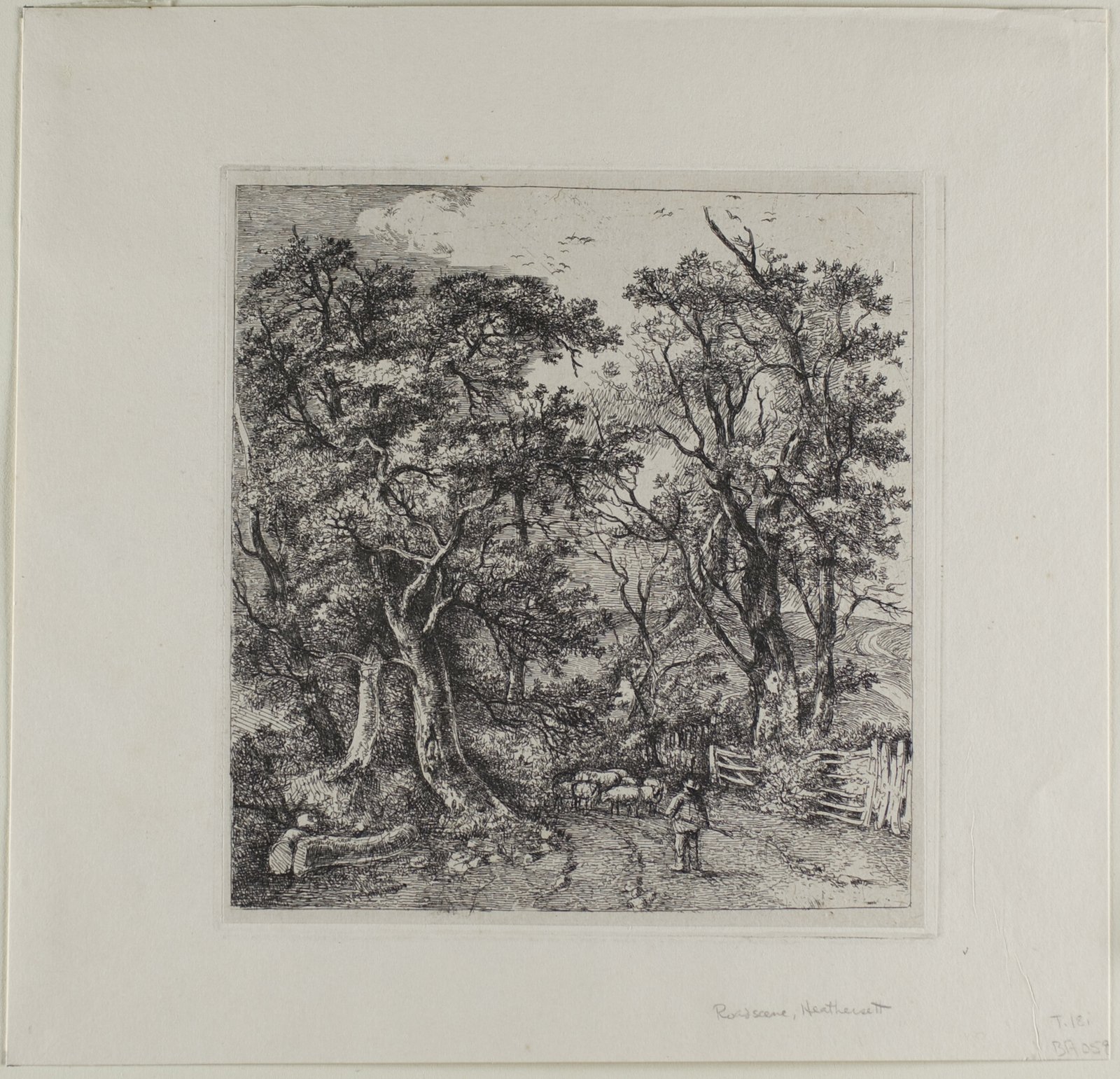
- The etchings, about 1809–13. Small plates of trees, lanes, mills and heaths, including Road Scene, Heathersett (1812) and At Bawburgh (1813) at the Art Institute of Chicago.
- Yarmouth Harbour – Evening, about 1817. Oil, Tate.
- Landscape with Boy Fishing, 1818. Watercolour over graphite, 10.3 × 27.5 cm, Robert Lehman Collection, the Met.
- Mousehold Heath, Norwich, about 1818–20. Oil, Tate Britain. Country Life reports that it was bought for the nation in 1863.
Tate points to the large collection at Norwich Castle Museum for Norwich School pictures, and it is the place to see Crome in depth.
What to look at in a John Crome etching
The tree as the whole composition
In Road Scene, Heathersett the trees are not scenery; they are the layout. Two great masses of foliage rise from either side of the road and almost meet at the top, so the sky becomes a pale shape cut out between them. The road, a gate and a few small figures sit at the bottom like a caption. The trunks lean outwards at different angles, which keeps a nearly symmetrical frame from feeling static.
Low horizons and big skies
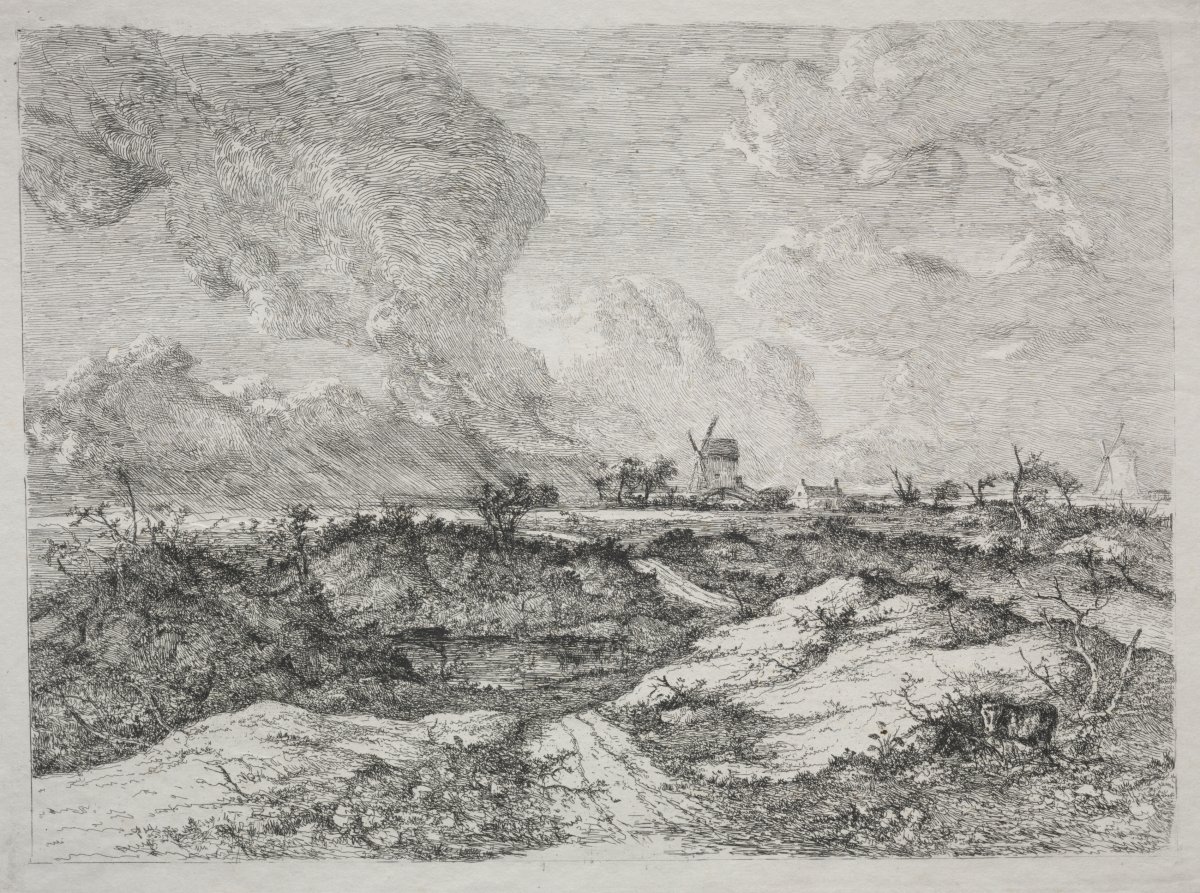
Mousehold Heath does the opposite. The land is a thin band of hollows, scrub and sandy tracks, and the horizon sits low, with two small windmills on it. Most of the plate is sky, built from long, curving parallel strokes that pile into a storm cloud on the left and thin out to bare paper on the right. The windmills are tiny, which makes the sky feel huge.
Texture as tone
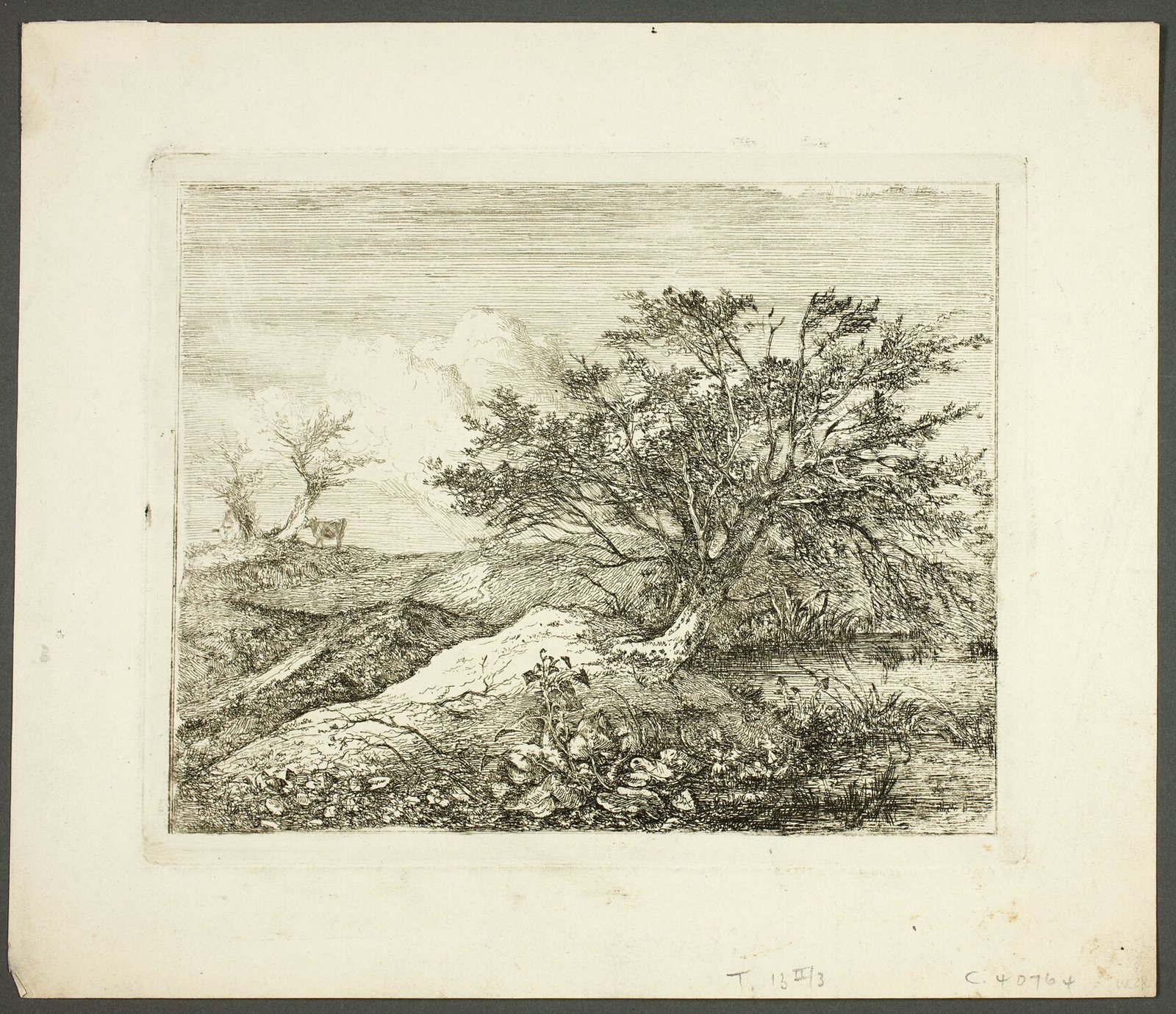
Crome rarely uses an outline. Light and dark come from the density and direction of marks: short scribbles for foliage, long horizontals for water and sky, sparse dots and dashes on a sunlit bank. In At Bawburgh a pale, almost empty slope runs diagonally through the plate, and the bush beside it is a dark tangle of strokes. The contrast between worked and unworked areas does all the modelling.
Technique: etching and soft-ground
Crome’s plates use ordinary etching, soft-ground etching and drypoint, often printed on chine collé, a thin sheet of China paper laid onto a heavier backing, as the Met and the Art Institute of Chicago record. In soft-ground etching, the Fitzwilliam Museum’s glossary explains, the ground contains a greasy material that never fully hardens, and some printmakers lay paper over the plate and draw on it, so that the pressure lifts the ground. The result is a soft, grainy line close to pencil.
The Met owns a useful pair of objects here. Study for Three Trees, dated 12 January 1812, is a graphite drawing with soft-ground etching on the back of the same sheet, and Study for Tree Trunks and Lane is similar. They show the drawing and the printed result as two sides of one process.
The etchings were not published in his lifetime. According to the Met, a set titled Norfolk Picturesque Scenery, described as thirty-one etchings by the late John Crome printed from the plates as he left them, was issued in 1834, with his widow Phoebe Crome and his son John Berney Crome among the publishers. The Cleveland Museum of Art counts thirty-three etchings by him in all.
His paintings follow the same logic in oil: a low horizon, one or two large trees or a single building, and a sky that carries the light. For the wider background, see our guide to landscape painting, and for the printmaking side our explainer on etching.
The palette of a John Crome print
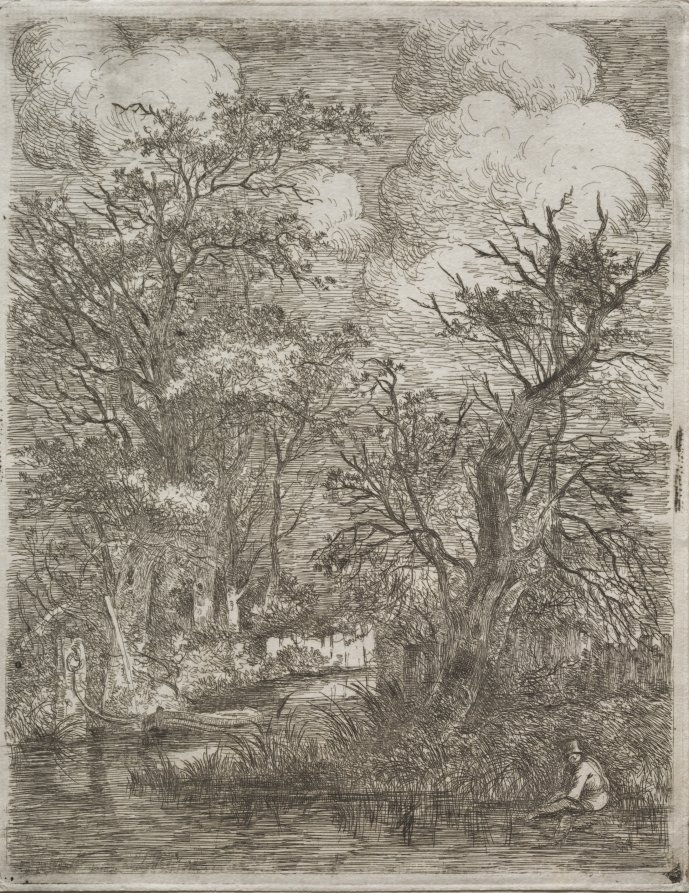
An etching has no colour of its own, but a printed sheet does: warm paper, brown-black ink and the greys between. Measured from the museum’s scan of this impression of Back of the Mills, the main values are a dark umber #635c50, a mid taupe #847d6f and a pale stone #ccc7bb. The Cleveland scan of Mousehold Heath is cooler, with #6f6d68 in the darks, #a8a59f in the middle and #d2d0ca in the lights. At Bawburgh, in the Art Institute of Chicago’s scan, is the warmest, with an olive-black #67634e against cream paper at #ebe8d3. You can sample your own with our image colour picker.
How designers can borrow from John Crome
- Let one shape carry the layout. A single tree mass, framed like the trees in Road Scene, Heathersett, can structure a poster or book jacket, with the open sky as the space for type.
- Drop the horizon. Put the land in the bottom fifth and give the rest to sky, as in Mousehold Heath. Small objects on the skyline make the space feel larger.
- Use direction of line as a code. Assign one stroke type to each material, such as long horizontals for water and sky and tight scribbles for leaves, and keep to it. The image reads even at small sizes.
- Leave white paper. The brightest parts of Crome’s plates are untouched. In line illustration, unworked areas work as highlights.
- Build a print palette. Three values of one warm grey-brown on cream paper are enough for an editorial series, packaging or a brand illustration set.
Where to see John Crome’s work
Norwich Castle Museum holds the main collection of Norwich School art. Tate Britain shows his oils, and the Met holds a painting, a watercolour and etchings. The etchings shown here are open-access impressions in Chicago and Cleveland. Browse more cleared prints in the MGD museum inspiration collection.
Frequently asked questions
Who was John Crome?
He was a Norwich landscape painter, etcher and drawing master (1768–1821) who helped found the Norwich Society of Artists in 1803 and became its president in 1808. He is often called “Old Crome” to distinguish him from his son John Berney Crome.
What is the Norwich School?
It is the group of landscape painters linked to the Norwich Society of Artists, formed in 1803. Tate describes their work as low-key realist landscape inspired by Norfolk, with Crome and John Sell Cotman as its main figures.
Did John Crome make prints?
Yes. He made a small body of etchings, many in soft-ground, dated by museums to about 1809–13. They were published after his death, in the 1834 set Norfolk Picturesque Scenery.
Where can I see Mousehold Heath?
The oil painting Mousehold Heath, Norwich is at Tate Britain in London. The etching of the same heath, shown above, is in the Cleveland Museum of Art and other print collections.