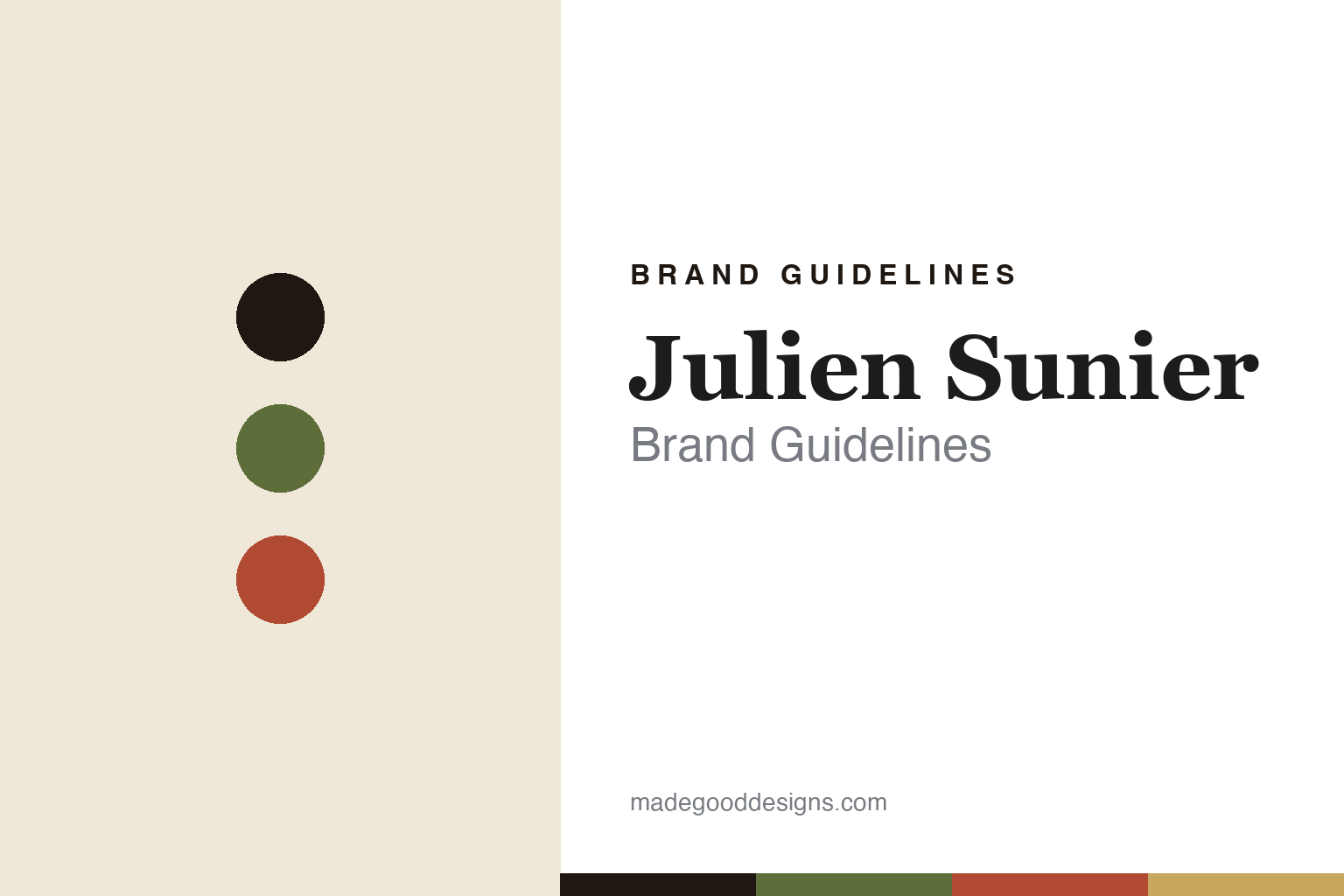
Julien Sunier Brand Guidelines
The wild-grass label.
Aa
Two constants: a meadow-and-terracotta palette and an elegant serif register. Abstract homage — not the Julien Sunier label.
The wild-grass label
Sunier’s whole range is one cream label with a meadow drawing.
Julien Sunier is a lesson in one motif, held across a range. Julien Sunier — who came to wine through Christophe Roumier in Burgundy before going independent — founded his domaine in 2008 near Avenas, in the high northern Beaujolais, making organic, whole-cluster Gamay from three crus: Régnié, Morgon and Fleurie.
Its brand identity is a single, unified house label. On cream paper, a delicate fine-line drawing of wild grasses and meadow flowers rises along the base — an etching-style botanical motif — beneath the cru name set in a warm red serif, the vintage, and “Julien Sunier” in a red handwritten signature over “Artisan Vigneron.” The crus are told apart only by the name at the top; the drawing, signature, palette and layout are identical across the range. It reads as a quiet grower’s hand.
(Honest notes: there is no fox on the label — that’s a myth; the motif is wild grasses. His mentor was Christophe Roumier, not Roulot. No designer or illustrator is credited, so we don’t name one. And there’s no official brand hex, so the tones here are an unofficial interpretation.)
Colour
Julien Sunier lives in a meadow-and-terracotta palette. Click a swatch to copy the hex.
Sunier’s identity is pastoral, botanical and restrained — a meadow green, an ink, a terracotta, a straw, and a cream. The palette pairs a meadow green with a warm terracotta — the register of wild grass, cream paper and a red-inked signature. It signals nature and craft rather than gloss. The honest caveat: with no published brand hex, these tones are an original, unofficial interpretation, not first-party values.
The lesson is a meadow green with a terracotta signals a pastoral, grower’s identity. Sunier’s world is a wild-grass drawing on cream paper. For designers, it is a reminder that a meadow green with a warm terracotta reads as botanical and hand-made — right for a natural-wine grower. The takeaways: anchor with ink; use a meadow green; warm it with a terracotta; and treat any single hex as unofficial — using ink for small text so the palette stays pastoral.
Typography
The register is an elegant serif — quiet, botanical, grower’s-hand.
Sunier’s identity carries a quiet, botanical, grower’s spirit — a meadow drawing and a red signature. An elegant serif captures the mood: it is refined and calm, the register of a hand-made estate label. Set in a meadow-and-terracotta palette, the elegant serif feels quiet and botanical — exactly the personality Sunier carries. It is understated rather than showy, mirroring a single cream label. (Sunier’s real label is a work we describe but do not reproduce, and the exact typeface is not ours to use.) Because it is not ours to use, the honest description is “an elegant serif spirit,” shown here in a stand-in. The type behaves like the brand: quiet, botanical and hand-made.
Aa
An elegant serif spirit — quiet and botanical. (Specimen set in Cormorant, an elegant serif STAND-IN; NOT the Julien Sunier label.)
One motif as identity
Julien Sunier stands for a single drawing held across a range.
Julien Sunier is a lesson in making one motif the identity. A meadow-and-terracotta palette, an elegant serif and a wild-grass drawing make one image the whole brand — quiet, botanical, consistent. The motif is the differentiator. The differentiator is a pastoral, grower’s-hand, unified identity.
For designers and brand-builders, Sunier offers a clear takeaway: consistency can be the design. The lessons: hold one motif across the whole range (the wild-grass drawing); change only what must change (the cru name); and let a handwritten signature carry the grower’s presence. It is also a reminder to stay accurate: there is no fox (the motif is grasses), the label’s designer is uncredited, and the palette here is an unofficial interpretation. Sunier made one motif the brand — proof that consistency can be the difference.
Explore & save
Keep Julien Sunier’s identity on hand — save it to a board in the Made Good inspiration library.
Julien Sunier identity set
Pin the meadow-and-terracotta palette and the elegant-serif register to your own board.