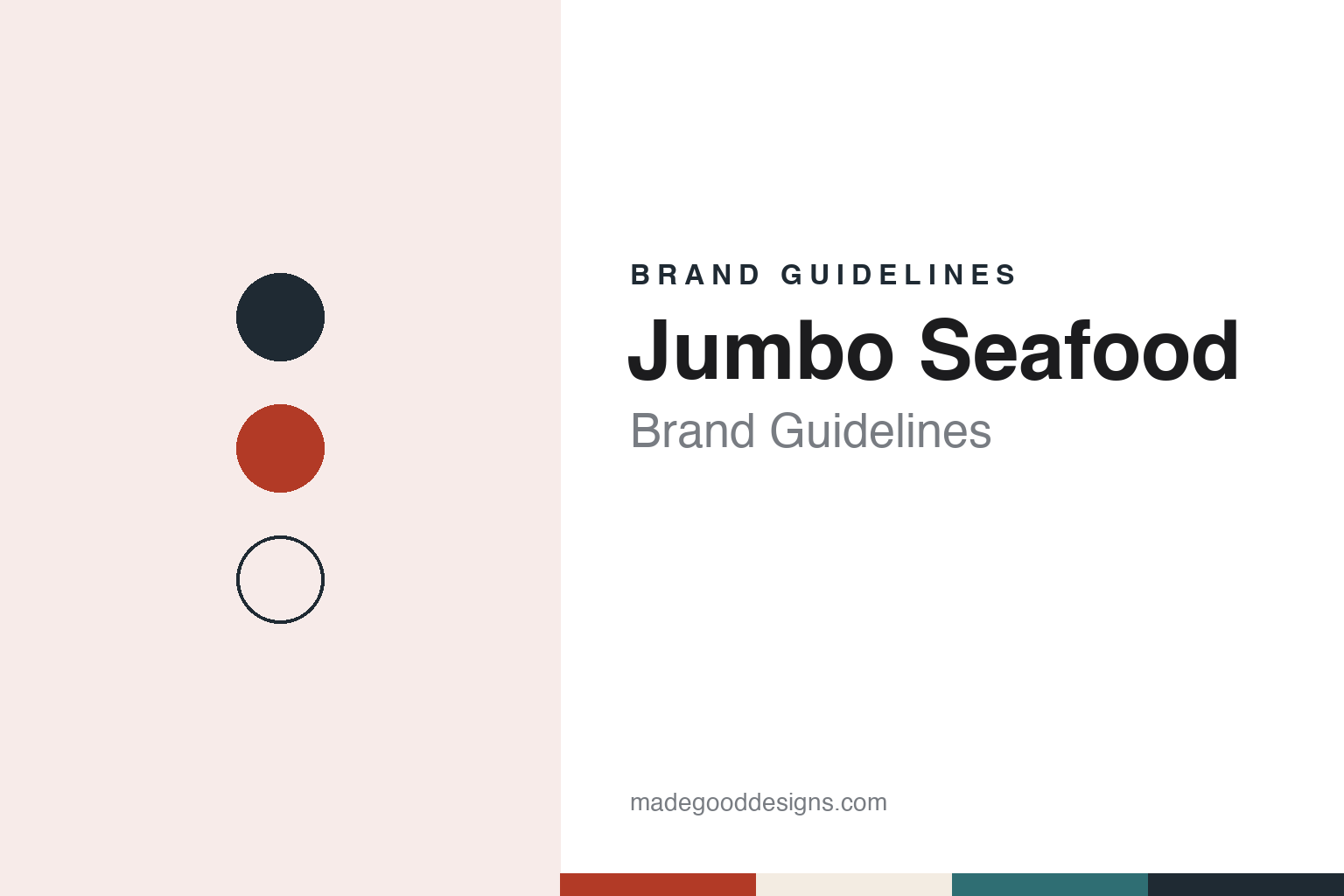
Jumbo Seafood Brand Guidelines
A seafood centre by the sea in 1987, a Shanghai mall in 2013, a share listing in 2015.
Aa
Two constants: a chilli red, shell cream and seawall teal palette and a bold seaside sans register. Abstract homage — not a Jumbo Seafood product or mark; no logo, dish or shop front is reproduced.
East Coast, 1987
A seafood restaurant by the sea wall.
Jumbo Seafood began with one restaurant at the East Coast Seafood Centre, a row of seafood restaurants in East Coast Park on Singapore’s south-east shore. Vulcan Post, in a December 2020 profile of the business, says the chain started there in 1987, and that it soon built a following for crab dishes such as its chilli crab and black pepper crab. English Wikipedia says the first outlet borrowed design elements from the Jumbo floating restaurant in Hong Kong, with which the Singapore business has no link.
Accounts of the founding differ. Tatler Asia, in a 2021 profile, says Jumbo was started in the 1980s by a group of friends who were seafood enthusiasts, and English Wikipedia uses the same story. The same Vulcan Post profile repeats the group-of-friends line but also describes the father of the present chief executive as the founder of Jumbo Seafood. Both versions agree on what came next: in 1993 Ang Kiam Meng, an engineer by training, joined and took over the business. Vulcan Post says he had worked as a software engineer after university and was persuaded by his father to join, at a point when the family felt the restaurant was ready to grow.
Growth was not a straight line. English Wikipedia says a second East Coast outlet closed in 1995, and Vulcan Post reports that Jumbo’s first restaurant outside Singapore, in Indonesia in 1995, did not last; the chief executive later put the failure down to inexperience. The company waited almost twenty years before trying abroad again.
At home the chain moved into the city. Tatler Asia lists Singapore openings in the 2000s at Riverside Point, Dempsey Hill, The Riverwalk and VivoCity, and Vulcan Post names Riverside Point and The Riverwalk, near the Central Business District, among its busiest outlets.
Colour
A central kitchen and a second try abroad.
The business behind the crab became a group. In 2008, Vulcan Post reports, Jumbo set up a central kitchen in Kaki Bukit to prepare sauces and mixes for its Singapore outlets and to develop new dishes; it brought in a food technology consultant so that its chilli crab could be made abroad without losing its flavour and texture. The same kitchen led to retail packs of chilli crab and black pepper crab paste for home cooks.
The second attempt abroad began in Shanghai in November 2013, with a restaurant at the IAPM mall on Huaihai Road. Vulcan Post says it was a joint venture with BreadTalk Group, which already knew the Chinese market and took a 30 per cent share. English Wikipedia says the Shanghai restaurant was among the first to carry a new Jumbo logo, which keeps the Chinese name of the old one and adds a crab pincer with an outline of the map of Singapore. Tatler Asia says a Jumbo Seafood restaurant opened at the Universal Studios theme park in Beijing in September 2021, its eighth in China. Vulcan Post adds Vietnam, South Korea, Thailand and Taiwan to the list of markets entered under Ang.
The listing came in 2015. Vulcan Post reports that Ang oversaw the initial public offering of JUMBO Group in October 2015. By then the group ran more than seafood. It took over the Ng Ah Sio bak kut teh brand in 2010, according to both English Wikipedia and Vulcan Post, added Chui Huay Lim Teochew Cuisine in the early 2010s, and brought the Hong Kong cha chaan teng chain Tsui Wah to Clarke Quay as a franchise in June 2018. Its Singapore-style hotpot chain JPOT, launched in 2009, closed its last outlet in April 2019, Vulcan Post says. Tatler Asia counted seven brands and 35 outlets across 12 Asian cities in 2021.
Typography
Asian restaurant chains and how they present themselves.
Asian restaurant chains tend to present themselves through what happens in the kitchen. Din Tai Fung’s own history page opens with the xiaolongbao and its count of 18 folds, and the Taipei Times traced that formula to the founder’s son working alongside the shop’s first dim sum chefs.
Names and shop fronts carry a lot of the identity. Tim Ho Wan’s Chinese name means “to add good luck,” English Wikipedia says, and Din Tai Fung’s joins the names of a former employer and an oil supplier, according to the company and the Taipei Times. Long-kept signs, such as the brushed board that Din Tai Fung says still hangs at its first restaurant on Xinyi Road, link a chain of many branches back to one room.
Dish naming is usually plain and descriptive: barbecue pork buns, steamed rice rolls, pan-fried turnip cake, soup dumplings. Groups can list signature dishes by name when they announce deals, as Jollibee Foods Corporation did for Tim Ho Wan in November 2024, GMA News reported. Guidebook recognition travels with a name too: Tim Ho Wan’s first shop in Mong Kok appeared with a star in the 2010 Michelin Guide, Gourmet Traveller reported in 2015, and that star still features in how the chain is introduced in press coverage.
The corporate side is published too. Company pages set out founders and founding years, parent groups describe their portfolios in stock exchange disclosures, and franchise partners appear in trade press when rights change hands. This guide sets out what can be checked about each brand — who founded it, who owns it and how it grew — and marks clearly what rests only on the company’s own word.
Aa
A bold seaside sans — a crab house that grew into a group. (Specimen set in Archivo, a sans STAND-IN; NOT the Jumbo Seafood logo.)
Jumbo Seafood
Leaving the first address.
The biggest change to the brand came in 2026, at the place where it began. On 29 May 2026 Mothership reported that JUMBO Group had announced it would close its East Coast Seafood Centre restaurant, the chain’s first, when the lease ended on 30 September 2026. The landlord, the National Parks Board, was studying the redevelopment of the seafood centre alongside longer-term plans for East Coast Park. Two days later Mothership reported that the board had told tenants they had to leave the centre during 2026, and that Jumbo had said on social media that it was exploring new sites, marking the end of 39 years at the address.
Mothership listed six other Singapore outlets in May 2026: Riverside Point, Dempsey Hill, ION Orchard, Jewel Changi Airport, The Riverwalk and Resorts World Sentosa, with restaurants abroad in China, South Korea, Thailand and Cambodia. Vulcan Post reported in July 2026 that the group expected to close six restaurants in six Chinese cities to concentrate on Shanghai, and that it had a new headquarters in Tai Seng with a dedicated catering kitchen and a catering subsidiary, Jumbo Catering Services; it named Jakarta and Ho Chi Minh City as the next markets the group was looking at.
The group’s own investor pages now present Jumbo Seafood as one name among several, beside Ng Ah Sio Bak Kut Teh, Chui Huay Lim and Zui Yu Xuan Teochew Cuisine, Chao Ting, a catering arm and a casual offshoot, JUMBO Kitchen, which the company describes as a lighter seafood format that keeps signature dishes such as chilli crab and cereal prawns. The company still dates the brand to the 1987 restaurant at the East Coast Seafood Centre.
For a design guide, Jumbo Seafood shows how a single seafood restaurant can turn a signature dish and a waterside address into a group identity that has to work in malls, airports and overseas cities. Compare BreadTalk, its partner in Shanghai, and Crystal Jade, another Singapore restaurant group that grew across Asia. For this guide we use a chilli red, shell cream and a seawall teal with a sans, an unofficial interpretation; no product or logo is reproduced.
Explore & save
Keep Jumbo Seafood’s identity on hand — save it to a board in the Made Good inspiration library.
Jumbo Seafood identity set
Pin the Jumbo chilli red, shell cream and seawall teal palette and the bold seaside sans register to your own board.