Kaigetsudo Ando painted almost nothing but people standing still, yet his scrolls feel loud. A single figure fills a tall sheet of paper, wrapped in a robe whose pattern is scaled up until it reads from across the room. There is no setting at all: no floor, no wall, no horizon. Outline, pattern and empty ground carry the whole picture, which is why his work translates so directly into poster, packaging and editorial layout.
Who was Kaigetsudo Ando?
The Metropolitan Museum of Art and the Cleveland Museum of Art both give his dates as about 1671–1743, and the print scholar John Fiorillo, on his Viewing Japanese Prints site, gives the same span. Fiorillo and the Cleveland Museum of Art place his studio in the Asakusa area of Edo, now Tokyo; Fiorillo names the district as Suwa-chō.
The studio had a clear specialty. The Cleveland Museum of Art describes it as a workshop of five painters working under Ando, producing portraits of high-ranking courtesans of the Yoshiwara, Edo’s licensed pleasure quarter. Fiorillo names the five as Anchi, Dohan, Doshin, Doshu and Doshū, and notes that Anchi was the only one to take a character from Ando’s own name.
Ando’s career in Edo was interrupted in 1714. Fiorillo records that he was exiled that year to the island of Izu Ōshima because of his association with a merchant caught up in the Ejima–Ikushima affair, a court scandal of that year, and that he was pardoned in 1722 and returned to Edo.
The detail that matters most for designers is the medium. According to Fiorillo, about thirty paintings attributed to Ando survive and no woodblock prints are attributed to him. His pupils, by contrast, also designed large single-sheet woodblock prints.
Key works you can see
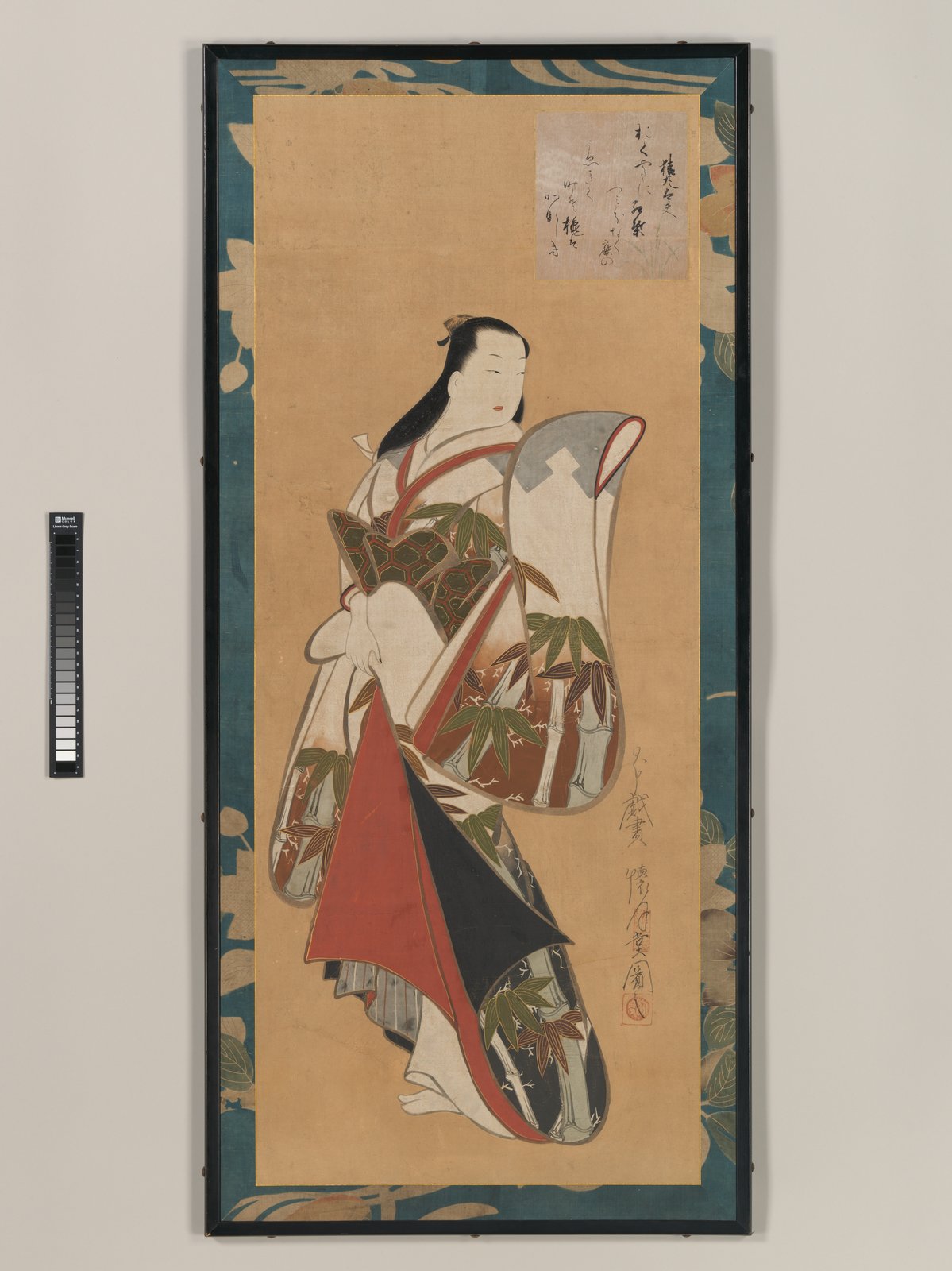
- Standing Courtesan, early 18th century, hanging scroll mounted as a panel, ink and colour on paper, image 104 × 42.2 cm, the Metropolitan Museum of Art (2015.300.118).
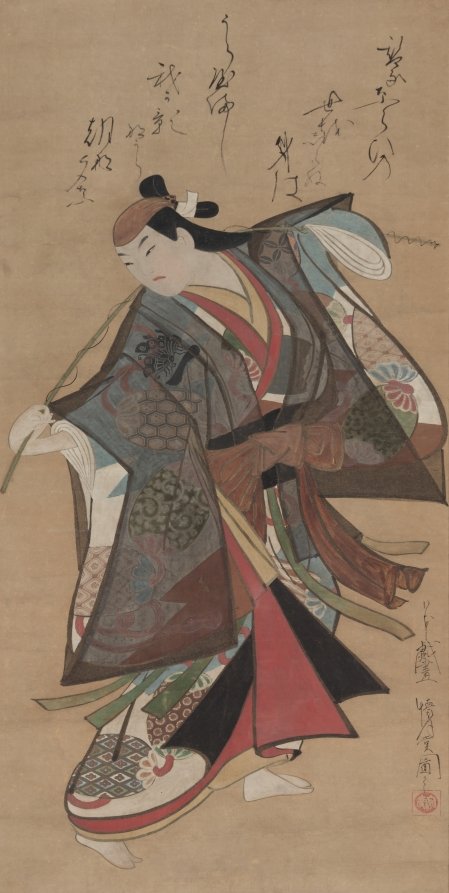
- Sanjō Kantarō II in the Role of Urashima Tarō, early 1700s, hanging scroll, ink and colour on paper, painting 105.7 × 59.4 cm, the Cleveland Museum of Art (1961.41). The museum identifies the sitter as a kabuki actor who specialised in youths’ and women’s roles, shown with a fishing rod as the fisherman of the folk tale.
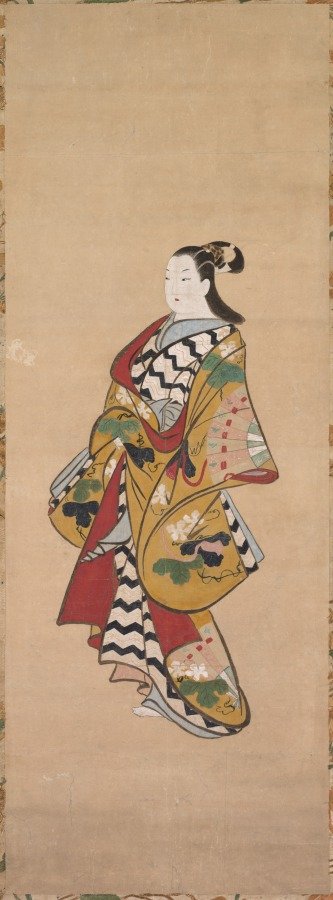
- Courtesan, 1700s, hanging scroll, ink and colour on paper, painting about 96 × 35.5 cm, the Cleveland Museum of Art (1985.264), catalogued as studio of Kaigetsudō Ando.
- Shoki Fighting for a Courtesan, about 1704–14, hanging scroll, ink and colour on paper, 40.7 × 65.1 cm, Princeton University Art Museum. The museum calls it a rare multi-figure narrative by Ando: the demon-queller Shoki holds off three pursuers with a sword while his demon servant carries off a courtesan. It is signed “Nihon giga Kaigetsudō Ando ga”.
The Cleveland Museum of Art also holds a Courtesan and Attendant catalogued as after Ando and dated much later, which is a reminder to read the attribution line in every record.
What to look at in Kaigetsudo Ando’s paintings
One figure, no setting
Both the Cleveland Museum of Art and Fiorillo describe the studio formula as a single figure on an empty background. In the Met’s Standing Courtesan the figure occupies roughly the central half of the sheet, and the paper around her is untouched apart from a small inscribed panel at the upper right and the signature and seal at the lower right. The empty ground is not leftover space; it is the frame that makes the silhouette legible.
A curved, column-like silhouette
Fiorillo points to the pronounced curve of the figures. In the Met scroll the body leans back while the hem kicks forward, so the whole robe forms a long S inside a narrow rectangle. In Cleveland’s actor portrait the figure strides, and the sleeves and sash flare outwards, filling more of the width.
Pattern scaled to the shape
The robes are where the energy lives. On the Met scroll, bamboo stalks and leaves run across the white kimono at a scale close to life size, so a few stems cover a whole sleeve. On the Cleveland actor, the museum notes that the hexagonal pattern on the robe stands for a tortoise’s shell, a link to the tortoise in the Urashima story. On the Cleveland studio work, a black-and-white zigzag underrobe sits against a mustard outer robe with fans and flowers. Large motifs, few colours, high contrast.
Brush line with weight
The Cleveland Museum of Art and Fiorillo both describe bold, sweeping ink lines. The outlines of sleeves and hems swell and taper, and they close each colour area firmly, much as a heavy keyline holds a flat-colour illustration together. Faces are drawn with very fine lines by comparison and follow a shared studio type, which keeps attention on the robe.
Colour, signature and inscription
Measured from the Metropolitan Museum of Art’s scan of Standing Courtesan, the main tones are a warm tan paper near #b28155 and a lighter ochre near #cea66b, with the pale robe near #d2bfa7, a brick red near #ac553c and a dark brown-black near #3e3930. These values describe the aged paper and pigments as photographed today, not the original colours. The proportion is the lesson: a large warm neutral, a pale figure, and red and black kept to narrow bands.
The signature is part of the layout. On the Cleveland actor portrait the inscription reads “Nihon giga Kaigetsudō Ando kore o zu su”, which the museum translates as a Japanese painting for amusement by Kaigetsudō, with a seal reading Ando. A waka poem fills the upper part of the same painting. The Princeton University Art Museum records the same opening on its Ando scroll, and Fiorillo and a Cleveland record for a scroll by Doshin show that the pupils kept the same “Nihon giga” opening and added “matsuyō”, meaning a follower, before their own names. The text sits in the empty ground in loose vertical columns, balancing the figure rather than labelling it.
Technique and formats: from scroll to print
Ando’s works in these museums are hanging scrolls in ink and colour on paper; Fiorillo notes that the studio also used silk. The tall scroll is a strict format. The Met painting is about 2.5 times taller than wide and the Cleveland studio scroll about 2.7, close to a phone screen or a pull-up banner, while the actor portrait is wider at about 1.8 to 1.
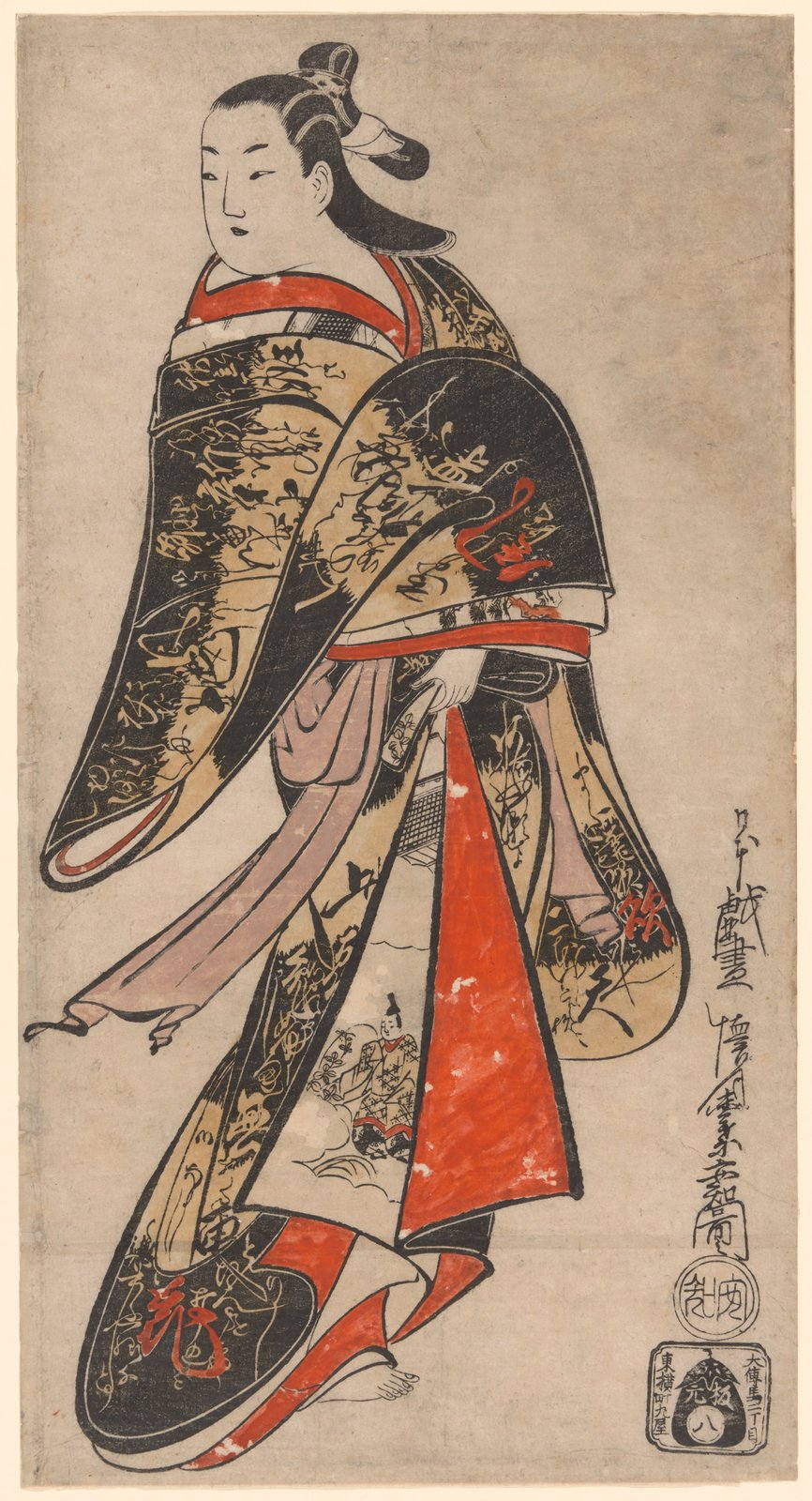
His pupils carried the same design into print. The Art Institute of Chicago’s Courtesan Walking by Kaigetsudō Anchi, about 1714, is a hand-coloured woodblock print in the tan-e style on a vertical ō-ōban sheet, 55.2 × 28.8 cm. Fiorillo describes ō-ōban as large prints, often printed on two joined sheets. Here the robe is black, covered in brushed characters, with orange-red touches added by hand: the painted formula reduced to line, one flat dark and one accent colour.
Compare Ando with Hishikawa Moronobu, whose line drawings shaped early ukiyo-e, and with Miyagawa Choshun, a painter of the same years who also worked only on scrolls. For the wider tradition, read our guide to ukiyo-e.
How designers can borrow from Kaigetsudo Ando
- Make one silhouette carry the page. On a poster, cover or product shot, give a single shape most of the height and leave the rest empty. Check it as a flat black shape first.
- Scale pattern up, not down. Ando’s bamboo is huge relative to the robe. Large motifs read at a distance and survive small reproduction; tiny repeats turn to texture.
- Use a weighted keyline. A contour that thickens on curves and thins at ends holds flat colour together and adds movement without shading.
- Limit the accent colours. Build on a warm neutral, keep the main shape pale or dark, and spend red in narrow bands. Pull starting values from a cleared scan with our image colour picker.
- Let text balance the figure. Place a short vertical line of text in the empty corner opposite the figure’s weight, as the poems and signatures do.
Browse more cleared scrolls and prints in the ukiyo-e theme and the Japanese prints theme of the MGD museum inspiration collection.
Frequently asked questions
Did Kaigetsudo Ando make woodblock prints?
According to John Fiorillo, no prints are attributed to him; his surviving works are paintings. Prints signed by his pupils, such as Anchi and Dohan, survive in the Art Institute of Chicago and the Metropolitan Museum of Art.
When did Kaigetsudo Ando live?
The Metropolitan Museum of Art and the Cleveland Museum of Art give about 1671–1743.
What happened to Kaigetsudo Ando in 1714?
John Fiorillo records that he was exiled to Izu Ōshima that year in connection with the Ejima–Ikushima affair, and pardoned in 1722.
What does “Nihon giga” mean in Kaigetsudo signatures?
The Cleveland Museum of Art translates it as “Japanese painting for amusement”. Ando and his pupils used it to open their signatures.