Kajita Hanko worked where painting, publishing and the new mass press met. In the 1890s and 1900s Japanese novels and literary magazines opened with a colour woodblock print, the kuchi-e, which showed a scene from the story. Hanko was one of the artists publishers turned to. His frontispieces crop figures tightly, leave wide areas of warm, untouched paper and spend strong colour on a single patterned sleeve or a spray of flowers. They read like film stills, and they still teach a lot about editorial illustration.
Who was Kajita Hanko?
Hanko was born in Tokyo in 1870 and died in 1917; the Agency for Cultural Affairs’ Art Platform Japan and the Metropolitan Museum of Art give the same years. According to the Kobayashi Kokei Memorial Museum of Art in Jōetsu, he first trained with the ukiyo-e artist Nabeta Gyokuei, then taught himself from classical painting, in particular Zenken kojitsu, the illustrated book of historical figures by Kikuchi Yōsai, and absorbed Western influences into his own style. The Ota Memorial Museum of Art in Tokyo describes the same mix of ukiyo-e and Nanga training and his self-study of Yōsai’s book.
Two strands of work followed. He painted refined, carefully researched history and figure subjects that, the Kokei museum notes, won awards at art-society exhibitions. He also drew for print. Scholten Japanese Art and Oberlin College’s Japanese print notes both record triptychs of the Sino-Japanese War from 1896, and the Kokei museum and Scholten both say his illustrations for the Yomiuri Shimbun newspaper were popular; Scholten dates that newspaper work from 1899 and links it to his move into frontispieces for novels.
The Kokei museum also records his friendships with the novelists Ozaki Kōyō and Tokuda Shūsei. Japanese biographical compilations cite a 1917 obituary in the literary journal Waseda bungaku that singled out his illustrations for Kōyō’s serial novel Konjiki yasha (The Golden Demon).
Kuchi-e: the format Hanko helped shape
The Ota Memorial Museum of Art, which held an exhibition of frontispieces in 2020, explains the format. A kuchi-e was a single-sheet colour woodblock print, roughly A4 in size, bound into the front of a novel or literary magazine and usually showing a scene from the text. Because domestic romances sold well, most showed women. They were popular from the 1890s into the early Taishō era, and publishers commissioned well-known painters to draw them.
The Ota museum names Hanko among the first generation of frontispiece artists, alongside Mizuno Toshikata, Takeuchi Keishū and Tomioka Eisen, and credits him with a fresh sense of design. It adds that frontispieces were carved and printed with the same technique as ukiyo-e, by craftsmen whose skills had advanced by then.
Key works you can date
The Met holds a group of his prints from the Lincoln Kirstein and Donald Keene gifts, all woodblock prints in ink and colour on paper and all flagged public domain:
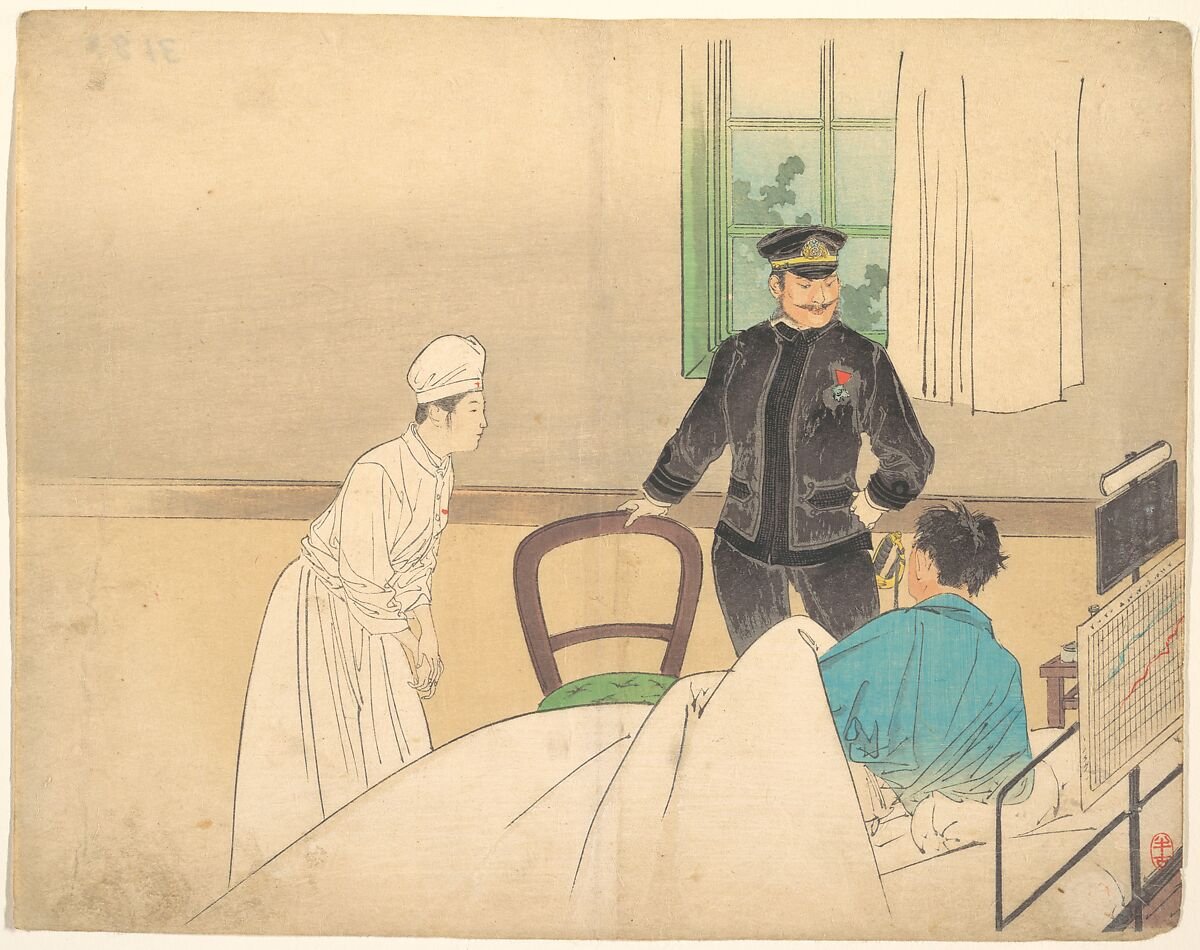
- The Torpedo Officer (Suirai shikan), about 1900, frontispiece for the literary magazine Bungei kurabu, 22.7 × 30.1 cm.
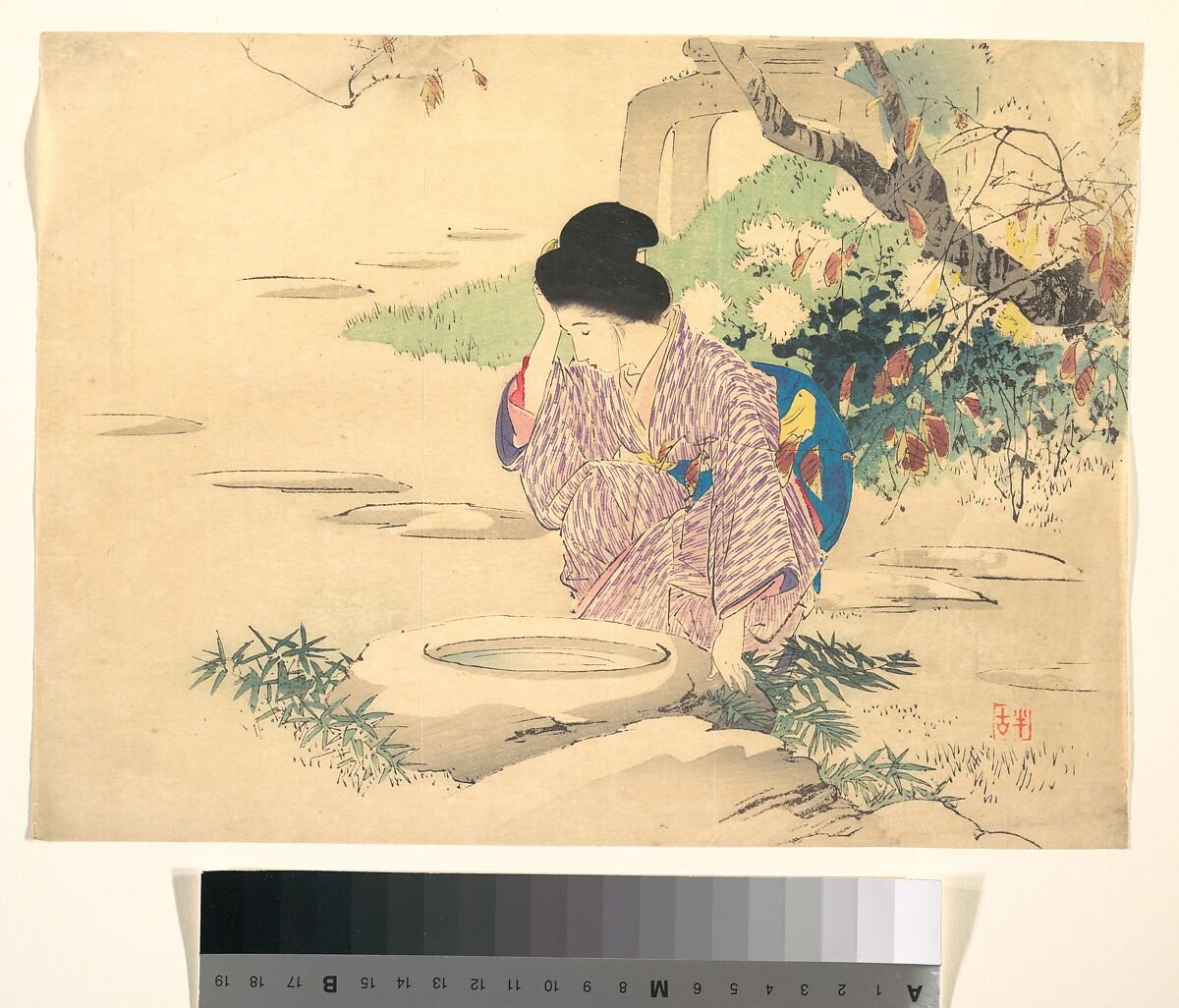
- Untitled print of a woman by a garden basin, November 1901, 22.2 × 30.2 cm.
- White Chrysanthemums (Kiku no kaori), 1902, frontispiece, 21.9 × 30.6 cm.
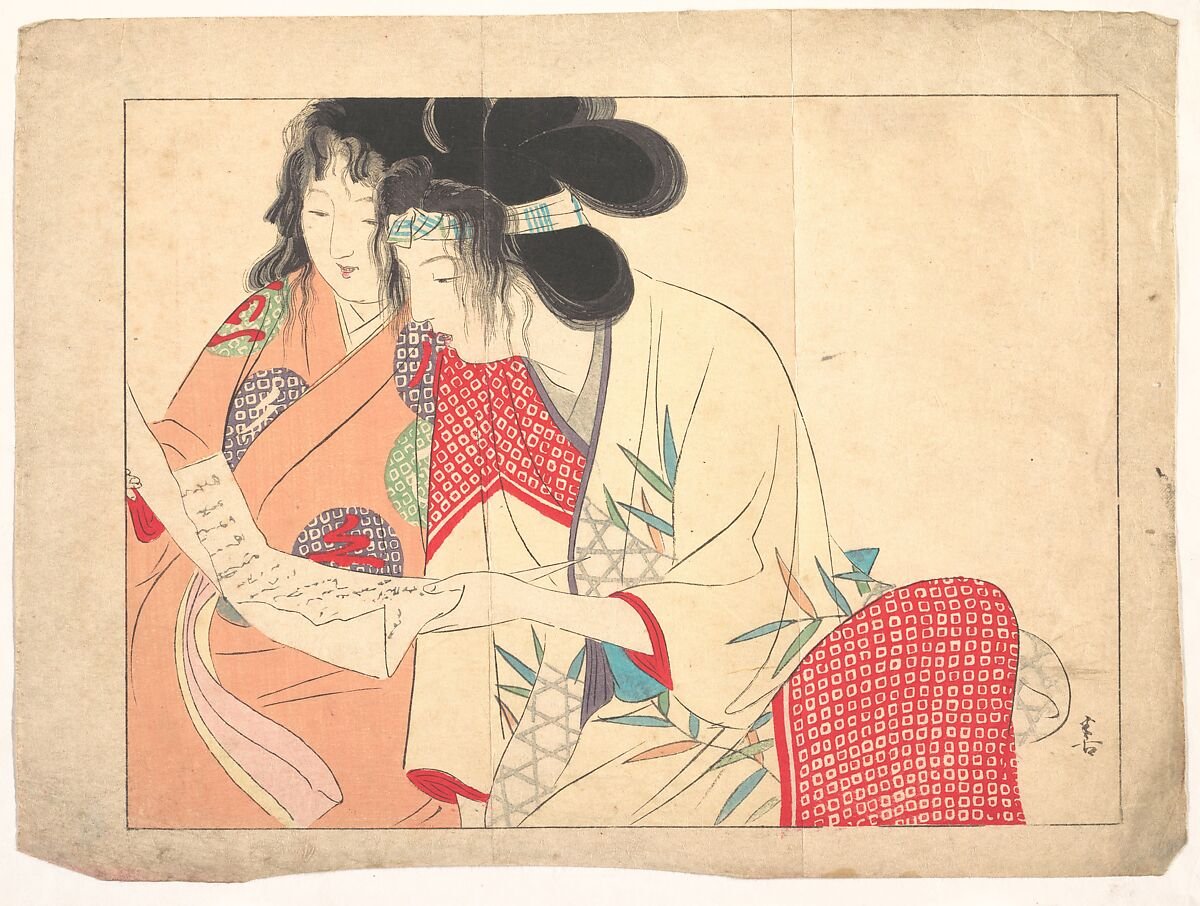
- Love Letter (Kesobumi), January 1906, 22.2 × 29.8 cm.
- Two samurai at the shore, an undated double-page print mounted in an album.
Paintings are mostly in Japanese collections. The Kokei museum showed his Atsumori and Sei Shōnagon in its 2025 exhibition, and Art Platform Japan lists a Pheasant of the late Meiji period at the Ome Municipal Museum of Art.

What to look at in Kajita Hanko’s prints
Tight, cinematic cropping
In White Chrysanthemums the woman’s head almost touches the top edge, her shoulder runs off the right, and a large brown quilt fills the lower left corner as a dark foreground shape. In Love Letter two figures fill the frame so closely that their hair breaks the printed border at the top. This is framing borrowed from close observation rather than from the wide, staged views of earlier prints, and it makes a small page feel intimate.
Pale paper as space and light
Hanko leaves large areas almost empty. Behind the reading women there is only cream paper; in the garden print a few stepping stones and grasses float on a light ground. The emptiness suggests air and quiet and lets the text pages that follow feel continuous with the image.
Pattern in one or two places
Colour and pattern are concentrated. In Love Letter the sharpest note is a red sleeve and skirt printed with small white squares, set against bamboo leaves on a white robe and a coral garment beside it. Measured from the Met’s scan of this impression, the main tones are a cream paper near #ffedbc and a deeper tan #d9c8a1, with salmon #fcad87, a bright red #f1424e, a sage green #9cb382 and a soft black #3d3d38 for hair and line. These are the colours of the scan today, not a record of the original inks, but the balance holds: a large pale field and small, saturated accents.
Line that changes with the subject
Faces and hands are drawn with fine, even lines, while hair is massed in flat black with a few strands pulled loose. In the samurai print, waves are a fan of thin grey lines and the pine is done in looser, broken strokes, closer to painting. The Kokei museum’s phrase for his figure work, precise and realistic, fits the faces; the settings are freer.
Technique: from drawing to woodblock
A frontispiece was a collaboration. Hanko supplied the drawing, and carvers and printers turned it into a set of blocks; the Ota museum notes that the technique was the same as ukiyo-e. The prints show what Meiji craftsmen could do: soft graded backgrounds, such as the peach glow behind the chrysanthemums, and textured printing on robes.
His subjects ranged widely. The Torpedo Officer, made for Bungei kurabu, is a modern scene in a Western-style room with a naval officer in uniform, a nurse in white and a patient in bed. Love Letter sets two women in old-fashioned court-style dress. The album print of two samurai on a shore is a double-page spread with a centre fold, a reminder that he also designed across the gutter of a book.
Teacher of the next generation
The Kokei museum says Hanko opened a private painting school around 1893 and that his pupils included Kobayashi Kokei, Maeda Seison and Okumura Togyū, who went on to major careers in Nihonga. Artist notes published by Hamamatsu City for an exhibition likewise record that Kokei studied history painting and court-costume lore at Hanko’s school, alongside the Gifu-born Seison. Scholten adds that from 1902 Hanko led a life-drawing study group whose participants included Seison and Kaburaki Kiyokata.

How designers can borrow from Kajita Hanko
- Crop closer than feels safe. Let a head touch the top edge or a figure break the frame. On a book cover or article header, it creates intimacy fast.
- Keep the ground pale and warm. A cream field instead of white makes a page feel printed and gives saturated accents more weight. Sample a starting palette from a cleared scan with our image colour picker.
- Put pattern in one place. Choose one sleeve, one flower cluster or one panel for the busy texture and keep everything else calm.
- Design across the fold. For spreads, place the main figure off-centre so the gutter falls in empty space, as in the samurai print.
- Illustrate a moment, not the plot. A frontispiece shows one telling scene, such as a letter being read, rather than a summary.
For the printing tradition behind these frontispieces, see our guide to woodblock printing, and browse more cleared works in the MGD museum inspiration collection.
Frequently asked questions
What is Kajita Hanko known for?
He is known for kuchi-e, the colour woodblock frontispieces of Meiji novels and magazines, for newspaper illustration in the Yomiuri Shimbun, and for teaching painters such as Kobayashi Kokei and Maeda Seison.
What is a kuchi-e?
A colour woodblock print bound into the front of a novel or literary magazine, usually showing a scene from the text. The Ota Memorial Museum of Art dates their popularity from the 1890s into the early Taishō era.
When did Kajita Hanko live?
He was born in Tokyo in 1870 and died in 1917, according to Art Platform Japan and the Metropolitan Museum of Art.
Can I use Kajita Hanko’s prints in my designs?
The Met prints shown here are flagged public domain in the museum’s open-access data. For other works, check the owning collection’s rights statement before reproducing them.