Kano Sanraku painted on the scale of rooms. His folding screens and sliding doors were made to stand around people, to be read panel by panel and as one sweep. He trained in the bold gold-ground manner of his teacher, but the screens attributed to him in Western museums are often calmer and more open: a lake that takes up half the surface, geese spaced across bare paper, gold laid in bands like mist. For designers working in wide formats, that balance of density and air is the thing to study.
Who was Kano Sanraku?
Sanraku was born in 1559 and died in 1635; those dates are given by the Metropolitan Museum of Art, the Cleveland Museum of Art and the Kyoto National Museum. The Kyoto National Museum describes him as the son of a retainer of the Asai clan who later served the Toyotomi, and the museum of Miidera, the temple at Ōtsu, names his family as the Kimura of Ōmi Province. His given name was Mitsuyori, according to Miidera.
On the recommendation of Toyotomi Hideyoshi he became a pupil of Kanō Eitoku (1543–1590), the Kyoto National Museum records; Miidera adds that Eitoku allowed him to use the Kanō name. Our guide to Kano Eitoku covers the teacher and his large gold-ground style. Miidera’s museum says Sanraku served the Toyotomi family and supplied paintings for Osaka Castle, the Jurakutei palace and Shitennōji temple, and produced screen paintings for Daikakuji and other temples.
The fall of Osaka in 1615 ended Toyotomi rule. The Kyoto National Museum says Sanraku then became a target of the Tokugawa shogunate and was saved through the intercession of the priest and calligrapher Shōkadō Shōjō and others. He stayed in Kyoto while the main Kanō line served the shoguns in Edo, and both the Kyoto National Museum and Miidera regard him as the founder of the Kyoto branch, known in Japanese as Kyō-Kanō. The Columbia University Japanese art dictionary JAANUS names Kanō Sansetsu (1589/90–1651) as his heir and the next head of the school in Kyoto.
Key works and dates
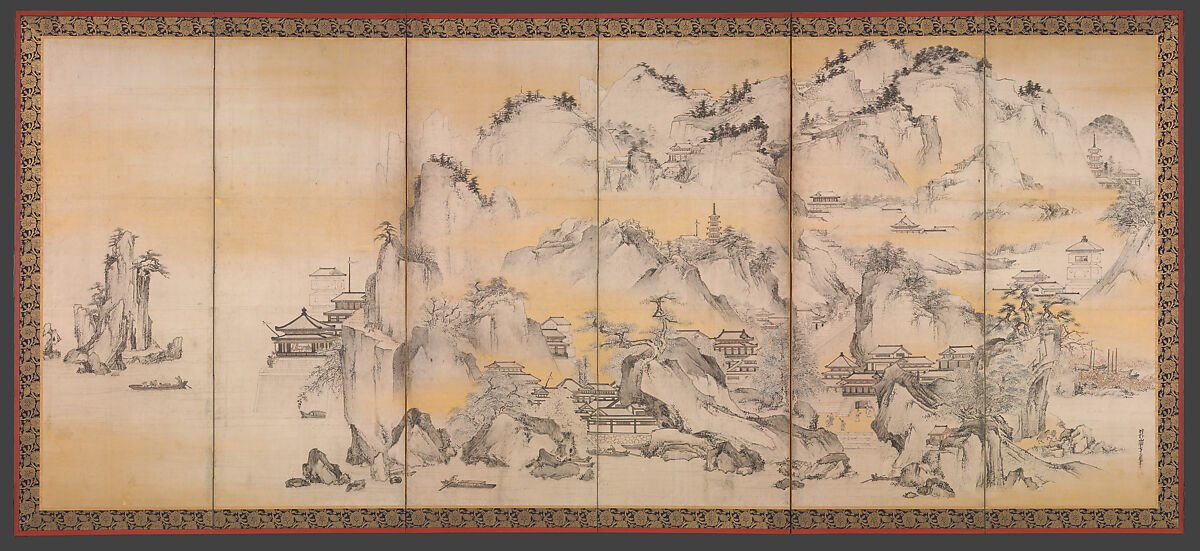
- Jinshan Island and West Lake, 1630, the Metropolitan Museum of Art (2015.300.74.1, .2). A pair of six-panel folding screens in ink, colour and gold on paper, each about 152.5 × 358.2 cm, painted five years before his death.
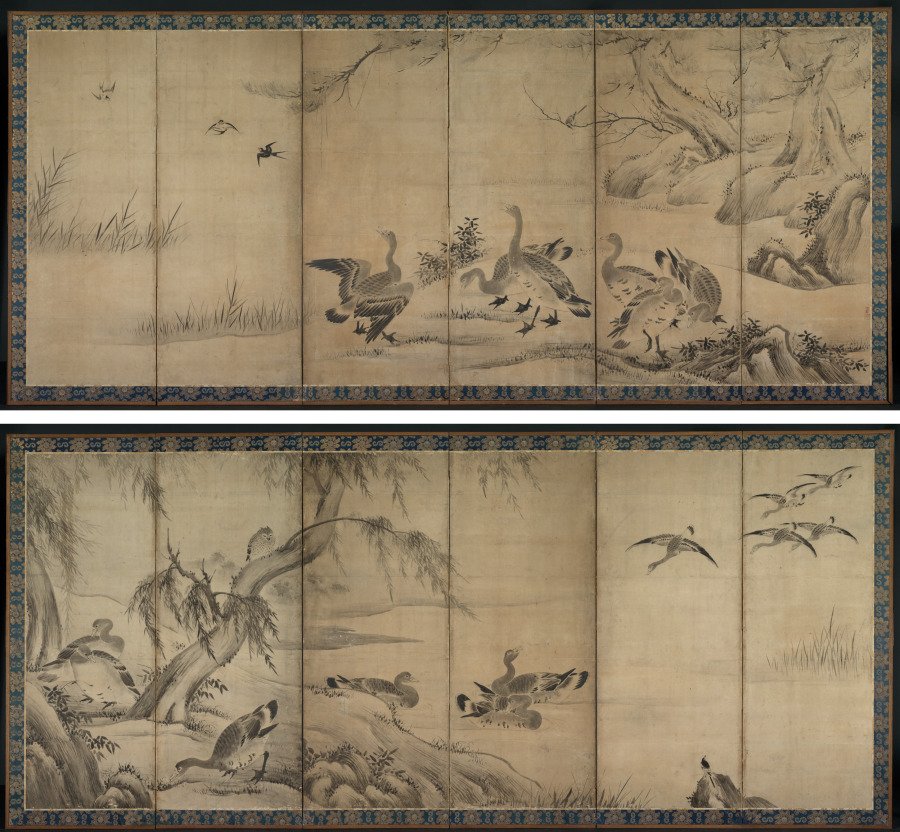
- Wild Geese, late 1500s–early 1600s, the Cleveland Museum of Art (1987.9). A pair of six-panel screens in ink on paper, each about 152 × 359 cm.
- Chinese Lion, Honpōji temple, Kyoto. A four-panel folding screen in ink, colours and gold on paper, named by the Kyoto National Museum.
- Chrysanthemum screens, Kōjōin reception hall, Miidera, late Momoyama period. The temple credits these to Sanraku on the strength of their close match to his style.
- Chinese Sages, late 16th–early 17th century, the Met (2020.359.1, .2), attributed to Sanraku. A pair of six-panel screens in ink on paper.
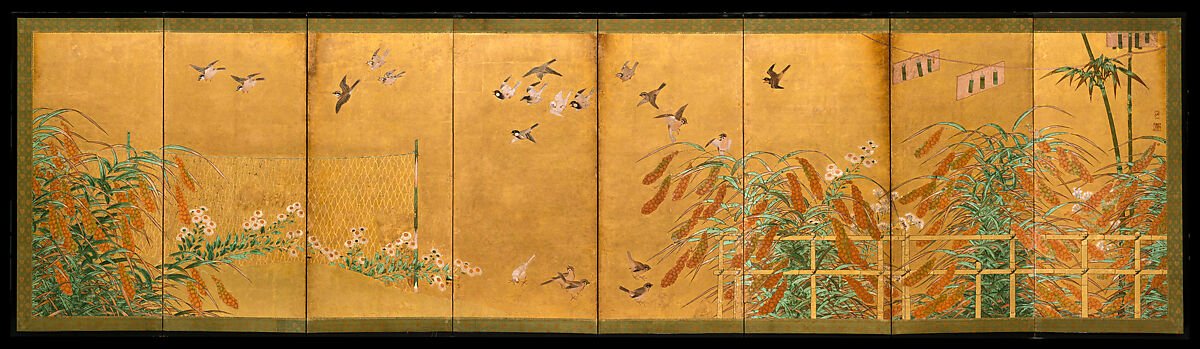
- Autumn Millet and Small Birds, Edo period, the Met (57.157.1, .2), attributed to Sanraku. A pair of eight-panel screens in ink, colour and gold on gilt paper, each 85.1 × 341.6 cm.
What to look at in Kano Sanraku’s screens
A panorama that reads in panels
On the Met’s 1630 screen, a crowd of cliffs, halls and pagodas fills the right four panels, while the left two hold only water, a small rocky island and a boat. The panel joins never stop the eye, but they act as a grid: each panel is a readable picture, and together they form one long view. The weight sits right, and the emptiness on the left gives the scene somewhere to breathe.
Gold as weather
The gold on that screen is not a solid ground. It floats in soft horizontal bands between the peaks, like mist catching the sun. Measured from the museum’s scan of this screen, the paper reads as a warm parchment, about #d9bfa6, the gold haze as a muted ochre near #cea980, and the ink as a brown-grey around #816d5b. The range is narrow, which is why the few dark accents of pine and roof read so clearly.
Ink alone, spaced like a score
Cleveland’s Wild Geese uses ink on paper with no gold at all. Groups of geese sit on a low bank in the centre panels, a willow and pines frame the ends, and single birds cross the open paper above. Measured from the museum’s scan, the toned paper sits near #a99271 and the main ink wash near #776750. The rhythm of clusters and gaps is the design.
A calmer Kanō manner
JAANUS describes Eitoku’s pupils, Sanraku among them, as moving away from their master’s monumental style towards more fragmented compositions, quieter moods, delicacy, elegance and decorativeness. That matches what the screens above show: big formats, but with space and restraint doing much of the work.
Technique: ink, colour and gold on paper
Every work in the list above is a painting on paper mounted as a screen, using ink alone or ink with mineral colour and gold. In a folding screen, the paper is mounted across a series of hinged panels, so the painter has to plan a composition that still works when the screen stands in a zigzag. JAANUS describes Eitoku’s gold-foil style as large trees, regal animals and Chinese figure themes on brilliant backgrounds; Sanraku’s Chinese Lion at Honpōji belongs to that family of subjects.
The Met screen attributed to Sanraku, Autumn Millet and Small Birds, shows the gilt-paper version of the method. Measured from the museum’s scan, the gold ground reads around #e5a34f with deeper tones near #c38735, the millet heads around #a95917, and the leaves an olive near #676330. A bamboo fence and a fine bird net, painted as pattern, cut across the gold and give the picture its structure.
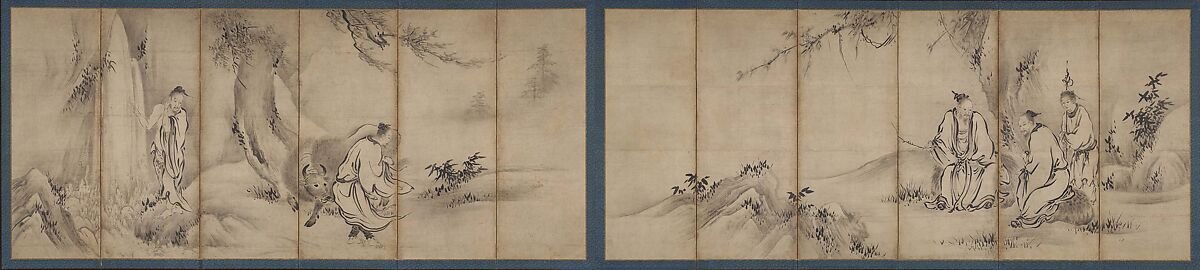
The ink screens rely on wash tone and brush pressure. In Chinese Sages, the robed figures are drawn with long, dark contours, while trees, rocks and grass are softer and greyer, so the figures always read first. Our overview of Japanese art sets the Kanō school in its wider history.
How designers can borrow from Kano Sanraku
- Design wide formats as panels. For banners, exhibition walls or a horizontal scroll page, make each segment hold up alone, then check the full sweep. Place the dense content to one side and leave the other open.
- Use metallic as atmosphere. Instead of a solid gold background, try metallic ink or foil only in soft horizontal bands, the way Sanraku’s gold mist drifts between peaks.
- Space repeated motifs like a rhythm. The geese and small birds fall in clusters and gaps. The same idea works for icon sets, product grids and pattern repeats.
- Let structure come from a pattern layer. A fence or net drawn across a field can organise a busy composition, much like a grid overlay on a poster.
- Keep the palette narrow. Start from parchment, ochre gold and one ink tone, then test variations in our colour palette generator, or sample the museum scans yourself with the image colour picker.
Where to see Kano Sanraku’s work
In the United States, the Metropolitan Museum of Art and the Cleveland Museum of Art hold the screens described above, which the museums flag as public domain (the Met) and CC0 (Cleveland) in their open-access data. In Japan, works associated with him remain in Kyoto temples such as Honpōji and Daikakuji and at Miidera; check each owner’s rights statement before reproducing any image. For more cleared works from Japan and beyond, browse the MGD museum inspiration collection.
Frequently asked questions
Who was Kano Sanraku?
Kano Sanraku (1559–1635) was a Japanese painter of the Momoyama and early Edo periods, a pupil of Kanō Eitoku who served the Toyotomi family and founded the Kyoto branch of the Kanō school.
What is the Kyoto Kano school?
It is the branch of the Kanō school that stayed in Kyoto after the main line moved to Edo. Sanraku is regarded as its founder, and his heir Kanō Sansetsu led it after him.
Where can I see Kano Sanraku’s paintings in the United States?
The Metropolitan Museum of Art holds Jinshan Island and West Lake (1630) and two pairs of screens attributed to him, and the Cleveland Museum of Art holds the Wild Geese screens.
Are Kano Sanraku’s screens in the public domain?
The works shown here are flagged public domain by the Met and CC0 by the Cleveland Museum of Art in their open-access data. Works in Japanese temples have their own owners and rules.