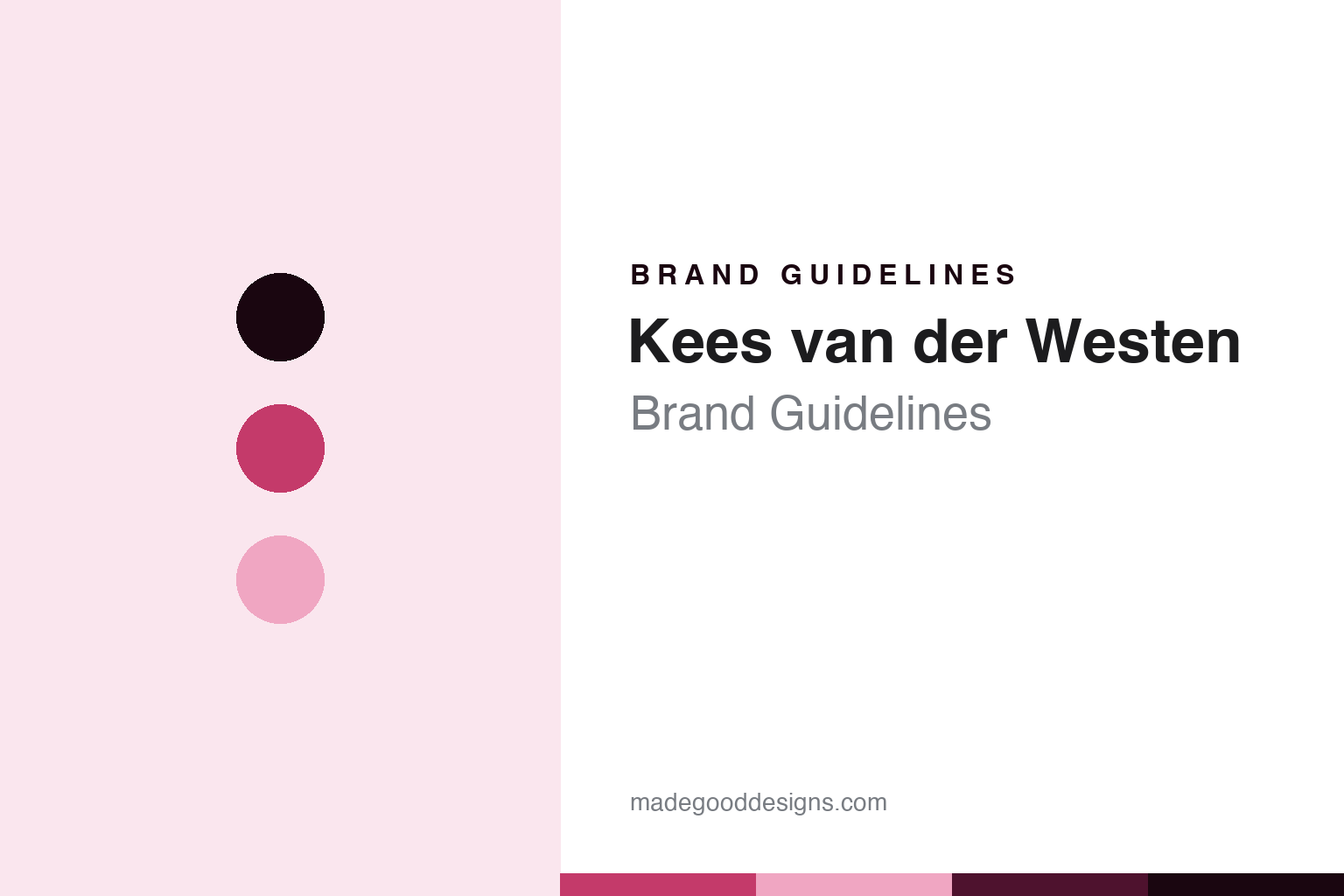
Kees van der Westen Brand Guidelines
The hand-built Dutch design workshop.
Aa
Two constants: a retro-magenta palette and a hand-build-sans register. Abstract homage — not a Kees van der Westen product or mark; no machine, group head or logo is reproduced.
The hand-built Dutch design workshop
Kees van der Westen is the Dutch designer’s hand-built espresso workshop near Eindhoven, known for the Speedster, Mirage and Spirit.
Kees van der Westen closes the factory round, and the four-round espresso arc, as the opposite of a factory — a tiny hand-build workshop. The Dutch designer’s company, near Eindhoven, hand-builds a small number of design-forward machines, the Speedster, the Mirage and the Spirit, at very low volume. It builds and sells the machines, and its answer to a round about the factory is that it barely has one: it hand-builds. A brand, hand-built.
Its identity is the hand-built Dutch design workshop. The Dutch hand-build, the designer’s own name and the design-forward machines are the story here. A brand, hand-built. The hand-built Dutch design workshop.
(Honest notes, so a relationship stays a partnership, and a heritage claim stays out. Kees van der Westen — Kees van der Westen Espressonistic Works — sells hand-built espresso machines as its heroes, the Speedster, Mirage and Spirit, plus the earlier Mistral, and we report its performance language as the brand’s own. It is named after a real person, its founder and designer, who trained in industrial design, and it is in Waalre, near Eindhoven, in the Netherlands; it is independent and founder- and family-run, and builds at very low volume. On a relationship worth clarifying: an early-1990s link with La Marzocco was a partnership, a distributorship and parts arrangement, that ended amicably in 2004, never an ownership. Three honest limits: its machines are pump and pre-infusion machines in the E61 lineage, not lever machines, so we do not call the range levers; a sometimes-cited spring-lever heritage we could not verify, so we leave it out; and its founding is better told as a timeline, from design school in 1985 to the first series machine, the Mistral, in 1999, than as a single year. We describe the work and legacy, and do not state anything about the founder’s current personal circumstances, which we cannot verify; its access is limited, so we frame it as continuing to operate. Its machines and marks are IP we describe but do not reproduce; there is no official brand hex; these tones are an unofficial interpretation.)
Colour
Kees van der Westen lives in a retro magenta. Click a swatch to copy the hex.
Kees van der Westen’s identity is hand-built, designed and Dutch — a retro magenta, an ink, a pale rose, a deep plum, and a paper. The palette leans retro magenta and pale rose: a design register that nods to the maker’s vivid, retro machines rather than a loud logo colour. It signals a hand-built Dutch design workshop. The honest caveat: with no published brand hex, these values are an original, unofficial interpretation, not first-party colours.
The lesson is a retro magenta signals a hand-built, designed identity. Kees van der Westen’s world is a hand-built design machine. For designers, it is a reminder that a retro magenta and a soft pale rose can carry a maker brand — a design tone held as colour not as a machine drawing. Because these tones can fail as small text, keep type dark and let the colour live in the accents, palette and band. The takeaways: keep the La Marzocco link a partnership; call the machines pump, not lever; tell the founding as a timeline; and treat any single hex as unofficial.
Typography
The register is a hand-build sans — hand-built, plain, designed.
Kees van der Westen’s identity carries a hand-built, plain, designed spirit — a workshop, not a graphics label. A hand-build sans captures the mood: clean, considered and confident, the register of a hand-built design machine. Set in a retro-magenta palette, the hand-build sans feels hand-built and designed — exactly the personality Kees van der Westen carries. It is a made machine rather than a logo, mirroring brushed steel. (Kees van der Westen’s real machines and designs are things we describe but do not reproduce, and the exact typeface is not ours to use.) Because it is not ours to use, the honest description is “a hand-build-sans workshop,” shown here in a stand-in. The type behaves like the brand: hand-built, plain and designed.
Aa
A hand-build-sans workshop — hand-built and designed. (Specimen set in Manrope, a hand-build-sans STAND-IN; NOT the Kees van der Westen logo or any machine.)
The factory
Kees van der Westen stands for the hand-built Dutch design workshop.
Kees van der Westen closes the factory round, and the espresso arc, as the opposite of a factory. A retro-magenta palette, a hand-build sans and a designer’s own name make one thing — the hand-built Dutch design workshop — the whole identity: hand-built, designed and Dutch. The Dutch hand-build is the pitch, and the designer’s name is the proof. The point is a workshop that barely has a factory, closing a round about the factory.
Put to work, the identity is the workshop told straight, the partnership kept a partnership and the machines called pump. A maker in this spirit would keep the La Marzocco link a partnership, call the machines pump rather than lever, and tell the founding as a timeline. A reader in this spirit would keep the facts right: Kees van der Westen Espressonistic Works sells hand-built espresso machines as its heroes — the Speedster, Mirage and Spirit, plus the earlier Mistral; it is named after its real founder and designer, is in Waalre, near Eindhoven, and is independent and founder-run, building at very low volume; its early-1990s La Marzocco link was a partnership that ended amicably in 2004, never an ownership; its machines are pump and pre-infusion machines in the E61 lineage, not levers; a sometimes-cited spring-lever heritage is unverified and left out; its founding is a timeline from design school in 1985 to the Mistral in 1999; and its current personal circumstances are not stated, with the workshop framed as continuing to operate. Kees van der Westen closes the round, and the arc, on the smallest possible factory. The honest editorial moves are to keep the La Marzocco link a partnership, to call the machines pump, to tell the founding as a timeline, and to describe the work rather than the founder’s circumstances.
For designers and brand-builders, Kees van der Westen closes the factory: keep a partnership a partnership — and describe the work, not the person’s circumstances. The lessons: let a hand-built machine carry a workshop brand; distinguish a distribution partnership from ownership; classify machines by their real mechanism; tell a founding as a timeline when a single year misleads; describe legacy without speculating about a living person; and never reproduce a machine or mark. It is also a reminder to stay precise: Kees van der Westen is the Dutch designer’s hand-built espresso workshop near Eindhoven, known for the Speedster, Mirage and Spirit — with the palette here an unofficial interpretation. Read that way, Kees van der Westen is less a machine than a hand-build workshop: designed, Dutch, low-volume. The lesson for a brand is that an honest partnership and a described legacy reinforce each other, and keeping both careful keeps the story earned. Kees van der Westen made the-hand-built-Dutch-design-workshop the identity — proof that the factory closes the round, and the arc, even at its smallest.
Explore & save
Keep Kees van der Westen’s identity on hand — save it to a board in the Made Good inspiration library.
Kees van der Westen identity set
Pin the retro-magenta palette and the hand-build-sans register to your own board.