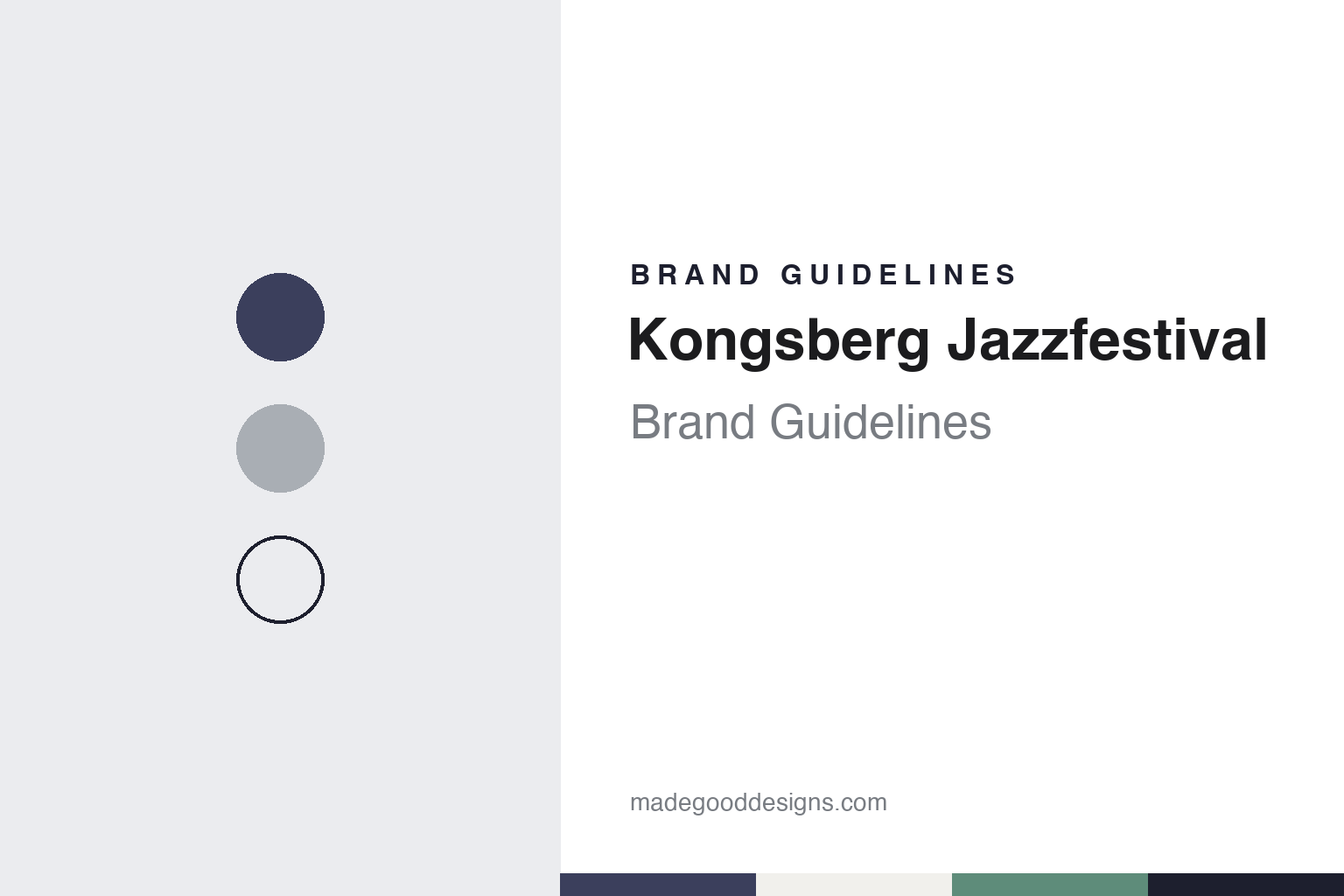
Kongsberg Jazzfestival Brand Guidelines
Kongsberg’s week-27 jazz festival, held every year since 1964.
Aa
Two constants: a Kongsberg Jazzfestival slate and silver palette and a town-square serif register. Abstract homage — not a Kongsberg Jazzfestival poster or mark; no logo, artwork or stage design is reproduced.
Jazz Evidence
A club weekend in a mining town.
Kongsberg Jazzfestival takes place in Kongsberg, a town in Norway whose mining museum is one of the festival’s venues. English and Norwegian Wikipedia both say it has been held every year since 1964, and the festival gives the same founding year. Norwegian Wikipedia says it began as a jazz weekend organised by the local club Jazz Evidence. The count of editions bears out the unbroken run: DownBeat described the July 2023 festival as the 59th, and the festival called its July 2026 festival the 62nd edition.
The organisation changed shape over time. According to Norwegian Wikipedia, from 1965 the festival was run on a volunteer basis by a board made up of the festival leader, the treasurer and the group leaders, all of them unpaid; in 1991 it became a foundation (stiftelse) with private founding contributors. The festival describes itself today as an ideell stiftelse, a non-profit foundation, and says it works with around 600 volunteers; Norwegian Wikipedia adds that volunteers have a vote at the festival’s annual meetings.
The festival keeps a fixed slot in the calendar. It is held every year in week 27, the first full week of July, over four days, the festival says. DownBeat reported the 2023 festival as running from 5 to 8 July, and the festival’s own report on the 2026 edition says it closed on Saturday 4 July.
A small paid staff leads it. Norwegian Wikipedia lists Ragnhild Menes as festival director from 2020 to 2026. In October 2026 the festival announced that Lars Ljosland, formerly manager of the EnergiMølla venue in Kongsberg, a former member of the festival board and head of its programme committee since 2022, would take over as festival director from 2 November 2026.
Colour
Fifteen stages across a small town.
Kongsberg Jazzfestival does not have a single site. The festival says its concerts take place at around 15 venues across the town, from clubs and churches to backyards and outdoor stages, and its report on the 2026 edition counted 14. Norwegian Wikipedia lists among them Kongsberg kirke, the town church; the EnergiMølla culture venue; the music theatre and Sølvsalen in the Krona culture centre; and two buildings at the Norwegian Mining Museum, Smeltehytta and Steinhuset.
The mining museum is where the festival keeps its most experimental music. DownBeat’s Bill Meyer reported in 2023 that two linked programmes, Særingfest and Avanthagen, devoted to free improvisation and experimental music, shared a stone room in the museum. The same report described the festival’s balance: pop acts and a late-night weekend street festival alongside international jazz and new Norwegian players. The 2023 opening night, Meyer wrote, belonged to the guitarist John McLaughlin with Shakti and the saxophonist David Murray with a Norwegian rhythm section. In 2026 the festival listed the singer Samara Joy among its international names.
Free stages carry the street life. Norwegian Wikipedia describes Jazzboksen, a free open-air stage on the corner of Storgata and Tinius Olsens gate with morning interviews and afternoon concerts by young bands, and Festivalgata, a stage in Christian Augusts gate, which is closed to traffic during the festival and filled with long tables. The children’s programme, Barnivalen, has run since 1977, Norwegian Wikipedia says. For 2026 the festival estimated that close to 10,000 people visited its free stages at Festivalgata, Jazzboksen and Barnivalen.
The festival also runs a film strand, Jazzfilm, with screenings of jazz and music films, and it presents a musician’s prize each year. That prize, established in 1996 according to English Wikipedia, has carried the names of successive sponsors, among them DNB.
Typography
Design and documentation.
A jazz festival rarely owns the ground it stands on, yet the ground often does most of the work of making it recognisable. An open-air amphitheatre, a grove of pines by the sea, a park beside a river, a village square under a marquee or a whole small town handed over for a week in summer: audiences remember the setting long after a particular evening’s line-up has blurred, and the festival name tends to fuse with the name of the place.
Inside that setting, stages are given names of their own, after a garden, a building, a street or a hall, and those names become part of the vocabulary regulars use when they plan a day. The annual poster does a similar job over time. Many festivals commission a different illustrator, painter or designer every year, so a run of posters becomes a visual archive that collectors keep and that the festival itself often reprints, exhibits or sells.
Behind the name there is usually a founder or a small founding group, and later an organisation that keeps it going: a non-profit association, a foundation, a tourist office or a public cultural body linked to the town. Changes in that structure seldom change what audiences see, but they shape who books the music, who commissions the poster and who looks after the archive of past editions.
Then there is the practical layer, the part visitors handle with their own hands. Printed programme books and day-by-day schedules, wristbands and passes, site maps, information points, signs that point from one stage to the next, and now festival apps all carry the same name, colours and lettering. This guide looks at how each festival’s identity holds together across those pieces, and keeps to what dated sources record about them.
Aa
A town-square serif — one word, Jazzfestival. (Specimen set in DM Serif Display, a serif STAND-IN; NOT the Kongsberg Jazzfestival logo.)
Kongsberg Jazzfestival
A band shell by Snøhetta.
The festival’s most fully documented design object is a stage roof. For its main outdoor stage the festival used the Tubaloon, a band shell designed by the Norwegian architecture firm Snøhetta. Architectural Record reported in October 2007 that the head of Snøhetta’s Oslo office had offered the firm’s services in 2003 to design a band shell for the festival’s open-air concerts, held in a square opposite the town’s church; a design workshop ended with a sketch of an air-filled shell the team called “The Jazz Heart.”
The project architect, Joshua Teas, told the magazine that the team drew on the curving walls and warped twists of the Philips Pavilion built for the 1958 World Expo in Brussels. To build it, Snøhetta adapted Tensairity, an air-beam system developed in Switzerland in 2000: air tubes stabilise a galvanised-steel frame and tension a coated PVC membrane, and the segmented frame goes up in a few days and is stored in containers for the rest of the year, Architectural Record wrote. By night, the magazine said, the shell was washed in shifting colours that recalled the northern lights.
Snøhetta’s project page gives the structure as about 20 metres high and around 40 metres long, names the client as Kongsberg Jazzscener AS, and says the stage stood for about three weeks each year. Its shape, the firm says, works like a clamshell over the audience for quiet sets while the fabric lets amplified sound pass through. Norwegian Wikipedia says the Tubaloon was first used at the 2006 festival and was in use, with some breaks, until 2016, returning for the children’s programme in 2022.
For a design guide, Kongsberg Jazzfestival shows how a festival can borrow a whole town as its venue and give it one memorable, temporary piece of architecture. Compare Oslo Opera House, the Snøhetta building in the Norwegian capital, and Vossa Jazz, the spring jazz festival in Voss. For this guide we use a mine slate, ore silver and a northern green with a serif, an unofficial interpretation; no product or logo is reproduced.
Explore & save
Keep Kongsberg Jazzfestival’s identity on hand — save it to a board in the Made Good inspiration library.
Kongsberg Jazzfestival identity set
Pin the Kongsberg Jazzfestival slate and silver palette and the town-square serif register to your own board.
Source & notes
Frequently Asked Questions
What font can I use to match the Kongsberg Jazzfestival look?
This guide describes Kongsberg Jazzfestival’s type as “A town-square serif — one word, Jazzfestival”. Its type specimen is set in DM Serif Display from Google Fonts as a stand-in; DM Serif Display is not Kongsberg Jazzfestival’s own lettering.
What colours are in the Kongsberg Jazzfestival palette?
This guide’s Kongsberg Jazzfestival palette is Mine slate #3B3F5C, Night shaft #1D1F2E, Ore silver #A9AEB4, Northern green #5E8C7A and Membrane white #F4F3EF. The tones are the guide’s own unofficial interpretation, not official Kongsberg Jazzfestival hex codes.
When was Kongsberg Jazzfestival founded?
Kongsberg Jazzfestival was founded in 1964, in Kongsberg, Norway.