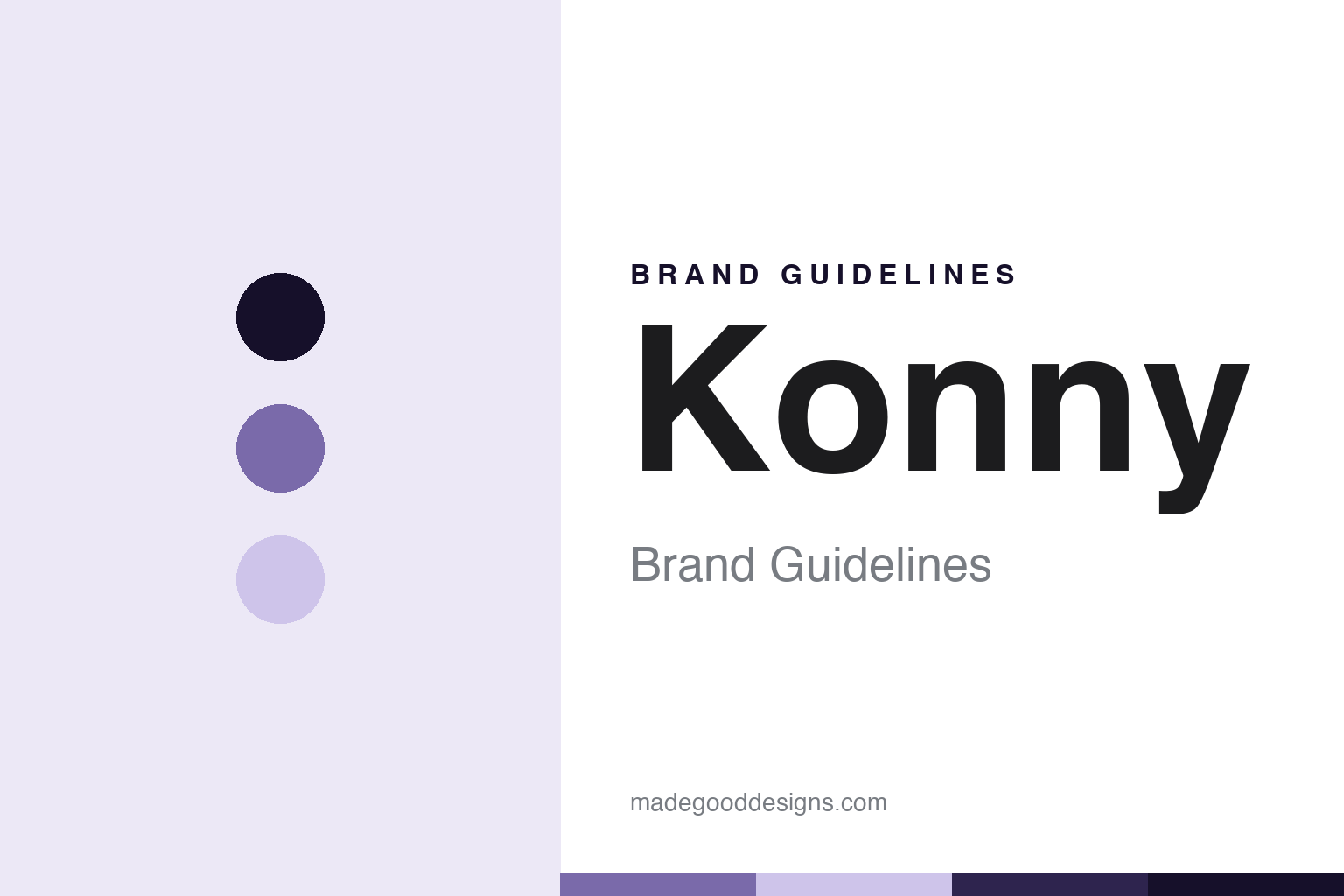
Konny Brand Guidelines
Born from a mother’s neck injury.
Aa
Two constants: a soft-lavender palette and a wrap-sans register. Abstract homage — not a Konny product or mark; no wrap, child or logo is reproduced.
Born from a mother’s neck injury
Konny is the founder-led Korean brand whose viral slip-on stretchy wrap grew from a carrier its founder sewed while injured.
Konny closes the carrier round as its viral node — a South Korean founder-led brand whose slip-on stretchy wrap grew from a carrier its founder sewed for herself while recovering from an injury, into a direct-to-consumer hit in more than a hundred countries. Its answer to a round about who owns the carriers and where they are made is a founder one: an independent, founder-led brand that says it makes in Korea.
Its identity is born from a mother’s neck injury. The founder origin, the slip-on wrap and the made-in-Korea claim are the story here. From pain to a wrap. Born from a mother’s neck injury.
(Honest notes, so the founding, the ownership, the making and the safety are framed accurately. Konny, or Konny by Erin, sells slip-on stretchy wrap carriers as its heroes — the Konny Wrap, the adjustable Konny Flex and the Dual Support Hip Seat; we report its language as the brand’s own. On origin: Konny’s prototype dates to 2016, handmade by founder Erin Lim while she recovered from a cervical-disc and neck injury after her first child, and the company was formalised in 2017, with Lim as chief executive and her husband Kim Dong-hyun as chief operating officer, headquartered in Seoul. On ownership: Konny is private and founder-led, with no parent, and although it has a globally distributed team across Korea, the United States, Japan and China, that is satellite staff rather than a foreign owner. On where it is made: Konny says its carriers are made in Korea through a long-term skilled sewing-factory partner, which we attribute to the brand and hedge for its newer buckle models. On its products: the Konny Wrap is a slip-on, sized, one-piece stretchy elastic wrap with no buckles or rings, and the Flex is an adjustable buckle hybrid. On safety, attributed: Konny states its Dual Support Hip Seat is acknowledged by the International Hip Dysplasia Institute and that its sling is designed to meet the ASTM sling-carrier standard, which we attribute rather than assert. Its designs and the Konny name are IP we describe but do not reproduce; there is no official brand hex; these tones are an unofficial interpretation.)
Colour
Konny lives in a soft lavender. Click a swatch to copy the hex.
Konny’s identity is founder-born, viral and made-in-Korea — a soft lavender, an ink, a pale lilac, a deep violet, and a paper. The palette leans soft lavender and pale lilac: a gentle, modern register that nods to calm and softness rather than a loud logo colour. It signals born from a mother’s neck injury — founder-born, viral and made-in-Korea. The honest caveat: with no official brand hex, and the brand associated with a blue-teal accent, these values are a gentle, unofficial interpretation, not first-party colours.
The lesson is a soft lavender signals a gentle, modern identity. Konny’s world is the slip-on wrap that went viral. For designers, it is a reminder that a soft lavender and a pale lilac can carry a gentle, modern brand — a calm tone held as an accent, not a product shot. Because a mid hue can fail as small text, keep type dark and let the colour live in the accents, palette and band. The takeaways: credit Erin Lim and the 2016 prototype into a 2017 company; note it is founder-led with a distributed team; attribute the made-in-Korea claim; and attribute the IHDI and ASTM claims.
Typography
The register is a wrap sans — founder-born, viral, made-in-Korea.
Konny’s identity carries a founder-born, viral, made-in-Korea spirit — a personal invention turned global hit. A wrap sans captures the mood: clean, soft and modern, the register of a gentle product. Set in a soft-lavender palette, the wrap sans feels calm and modern — exactly the personality Konny carries. It behaves like a made, gentle thing rather than a loud logo, mirroring a sling-curve and a wrap-fold. (Konny’s real products and the name are things we describe but do not reproduce, and the exact typeface is not ours to use.) Because it is not ours to use, the honest description is “a wrap-sans brand,” shown here in a stand-in. The type behaves like the brand: founder-born, viral and made-in-Korea.
Aa
A wrap-sans brand — calm and modern. (Specimen set in Space Grotesk, a wrap-sans STAND-IN; NOT the Konny logo or products.)
The carrier node
Konny stands for born from a mother’s neck injury.
Konny closes the round as its viral node. A soft-lavender palette, a wrap sans and a personal-invention origin make one thing — born from a mother’s neck injury — the whole identity: founder-born, viral and made-in-Korea. The founder origin is the pitch, the slip-on wrap is the product, and the made-in-Korea claim is the honest detail. The point is a personal invention turned global hit, in a round about who owns the carriers and where they are made.
Put to work, the identity is the brand told straight, the origin credited and the claims attributed. A brand in this spirit would credit Erin Lim and the 2016-into-2017 origin, note it is founder-led with a distributed team, attribute the made-in-Korea claim, and attribute the IHDI and ASTM claims. A reader in this spirit would keep the facts right: Konny sells the Konny Wrap, Flex and Dual Support Hip Seat as its heroes; its prototype dates to 2016, handmade by Erin Lim while recovering from a neck injury, and the company was formalised in 2017, HQ Seoul, with a distributed team; it is private and founder-led; it says its carriers are made in Korea; and it attributes its hip and ASTM claims. Konny closes the round, after WildBird. The honest editorial moves are to credit the founder, to note the ownership, to attribute the making, and to attribute the safety.
For designers and brand-builders, Konny closes the carrier node: credit a personal-invention origin — and attribute the made-in and safety claims. The lessons: a brand can grow from a personal need, here a wrap sewn while injured; a founder, Erin Lim, and a 2016-prototype-into-2017-company origin are credited; an ownership is noted as founder-led with a distributed team rather than a foreign parent; a made-in-Korea claim is attributed to the brand and hedged for newer models; and hip and ASTM claims are attributed to the institute and the standard. It is also a reminder to stay precise: Konny is the founder-led Korean viral wrap brand, made in Korea per the brand — with the palette here an unofficial interpretation. The hook is that origin: born from pain, not a boardroom, Erin Lim sewed the first Konny herself while recovering from a neck injury that made every existing carrier hurt, and it now sells in more than a hundred countries with most of its revenue from overseas. Read that way, Konny is less a single wrap than born from a mother’s neck injury: founder-born, viral, made-in-Korea. The lesson for a brand is that crediting the origin and attributing the claims reinforce each other, and noting the ownership keeps the story earned. Konny made born-from-a-mother’s-neck-injury the identity — proof that a personal-invention origin can close a round.
Explore & save
Keep Konny’s identity on hand — save it to a board in the Made Good inspiration library.
Konny identity set
Pin the soft-lavender palette and the wrap-sans register to your own board.