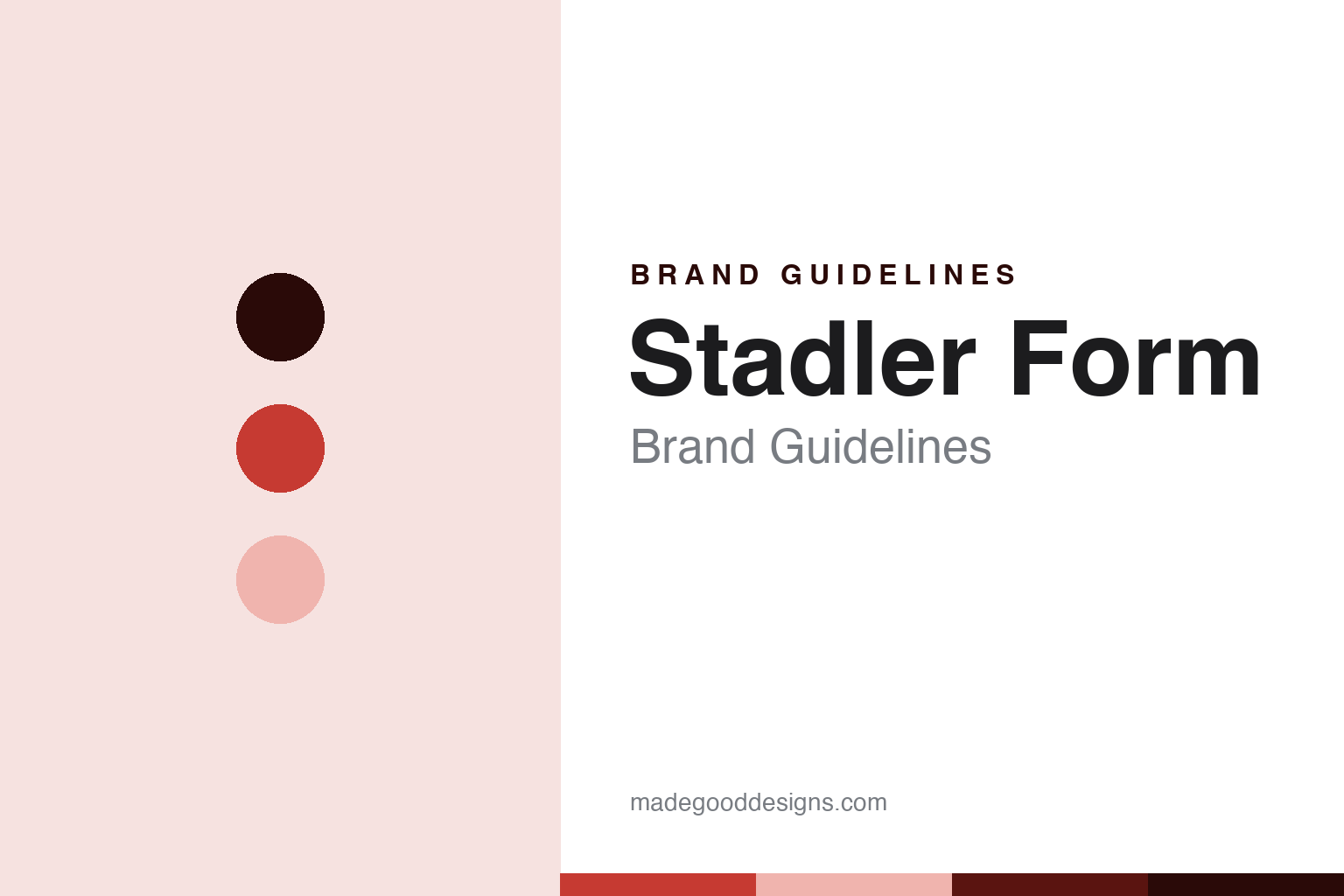
Stadler Form Brand Guidelines
Swiss design, one name at a time.
Aa
Two constants: a Swiss-red palette and a design-sans register. Abstract homage — not a Stadler Form product or mark; no fan, humidifier or logo is reproduced.
Swiss design, one name at a time
Stadler Form is the founder-led Swiss studio that names its humidifiers and fans like people — and registers every design.
Stadler Form follows Hunter as the round’s design-studio node — a Swiss air-treatment brand that treats a humidifier or a fan like a design object with a human name, is still led by its founder, and protects its work fiercely. Its answer to a round about who owns the fans and where they are made is a design-led one: an independent Swiss studio, designing at home and manufacturing in China.
Its identity is Swiss design, one name at a time. The founder-led ownership, the person-named products and the design-award record are the story here. Fred, Otto, Oskar. Swiss design, one name at a time.
(Honest notes, so the founding, the ownership and the making are framed accurately, with a naming trap avoided. Stadler Form sells air-treatment products as its heroes — humidifiers, fans, air purifiers, heaters and aroma diffusers, named after people, from the first, Fred, to Oskar, Otto and beyond; we report its language as the brand’s own, and note that the exact product category for a given name should be confirmed against the current catalogue. On origin: Stadler Form was founded in September 1998 by Martin Stadler in Zug, Switzerland, starting in a garage office, with its first product, the Fred humidifier, launched in autumn 1999. On headquarters: Zug, Switzerland. On ownership: it is independent and founder-led, with Martin Stadler as founder, board member and chief executive, and no outside parent found, though the current cap table is not confirmed, so we say founder-led and independent. On a naming trap: Stadler Form is not Stadler Rail, the unrelated publicly-traded train maker, so we keep them distinct and do not borrow the rail company’s colours or facts. On where it is made: it is designed in Switzerland and manufactured in China, which the Swiss intellectual-property office’s own case study confirms, so we say Swiss-designed and made in China. On awards: the company claims more than forty design awards, and verified honours include Red Dot, the German Design Award, Good Design in Japan and the Iconic Awards. We found no recall, which we state as none identified. On intellectual property, which is central here: the founder says the company registers every design, even prototypes, and actively pursues copies, so the distinctive person-named product shapes and the wordmark are protected and we describe rather than illustrate them. Its designs and the Stadler Form name are IP we describe but do not reproduce; there is no official brand hex; these tones are an unofficial interpretation.)
Colour
Stadler Form lives in a Swiss red. Click a swatch to copy the hex.
Stadler Form’s identity is design-led, founder-owned and China-made — a Swiss red, an ink, a pale red, a deep red, and a paper. The palette leans Swiss red and pale red: a clean, graphic register that nods to a Swiss design tradition rather than a loud logo colour. It signals Swiss design, one name at a time — design-led, founder-owned and China-made. The honest caveat: with no official brand hex, and with the unrelated Stadler Rail’s blue kept well away, these values are a design-forward, unofficial interpretation, not first-party colours.
The lesson is a Swiss red signals a clean, design-led identity. Stadler Form’s world is the appliance as a design object. For designers, it is a reminder that a clean red and a pale red can carry a Swiss, design-led brand — a graphic tone held as an accent, not a product shot. Because a bright hue can fail as small text, keep type dark and let the colour live in the accents, palette and band. The takeaways: date the founding to September 1998 and Martin Stadler in Zug, with the Fred humidifier from 1999; describe ownership as founder-led and independent; keep Stadler Form distinct from Stadler Rail; say Swiss-designed and made in China; and credit the person-named products and the forty-plus design awards while respecting the registered designs.
Typography
The register is a design sans — design-led, founder-owned, China-made.
Stadler Form’s identity carries a design-led, founder-owned, China-made spirit — a Swiss studio that names its work. A design sans captures the mood: clean, geometric and considered, the register of Swiss design. Set in a Swiss-red palette, the design sans feels precise and warm — exactly the personality Stadler Form carries. It behaves like a made, considered thing rather than a loud logo, mirroring a breeze-line and an airflow-arc. (Stadler Form’s real products and the name are things we describe but do not reproduce, and, given how fiercely the designs are registered, we are especially careful here; the exact typeface is not ours to use.) Because it is not ours to use, the honest description is “a design-sans brand,” shown here in a stand-in. The type behaves like the brand: design-led, founder-owned and China-made.
Aa
A design-sans brand — precise and warm. (Specimen set in Space Grotesk, a design-sans STAND-IN; NOT the Stadler Form logo or products — the real designs are registered.)
The air-circulation node
Stadler Form stands for Swiss design, one name at a time.
Stadler Form sits fourth in the round as its design-studio node. A Swiss-red palette, a design sans and a 1998 founding make one thing — Swiss design, one name at a time — the whole identity: design-led, founder-owned and China-made. The founder-led ownership is the pitch, the person-named products are the turn, and the design awards are the proof. The point is an independent Swiss studio that treats appliances as design objects, in a round about who owns the fans and where they are made.
Put to work, the identity is the brand told straight, the ownership described and the making named. A brand in this spirit would date the founding to September 1998 and Martin Stadler in Zug, describe ownership as founder-led and independent, keep Stadler Form distinct from Stadler Rail, say Swiss-designed and made in China, and credit the person-named products and awards while respecting the registered designs. A reader in this spirit would keep the facts right: Stadler Form sells humidifiers, fans, purifiers, heaters and diffusers named after people, from Fred to Oskar; it was founded in September 1998 by Martin Stadler in Zug, the Fred humidifier arriving in 1999; it is founder-led and independent, with Martin Stadler as founder, board member and CEO; it is designed in Switzerland and made in China; and it has won more than forty design awards. Stadler Form sits after Hunter and before Meaco. The honest editorial moves are to date the founding, to describe the ownership, to keep the names distinct, and to name the making.
For designers and brand-builders, Stadler Form carries the air-circulation node: treat an appliance as a design object — and respect a studio that registers everything. The lessons: a brand can name its products like people, here Fred, Otto and Oskar; a founding is dated to September 1998 and Martin Stadler in Zug, with the Fred humidifier from 1999; an ownership is described as founder-led and independent, with the current cap table left unclaimed rather than guessed; a making is named as Swiss-designed and made in China; and a design record is credited across Red Dot, the German Design Award, Good Design in Japan and the Iconic Awards. It is also a reminder to stay precise: Stadler Form is the founder-led, Zug-based, China-made air-treatment brand — not Stadler Rail — with the palette here an unofficial interpretation, and, because the studio registers even its prototypes, the designs are described rather than illustrated. The hook is that discipline: Stadler Form treats a humidifier or a fan like a design object with a human name, and it registers every design, even prototypes, having won more than forty awards. Read that way, Stadler Form is less a single fan than Swiss design, one name at a time: design-led, founder-owned, China-made. The lesson for a brand is that naming a product like a person and protecting the design reinforce each other, and dating the founding keeps the story earned. Stadler Form made Swiss-design-one-name-at-a-time the identity — proof that a design-led studio can anchor a node.
Explore & save
Keep Stadler Form’s identity on hand — save it to a board in the Made Good inspiration library.
Stadler Form identity set
Pin the Swiss-red palette and the design-sans register to your own board.