Landi Brand Guidelines
The farmers’ cooperative shops of the fenaco group.
Aa
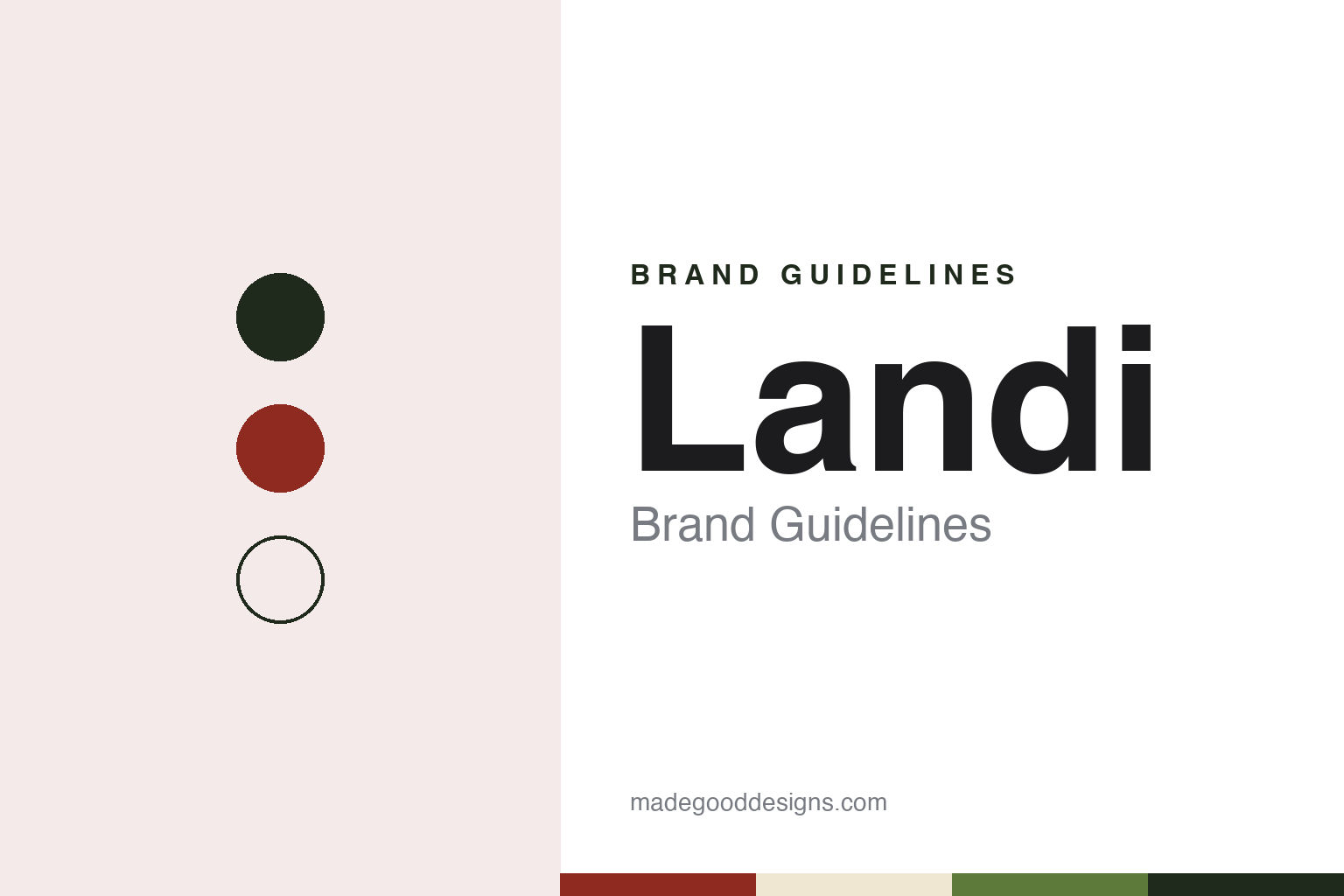
Two constants: a barn red, meadow green and straw palette and a sturdy grotesque register. Abstract homage — not a Landi product or mark; no shop sign, logo or own-brand pack is reproduced.
From Ressort Geräte to Landi
Farm cooperatives pooling their buying.
Landi grew out of the Swiss agricultural cooperatives, which German Wikipedia says formed across the country in the nineteenth century to market farmers’ harvests and buy supplies more cheaply. The company’s own timeline starts in 1964, when the Verband landwirtschaftlicher Genossenschaften Bern (VLG) set up a “Ressort Geräte,” an equipment department built around farm machinery whose customers were mainly farmers.
In 1971 five cooperative federations from the Swiss plateau and western Switzerland formed a working group, Haus & Garten, to pool their buying. In 1979 the federations of Bern, Solothurn, Lucerne, Fribourg and Lausanne founded UFA Haus & Garten AG in Bern, with a warehouse in the Felsenau district; the company gives its first storage space as 8,000 square metres. German Wikipedia’s infobox gives 1978 as the founding year, while its text and the company’s timeline give 1979. In 1984 the eastern Swiss federations, VOLG Winterthur, the St. Gallen Landverband and the Schaffhausen federation, founded a sister company at Pfungen.
The two merged in 1988, and in 1989 the business moved from Bern and Pfungen to Dotzigen in the Bernese Seeland, where it is still based. German Wikipedia describes the merged company as a service organisation for the cooperatives’ sales points, handling marketing strategy and a shared advertising look, shop layout and fittings, staff training, purchasing and logistics.
The name came in 1994, a year after the founding of the agricultural group fenaco: UFA Haus & Garten became Landi Schweiz AG and the cooperatives’ sales points were renamed LANDI shops. German Wikipedia says the first Landi shop in today’s form opened that year in Ebikon, near Lucerne. The company’s own timeline adds a high-bay warehouse at Dotzigen in 2008 and an automated container store later; German Wikipedia says national distribution from Dotzigen has been outsourced to Fiege Logistik.
Colour
Own brands and everyday low prices.
Landi’s structure is easy to misread. Landi Schweiz AG, with about 400 staff, runs purchasing, logistics, product service and national marketing for the retail brand, the company says, while the shops themselves belong to regional LANDI cooperatives and companies. Its main shareholder is the fenaco Genossenschaft; the LAVEBA cooperative of St. Gallen and the Genossenschaftsverband Schaffhausen hold the other shares. The company says fenaco is carried by more than 180 LANDI cooperatives, mostly owned by Swiss farmers; the Bern news site Hauptstadt, in March 2026, put the number of Landi cooperatives under fenaco at about 140.
The Schweizer Bauer farm newspaper counted 270 shops in February 2026, in the German- and French-speaking parts of the country. In August 2020 the BauernZeitung reported, from fenaco’s figures, that each shop carried twelve assortment categories with 30 exclusive own brands, sold on an everyday-low-price basis without promotions. German Wikipedia names Farmer for drinks, Okay for garden equipment, Capito for soil and plant food, and bitscat and bitsdog for pet food.
Where the goods come from has been a recurring question among farmers. fenaco told the BauernZeitung in 2020 that it buys directly from producers with the priority Switzerland, Europe, overseas; that apples, potatoes, sugar, rapeseed oil, flour and apple juice are Swiss; and that lawnmowers, drills, textiles and pottery are sourced worldwide because no Swiss supply exists. By fenaco’s count, 52 percent of the products came from Switzerland and 11 percent from China.
The range has moved well beyond the farmyard. Hauptstadt described Landi as a shop that began with feed, seed and fertiliser for farmers and, from the 1990s, added drills, lawnmowers, clothes airers and garden tents. Its March 2026 report visited the Landi at Wankdorf in Bern, opened in summer 2025 in a former Migros Do it + Garden store and run by the Landi Bolligen cooperative: about 10,000 articles on more than 3,000 square metres, more floor space than any other Landi, with a core range set by Landi Schweiz and no feed for large livestock. The same report noted a takeover of a former Do it + Garden near Aarau and a new Landi in Winterthur in March 2026.
Typography
Swiss retail and its signs.
Swiss retailers present themselves to a country with several official languages, and many of them publish the same name, shop sign and carrier bag across German-, French- and Italian-speaking regions. Manor, for example, runs its website in German, French and Italian under one name, and uses it for department stores, supermarkets and restaurants alike. Where a company publishes its own colours, logo or typeface, this guide says so; where it does not, the palette shown is an unofficial interpretation of our own.
The formats vary widely. This group of guides runs from city department stores with roots in Zurich, Bern and Lucerne to village shops, farm-and-garden stores, electronics and household-appliance chains, online shops and marketplaces, and menswear stores. Some trace their origins to the 19th century; the Historisches Lexikon der Schweiz, for instance, dates Jelmoli’s Zurich business to 1833.
Ownership is set out plainly in each guide. Some chains belong to cooperatives, some to founding families, and some to larger retail or property groups; a brand can also outlive its store, as Jelmoli’s name did when its owner, the property company Swiss Prime Site, closed the department store in February 2025. Acquisitions, closures and changes of owner are given with their dates and sources.
Each guide also notes the own brands, store formats and services a company names on its own pages, and what its corporate pages say about founders and owners, marked as the company’s own account. Independent dated sources, such as the Historisches Lexikon der Schweiz, SRF, swissinfo.ch and the Swiss business press, are named alongside them.
Aa
A sturdy grotesque — a register for shop signs and price boards. (Specimen set in Archivo, a sans STAND-IN; NOT the Landi logo.)
Landi
A Swiss chain that stayed at home.
Landi tried to take its format abroad and stepped back. The company’s own timeline records a Garden Center Plus in Luxembourg opened in 2020 and closed in 2023. The Schweizer Bauer reported on 13 February 2024 that the Luxembourg garden centre, taken over in April 2020, had closed at the end of 2023 and its subsidiary had been liquidated. The same report described a joint venture with Germany’s ZG Raiffeisen, Landwelt GmbH, owned in equal shares, announced in November 2021 to open five pilot shops in southern Germany; it was ended in early February 2024 after about 150 possible sites had been examined and the Landi assortment mix proved incompatible with German planning rules for out-of-town shops. fenaco and ZG Raiffeisen had run a shared logistics centre at Lahr in Baden since 2015, the newspaper added.
One naming point is worth knowing. In Switzerland “Landi” is also the familiar name of the 1939 Swiss national exhibition, and the aluminium Landi chair that Hans Coray designed for it, German Wikipedia says, is a Swiss design classic. Neither has anything to do with the cooperative chain, which took the name in 1994.
For a design guide, Landi shows how a federation of farmers’ cooperatives can present a single national shop brand while the shops stay locally owned. Compare Volg, the village-shop chain in the same fenaco group, and Coop, another Swiss cooperative retailer. For this guide we use barn red, meadow green and straw with a sans, an unofficial interpretation; no product or logo is reproduced.
Explore & save
Keep Landi’s identity on hand — save it to a board in the Made Good inspiration library.
Landi identity set
Pin the Landi barn red, meadow green and straw palette and the sturdy grotesque register to your own board.
Source & notes
Frequently Asked Questions
What font can I use to match the Landi look?
This guide describes Landi’s type as “A sturdy grotesque — a register for shop signs and price boards”. Its type specimen is set in Archivo from Google Fonts as a stand-in; Archivo is not Landi’s own lettering.
What colours are in the Landi palette?
This guide’s Landi palette is Barn red #8E2A1F, Field ink #1F2A1C, Meadow green #5E7A3A, Straw #EFE7D2 and Paper #FAF8F2. The tones are the guide’s own unofficial interpretation, not official Landi hex codes.
When was Landi founded?
Landi was founded in 1979 (UFA Haus & Garten AG); Landi Schweiz AG since 1994, in Bern and Dotzigen, Switzerland.
Who owns Landi?
Landi is owned by fenaco (main shareholder), LAVEBA, GVS Schaffhausen.