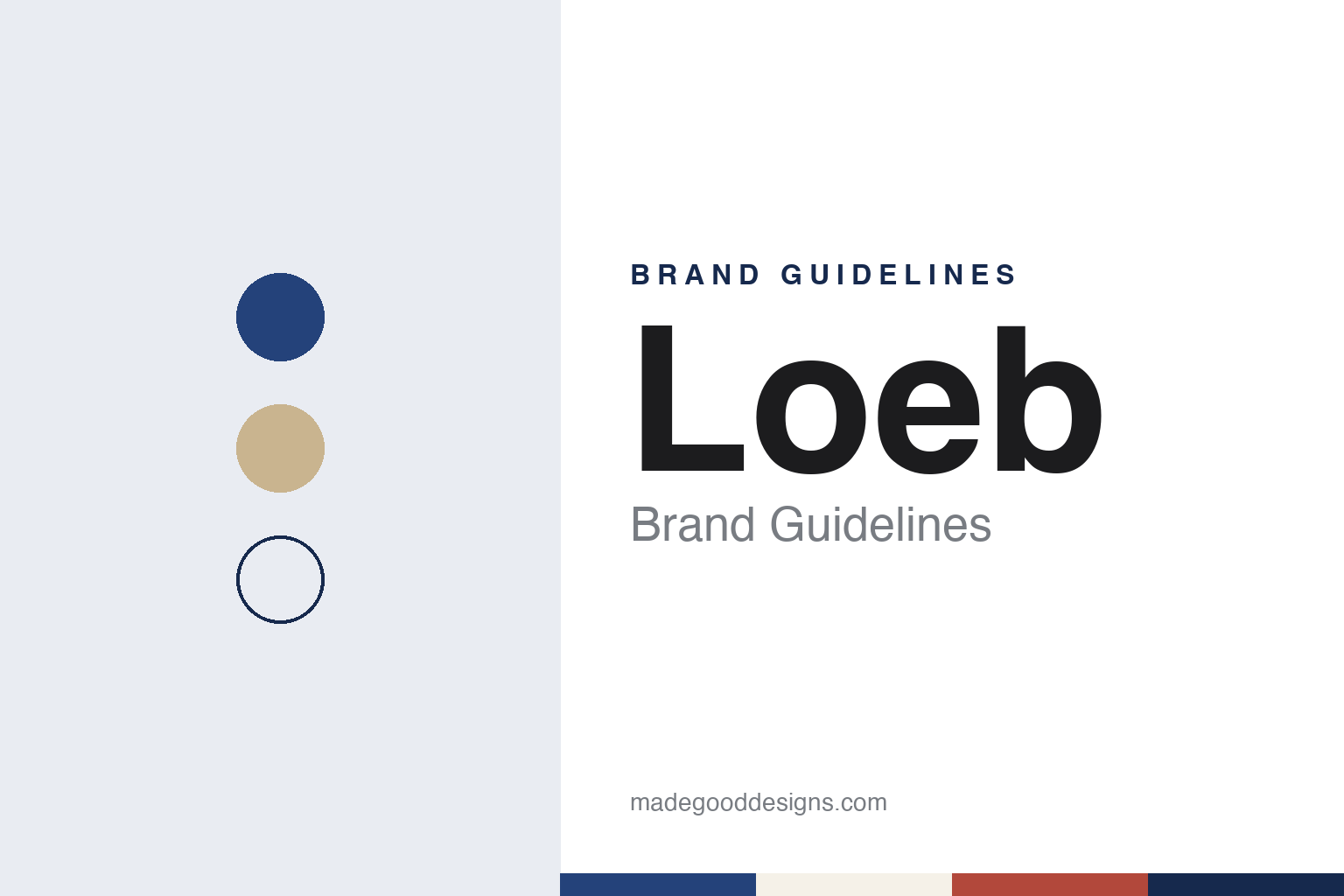
Loeb Brand Guidelines
A Bern department store, a family name and a row of shop windows under the arcades.
Aa
Two constants: a blue, sandstone and red palette and a plain sans register. Abstract homage — not a Loeb product or mark; no logo, sign or window display is reproduced.
Gebrüder Loeb
Four brothers and a textile shop on the Spitalgasse.
Loeb’s roots lie in market trading: the company says the founders’ forebears sold their goods at fairs and markets in Bern. The Historical Dictionary of Switzerland (HLS), in an entry by Andrea Weibel edited in 2009, says the Jewish merchant family Loeb ran a small shop in Freiburg im Breisgau from 1869 and opened shops in Zurich in 1874 and Basel in 1876. A 2025 article on the Swiss National Museum blog by Nadja Ackermann, the archivist for company records at the Burgerbibliothek Bern, says David Loeb from Freiburg im Breisgau was already selling wool, thread and other goods in Bern from 1867.
On 9 September 1881, according to the company, the brothers David, Julius, Louis and Eduard Loeb opened a small textile shop on Bern’s Spitalgasse under the name Gebrüder Loeb. In 1891 David and his wife Fanny took over the business, and in 1899 they turned it into what the HLS calls the first modern department store in the city, with 60 employees. The company says that store had sales rooms on three floors, and that a water-powered lift to the third floor followed in 1905.
The next generation took over in 1905, when the sons Arthur and Eugen became the owners. They opened a branch in Thun in 1912, and the firm became a limited company in 1918, the HLS says. The company adds that it opened a tea room in 1915 and that a yellow and black delivery lorry extended its home delivery service. In 1929, after the old Hotel Löwen next door was demolished, the Bern store was rebuilt and extended into the form it still has, according to the company.
Family members have run the business since. The HLS says Arthur’s son Fritz joined the management in 1929, Eugen’s son Victor became chairman of the board in 1938, and Victor’s son François Loeb took the chair in 1975. The firm changed its name from Gebrüder Loeb AG to Loeb AG in 1973, the company says, and the holding company Loeb Holding AG was formed in 1987.
Colour
Windows under the arcades.
Loeb’s visual reputation rests less on a logo than on its shop windows. The Swiss National Museum blog explains that the 1899 store broke with Bern’s arcaded old town: its display windows ran across the first and second upper floors instead of staying in the arcade zone. The new façade met strong criticism and was mocked as the “gap tooth,” and for the 1913 extension the firm returned to the neo-Renaissance style that still marks the Spitalgasse.
The windows under the arcades became the stage instead. From 1960 to 1993 they were designed by Peter Knuchel, who staged both merchandise and exhibitions, the blog says: a 1975 series on the history of theatre, windows on film two years later, and, in 1972, three mannequins more than six metres tall installed above the corner overnight. The curator Harald Szeemann called Loeb the “prince of shop windows,” according to the same article. The HLS also notes that the store made a name for itself with its window design.
Loeb also ran country weeks, about two a year, the blog says. In 1967 “Britain at Loeb” brought policemen in British uniforms to direct traffic at the store’s corner, and later weeks featured Finland, Mexico and Brazil. The corner itself, the Loeb-Egge, is described by the blog as Bern’s most famous meeting point.
Print mattered too. For posters and catalogue covers, the blog says, Loeb hired artists including Emil Cardinaux, Alois Carigiet, Herbert Leupin and Donald Brun; its catalogues from 1902 to 1977 are digitised at the Burgerbibliothek Bern. The company still runs a window stage of about fifty square metres, which it calls the Schaufensterbox, with seasonal themes.
The shop interior has changed with the times. The company says Bern got its first escalator in the store in 1956 and a self-service food hall in 1964. In September 2019 TextilWirtschaft reported the completion of a rebuild of the 14,000-square-metre Bern store over five floors, designed and fitted out by Dula of Dortmund, with light oak parquet alternating with grey concrete floors, an open ceiling painted grey and black-lacquered lighting rails, plus a sewing café, a beauty lounge and an event kitchen in the household department.
Typography
Swiss retail.
Swiss retailers present themselves to a country with several official languages, and many of them publish the same name, shop sign and carrier bag across German-, French- and Italian-speaking regions. Manor, for example, runs its website in German, French and Italian under one name, and uses it for department stores, supermarkets and restaurants alike. Where a company publishes its own colours, logo or typeface, this guide says so; where it does not, the palette shown is an unofficial interpretation of our own.
The formats vary widely. This group of guides runs from city department stores with roots in Zurich, Bern and Lucerne to village shops, farm-and-garden stores, electronics and household-appliance chains, online shops and marketplaces, and menswear stores. Some trace their origins to the 19th century; the Historisches Lexikon der Schweiz, for instance, dates Jelmoli’s Zurich business to 1833.
Ownership is set out plainly in each guide. Some chains belong to cooperatives, some to founding families, and some to larger retail or property groups; a brand can also outlive its store, as Jelmoli’s name did when its owner, the property company Swiss Prime Site, closed the department store in February 2025. Acquisitions, closures and changes of owner are given with their dates and sources.
Each guide also notes the own brands, store formats and services a company names on its own pages, and what its corporate pages say about founders and owners, marked as the company’s own account. Independent dated sources, such as the Historisches Lexikon der Schweiz, SRF, swissinfo.ch and the Swiss business press, are named alongside them.
Aa
A plain sans; the company says it redrew its logo in a plain blue in 2018. (Specimen set in Figtree, a sans STAND-IN; NOT the Loeb logo.)
Loeb
A family store that narrowed its map.
Loeb grew beyond Bern after the war. The HLS says several new branches opened in the 1960s and 1970s, that staff numbers reached about 900 by 1978, and that the group had eight branches in 2006. The company says it bought the Bouldoires department store in Biel in 1978 and the Knopf store in Interlaken in 1979. In 2005 François Loeb withdrew from the business and his daughter Nicole Loeb became the board’s delegate, according to the HLS and the company.
The map then shrank again. The company says its Brig, Visp and Interlaken branches passed in 2006 to Bayard Wartmann, then part of the Loeb group; its rebuilt main store in Bern reopened in May 2008; and it opened its first online shop on 1 February 2012. In February 2013 it launched MAGGS, a fashion and lifestyle concept store in Bern. It closed its branch in the Shoppyland centre at Schönbühl in January 2017, and in 2018 it closed several MAGGS and Loeb stores. That same year, the company says, it gave its logo a plain blue redesign.
New partners moved in. On 5 November 2019 Blick reported that Lidl had opened its first Swiss store inside a department store, in the basement of Loeb in Biel, on 1,100 square metres; German Wikipedia adds a second in Loeb Bern in 2021. On 25 March 2022 20 Minuten reported that Loeb’s clothes and accessories were going on sale on Zalando through its Connected Retail programme, with orders still packed by Loeb’s own staff.
Today the company lists department stores in Bern, Biel and Thun and the MAGGS store in Bern. In September 2026 TextilWirtschaft introduced an interview with Nicole Loeb as the fifth generation of the family to lead the business. Ronald Christen has been managing director of Loeb AG since 1 September 2015, the company says.
For a design guide, Loeb shows how a department store can build its image through windows, posters and a street corner rather than a single mark. Compare Globus, another Swiss department store, and Manor. For this guide we use a deep blue, a sandstone beige and a muted red with a sans, an unofficial interpretation; no product or logo is reproduced.
Explore & save
Keep Loeb’s identity on hand — save it to a board in the Made Good inspiration library.
Loeb identity set
Pin the Loeb blue, sandstone and red palette and the plain sans register to your own board.
Source & notes
Frequently Asked Questions
What font can I use to match the Loeb look?
This guide describes Loeb’s type as “A plain sans; the company says it redrew its logo in a plain blue in 2018”. Its type specimen is set in Figtree from Google Fonts as a stand-in; Figtree is not Loeb’s own lettering.
What colours are in the Loeb palette?
This guide’s Loeb palette is Arcade blue #24427A, Night blue #16294D, Sandstone #C9B48F, Window red #B2483B and Paper #F7F4ED. The tones are the guide’s own unofficial interpretation, not official Loeb hex codes.
When was Loeb founded?
Loeb was founded in 1881 (as Gebrüder Loeb), in Bern, Switzerland.
Who founded Loeb?
Loeb was founded by David, Julius, Louis and Eduard Loeb in 1881 (as Gebrüder Loeb).