PKZ Brand Guidelines
Paul Kehl Zürich: a clothing factory that became a Swiss fashion chain.
Aa
Two constants: a navy, camel and grey palette and a high-contrast serif register. Abstract homage — not a PKZ product or mark; no logo, label or poster is reproduced.
Paul Kehl Zürich
A Winterthur clothing factory with a Zurich name.
The three letters stand for Paul Kehl Zürich. In August 2022 swissinfo.ch wrote that the family company’s history began in 1881 with a clothing factory in Winterthur. The company’s own account, in a 2021 press release, adds that Paul Kehl moved the business to Zurich in 1884 and registered it there in 1891 under the name Paul Kehl Zürich. On its website today PKZ describes the founder as a men’s outfitter.
The business soon spread across Switzerland. German Wikipedia says the first branches opened from 1896, in Basel, St. Gallen, Lucerne, Lausanne, Winterthur, Zurich and Geneva. After Paul Kehl’s time, it says, his son-in-law Karl Burger took over in 1910, and the firm became PKZ Burger-Kehl & Co., the name it still carries. Karl Burger’s sons inherited the company in 1935, according to the same article, and it names a grandson of Karl Burger as a later owner and chairman of the board.
For most of its first century PKZ made the clothes it sold. Interviewed by swissinfo.ch in 2022, chief executive Manuela Beer said PKZ’s two factories, in Zurich and in Ticino, employed around 1,000 people until 1974, when the company stopped Swiss production because of the oil crisis and the strong franc. Its own collections could no longer be exported, she said, and since then PKZ has concentrated on retail in Switzerland. German Wikipedia also gives 1974 as the end of the company’s own clothing production.
Beer told swissinfo.ch that PKZ’s own labels are designed in Switzerland and made in countries including Portugal, the Czech Republic and China.
Colour
Hohlwein’s dapper man.
A well-documented part of PKZ’s design history is on paper. Poster House, the poster museum in New York, holds a 1911 lithograph by the German designer Ludwig Hohlwein titled “Burger-Kehl & Co/PKZ,” printed by the Graphische Werkstätten Gebr. Fretz in Zurich and measuring 127 by about 95 centimetres. Its catalogue note says it is one of three posters Hohlwein designed for the men’s clothing firm from 1908, and that its dapper man in a pale day suit, walking his dog, shows Hohlwein’s early use of the minimal forms and restricted colours of the Sachplakat, or object poster. German Wikipedia illustrates the company with a 1913 poster by the Swiss artist Burkhard Mangold for PKZ Burger-Kehl & Co.
For a design guide, that catalogue note names the essentials of the style: minimal forms and a restricted colour palette around one figure. The three-letter abbreviation works in a similar way, as a compact monogram for a long company name.
The stores now carry that register in interiors. In September 2019 TextilWirtschaft described a new store design in St. Gallen and at the Glattzentrum in Wallisellen: wooden floors, soft rugs, seating, display units that recall living-room tables and chests of drawers, and walls in shades of grey with accents in rose and forest green. In March 2024 the same magazine reported that the menswear house on Zurich’s Bahnhofstrasse had reopened after a full renovation, now spread over seven floors instead of six on about 1,400 square metres, with a made-to-measure department and a big-sizes section in the loft floor.
The September 2019 report described the redesign as part of a gradual refit: most of the womenswear stores and about half of the menswear stores already had the new fittings, with Geneva modernised that May. PKZ also publishes its own magazine. In the 2022 swissinfo.ch interview Beer described the quarterly Inside Magazine as aimed at both store and online customers, with a print run of 400,000 copies.
Typography
Swiss retail.
Swiss retailers present themselves to a country with several official languages, and many of them publish the same name, shop sign and carrier bag across German-, French- and Italian-speaking regions. Manor, for example, runs its website in German, French and Italian under one name, and uses it for department stores, supermarkets and restaurants alike. Where a company publishes its own colours, logo or typeface, this guide says so; where it does not, the palette shown is an unofficial interpretation of our own.
The formats vary widely. This group of guides runs from city department stores with roots in Zurich, Bern and Lucerne to village shops, farm-and-garden stores, electronics and household-appliance chains, online shops and marketplaces, and menswear stores. Some trace their origins to the 19th century; the Historisches Lexikon der Schweiz, for instance, dates Jelmoli’s Zurich business to 1833.
Ownership is set out plainly in each guide. Some chains belong to cooperatives, some to founding families, and some to larger retail or property groups; a brand can also outlive its store, as Jelmoli’s name did when its owner, the property company Swiss Prime Site, closed the department store in February 2025. Acquisitions, closures and changes of owner are given with their dates and sources.
Each guide also notes the own brands, store formats and services a company names on its own pages, and what its corporate pages say about founders and owners, marked as the company’s own account. Independent dated sources, such as the Historisches Lexikon der Schweiz, SRF, swissinfo.ch and the Swiss business press, are named alongside them.
Aa
A high-contrast serif for a tailoring register. (Specimen set in Bodoni Moda, a serif STAND-IN; NOT the PKZ logo.)
PKZ
From menswear to two halves of one name.
The modern chain was assembled through takeovers. German Wikipedia says PKZ took over the branches of Esco in the 1990s, including 24 Esco men’s shops in 1994, where it built a casual line called Blue Dog that was later dropped. In 1997 it bought Feldpausch, a womenswear chain founded in Basel in 1927 by Willy Feldpausch.
The name then spread to womenswear. On 6 March 2014 TextilWirtschaft reported that Feldpausch had been renamed PKZ: with the reopening of the former Feldpausch flagship on Zurich’s Bahnhofstrasse, ten more womenswear stores took the PKZ name, so that all 45 stores of the group traded under it; until then only the menswear stores had. German Wikipedia adds that the group’s online shop, opened in 2011 as Thelook.com, became PKZ.CH in March 2014.
Leadership changed in the mid-2010s. Blick reported in July 2019 that Manuela Beer, who had previously worked for de Sede and Globus, was the first woman to lead the family company and had been in charge since September 2014; swissinfo.ch gave February 2015. In 2019 she told Blick that PKZ had 39 stores alongside its online shop, and that its womenswear stores in Basel, Bern and Zurich were the group’s biggest. In the same interview she said the company had defined a new strategy in 2015 built around the shopping experience in its stores.
In April 2021 TextilWirtschaft reported that PKZ had opened a new menswear flagship on Löwenstrasse in Zurich, a store of more than 1,400 square metres taken over from Globus. Today the company says it has 41 stores and sells about 170 international brands alongside its own labels Paul Kehl, Paul, Pauline and Burger Collection, the four also named by finews.ch in December 2024. The head office is in Urdorf, near Zurich.
For a design guide, PKZ shows how a founder’s initials can carry a fashion business for well over a century, from Hohlwein’s posters to today’s store fronts. Compare Globus and Manor, two Swiss department stores. For this guide we use a deep navy, a camel and a flannel grey with a serif, an unofficial interpretation; no product or logo is reproduced.
Explore & save
Keep PKZ’s identity on hand — save it to a board in the Made Good inspiration library.
PKZ identity set
Pin the PKZ navy, camel and grey palette and the high-contrast serif register to your own board.
Source & notes
Frequently Asked Questions
What font can I use to match the PKZ look?
This guide describes PKZ’s type as “A high-contrast serif for a tailoring register”. Its type specimen is set in Bodoni Moda from Google Fonts as a stand-in; Bodoni Moda is not PKZ’s own lettering.
What colours are in the PKZ palette?
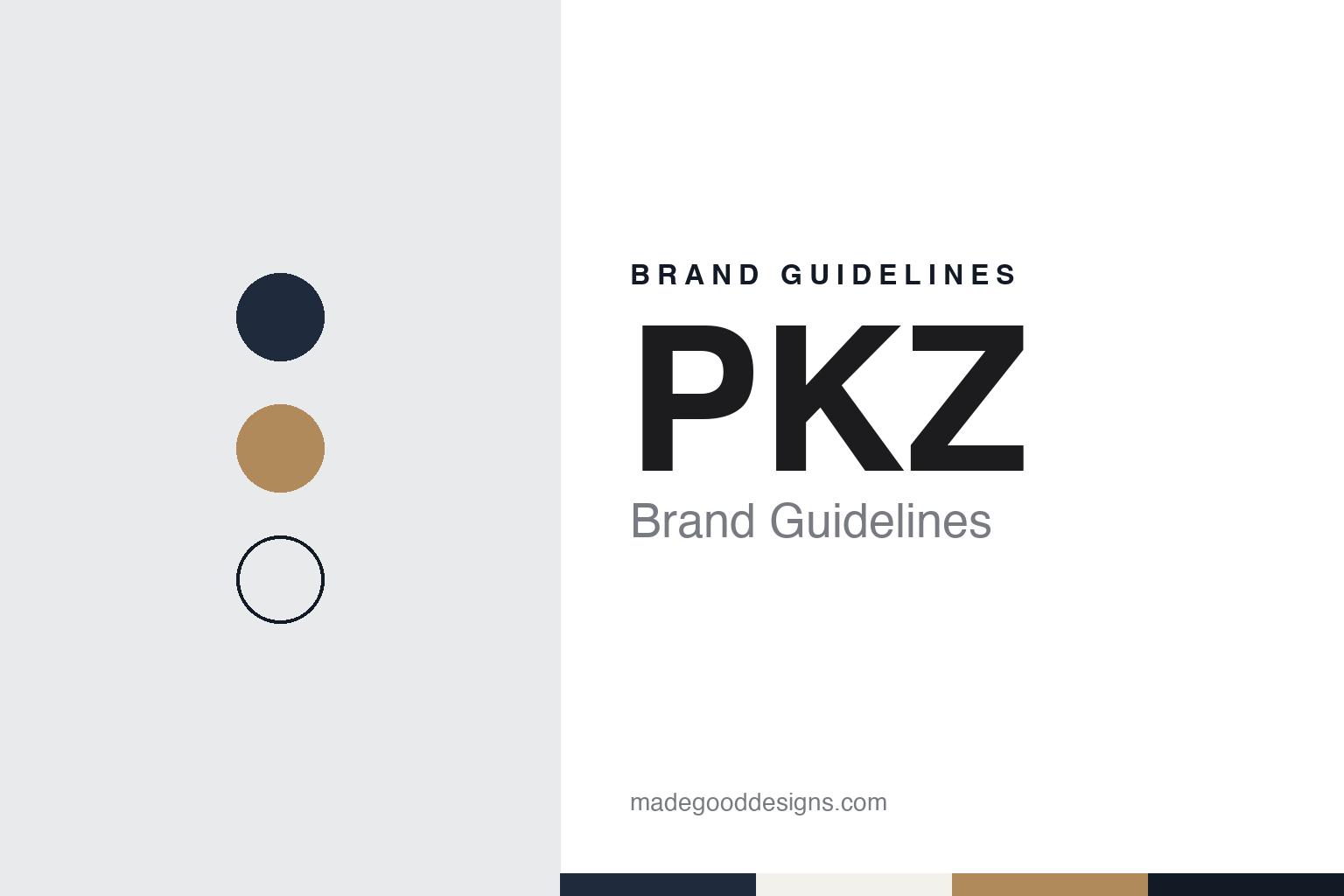
This guide’s PKZ palette is Tailor navy #1F2B3D, Ink #121A26, Camel #B08A5B, Flannel grey #8B8E91 and Shirt white #F5F3EF. The tones are the guide’s own unofficial interpretation, not official PKZ hex codes.
When was PKZ founded?
PKZ was founded in 1881 (clothing factory), in Winterthur, Switzerland.
Who founded PKZ?
PKZ was founded by Paul Kehl in 1881 (clothing factory).