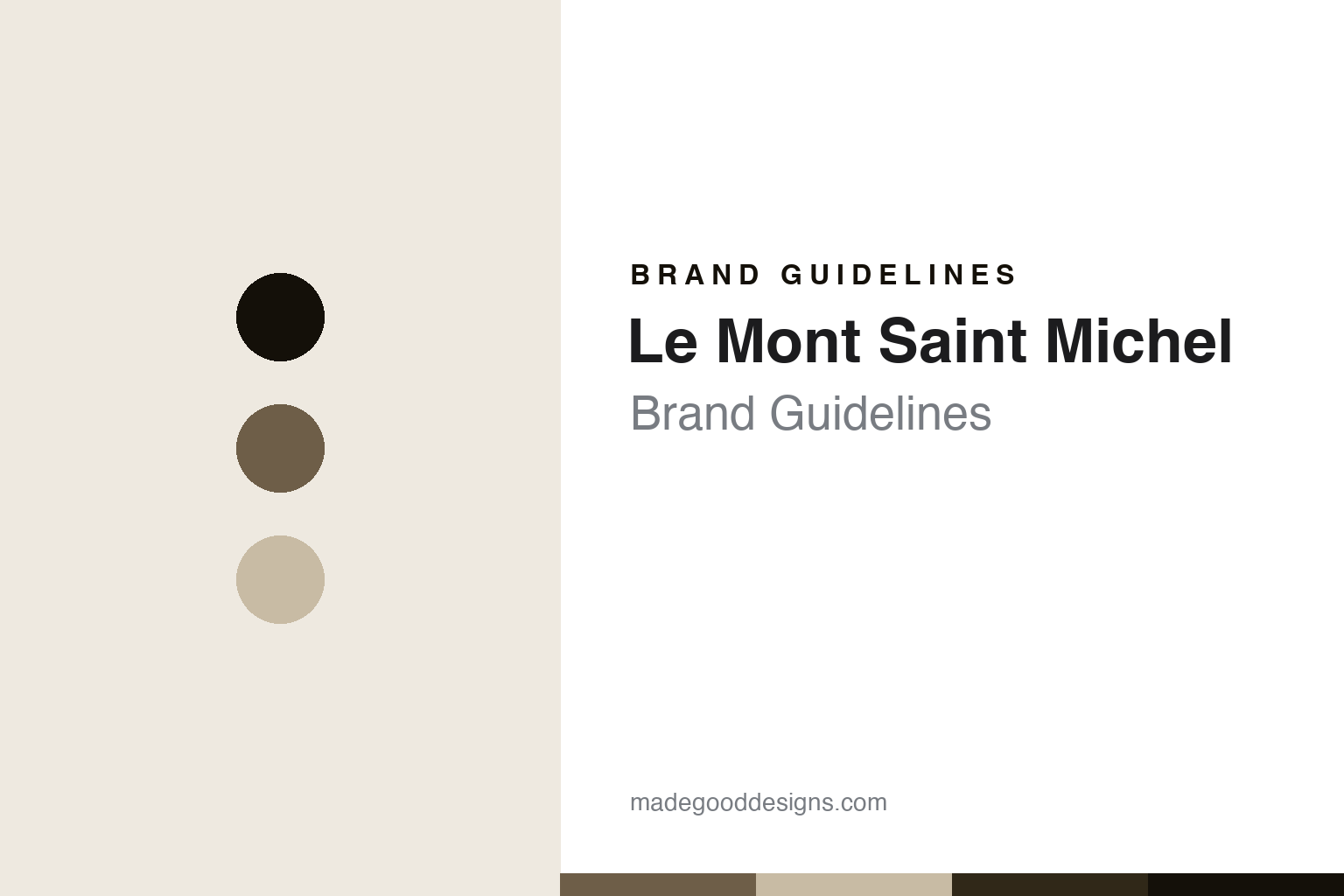
Le Mont Saint Michel Brand Guidelines
The revived moleskin.
Aa
Two constants: a moleskin-taupe palette and an atelier-sans register. Abstract homage — not a Le Mont Saint Michel garment or mark.
The revived moleskin
Le Mont Saint Michel is the French moleskin work-jacket name, dating to 1913 but revived in 1998, with its manufacturing undisclosed.
Le Mont Saint Michel is the round’s revived name — a French work-jacket label carried on the strength of a soft moleskin cloth. From France, Le Mont Saint Michel makes work jackets and workwear-derived clothing in moleskin, serge and gabardine, in the tradition of French labourers’ wear. Its answer to how a maker becomes a name is a fabric and a revival: take a French work-jacket name and its moleskin cloth, and bring them back for a modern audience. A French work jacket, in moleskin, revived.
Its identity is the revived moleskin. Le Mont Saint Michel’s moleskin cloth, its French work-jacket heritage and its honest revival are the work it is known for. A jacket, in moleskin. A 1913 name, brought back.
(Honest notes, so the story stays precise, and two caveats matter. Le Mont Saint Michel — at lemontsaintmichel.fr, with the .com parked — presents a heritage “since 1913,” but this is a revival, not a continuous line: the name was revived and merged into its current form in 1998 by Alexandre Milan, of the Tricotages de l’Aa family, so it is a 1998 revival of a 1913 name rather than a house that has traded without a break. The founding lore itself is contested — the brand tells of the Ariès brothers in Pontorson, while reference sources name a different origin around 1920 — so we attribute the origin rather than assert one version. On what it makes, moleskin, serge and gabardine work jackets and workwear-derived pieces. On where it is made — the crux of this round — this is undisclosed: the brand runs a design studio at Monthorin in Brittany, but that is design, not a stated factory, and we could not verify a country of manufacture, so we do not claim it is made in France. On ownership, it is led by Alexandre Milan, which we present as reported. Its name is that of the famous abbey and UNESCO site, so we reference the name only and use no abbey, island or religious imagery. Its marks are IP, described but never reproduced, and there is no official brand hex; these tones are an unofficial interpretation. This is design commentary and does not promote any product.)
Colour
Le Mont Saint Michel lives in a moleskin-taupe palette. Click a swatch to copy the hex.
Le Mont Saint Michel’s identity is soft, French and revived — a moleskin taupe, an ink, an oat, a deep moleskin, and a paper. The palette leans moleskin and oat: the register of a brushed moleskin cloth and a worn work jacket. It signals French workwear heritage. The honest caveat: with no published brand hex, these values are an original, unofficial interpretation, not first-party colours.
The lesson is a moleskin-taupe palette signals a soft, French-heritage identity. Le Mont Saint Michel’s world is a soft, cotton, French object. For designers, it is a reminder that a warm moleskin taupe and a soft oat can carry a work-jacket name — the grey-brown of moleskin and the neutral of a worn cloth. Because these tones can fail as small text, keep type dark and let the colour live in the accents, palette and band. The takeaways: lead with the cloth; be honest that it is a revival; don’t claim a make you can’t verify; and treat any single hex as unofficial.
Typography
The register is an atelier sans — soft, French, made.
Le Mont Saint Michel’s identity carries a soft, French, considered spirit — a moleskin work-jacket name, not a loud fashion label. An atelier sans captures the mood: quiet, warm and French, the register of a revived workwear house. Set in a moleskin-taupe palette, the atelier sans feels soft and considered — exactly the personality Le Mont Saint Michel carries. It is a fabric heritage rather than a logo, mirroring a moleskin jacket. (Le Mont Saint Michel’s real wordmark, and the abbey its name evokes, are things we describe but never reproduce, and the exact typeface is not ours to use.) Because it is not ours to use, the honest description is “an atelier-sans spirit,” shown here in a stand-in. The type behaves like the cloth: soft, French and considered.
Aa
An atelier-sans spirit — soft and considered. (Specimen set in Manrope, an atelier-sans STAND-IN; NOT the Le Mont Saint Michel logo or any abbey imagery.)
The workwear houses around the world
Le Mont Saint Michel stands for a revived name, made where it does not say.
Le Mont Saint Michel is a lesson in how to read a heritage date, and a silence about the make. A moleskin-taupe palette, an atelier sans and a moleskin jacket make one thing — the revived moleskin — the whole identity: soft, French and revived. The moleskin cloth is the differentiator, and the honesty about the revival is the meaning. The point is a French work-jacket name, genuinely old but brought back in 1998, carried on a soft cloth, with its manufacturing left unsaid.
Put to work, the identity is a revival, read honestly, as design. A maker in this spirit would lead with the cloth and be straight about the dates — moleskin, serge, a 1913 name revived in 1998. A reader in this spirit would ask the round’s two questions and get one clear and one blank. Is the heritage continuous? No: it is a revival, and even the founding lore is contested, so the honest move is to say a 1998 revival of a 1913 name and attribute the origin. Where is it made? Undisclosed: a Brittany design studio is not a stated factory, so a reader should not assume made in France. Le Mont Saint Michel holds the round’s undisclosed pole on the central question, beside the Swedish house, and its revived-versus-continuous thread against the genuine continuity of Private White V.C. The honest editorial moves are to say revival rather than an unbroken line, to attribute the contested origin, to withhold a made-in claim we cannot verify, and to use no abbey imagery. The lesson Le Mont Saint Michel teaches is a reader’s lesson: a heritage date and a country of make are things to verify, not assume. The cloth is the personality, and the honestly-read revival is the proof.
For designers and brand-builders, Le Mont Saint Michel holds the France pole in the workwear houses around the world: lead with the cloth — and be honest about the date and the make. The lessons: build on a real fabric; don’t imply an unbroken line you don’t have; don’t claim a make you can’t verify; separate a name from a place; and never reproduce a logo. It is also a reminder to stay precise: Le Mont Saint Michel is the French moleskin work-jacket name, dating to 1913 but revived in 1998, with its manufacturing undisclosed — with the palette here an unofficial interpretation. Le Mont Saint Michel made a revived cloth the identity — proof that a moleskin jacket, honestly read, can be the difference.
Explore & save
Keep Le Mont Saint Michel’s identity on hand — save it to a board in the Made Good inspiration library.
Le Mont Saint Michel identity set
Pin the moleskin-taupe palette and the atelier-sans register to your own board.