M. Graham Brand Guidelines
Honey and walnut oil.
Aa
Two constants: a honey-amber palette and a small-batch-sans register. Abstract homage — not an M. Graham colour, label or wordmark.
Honey and walnut oil
M. Graham is the independent small-batch Oregon maker whose watercolours are bound with honey and whose oils are ground in walnut oil.
M. Graham is a lesson in how a colour is made distinctive by its binder. From Oregon, this small-batch American maker built its identity on two unusual choices: it binds its watercolours with honey, so they stay moist and re-wet easily even after months, and it grinds its oils in walnut oil rather than linseed. Its answer to how a colour is made is to change the medium, not just the pigment: pick a binder that behaves better, and leave the fillers out. A colour defined by what it is mixed with.
Its identity is the honey-and-walnut-oil maker. M. Graham’s honey watercolours and its walnut-oil oils are the work it is known for. A binder, made the signature. A house that competes on chemistry rather than heritage.
(Honest notes, so the story stays precise. M. Graham & Co. is an independent, small-batch maker in Oregon — its address is in Hubbard, Oregon, and its use of Northwest honey supports genuine local, hand-crafted manufacture; we say “Oregon, USA” rather than pin an exact factory. It was founded in the late 1990s — the company says “about 25 years ago,” so we do not state a precise year — by Arthur “Art” Graham, and its own account credits “two artists,” so we describe it as artist-founded rather than asserting a family-ownership structure it does not publish. Its watercolours use blackberry honey as a natural humectant to stay semi-moist and re-wettable; its oils use pure walnut oil, solvent-free, with no fillers or additives. One honest caveat: walnut oil is not M. Graham’s invention — it has centuries of use in painting — so its distinction is reviving it at scale for a modern line, not originating it. Its name and labels are its IP, described but never reproduced, and there is no official brand hex — these tones are an unofficial interpretation. This is design commentary and does not promote any product.)
Colour
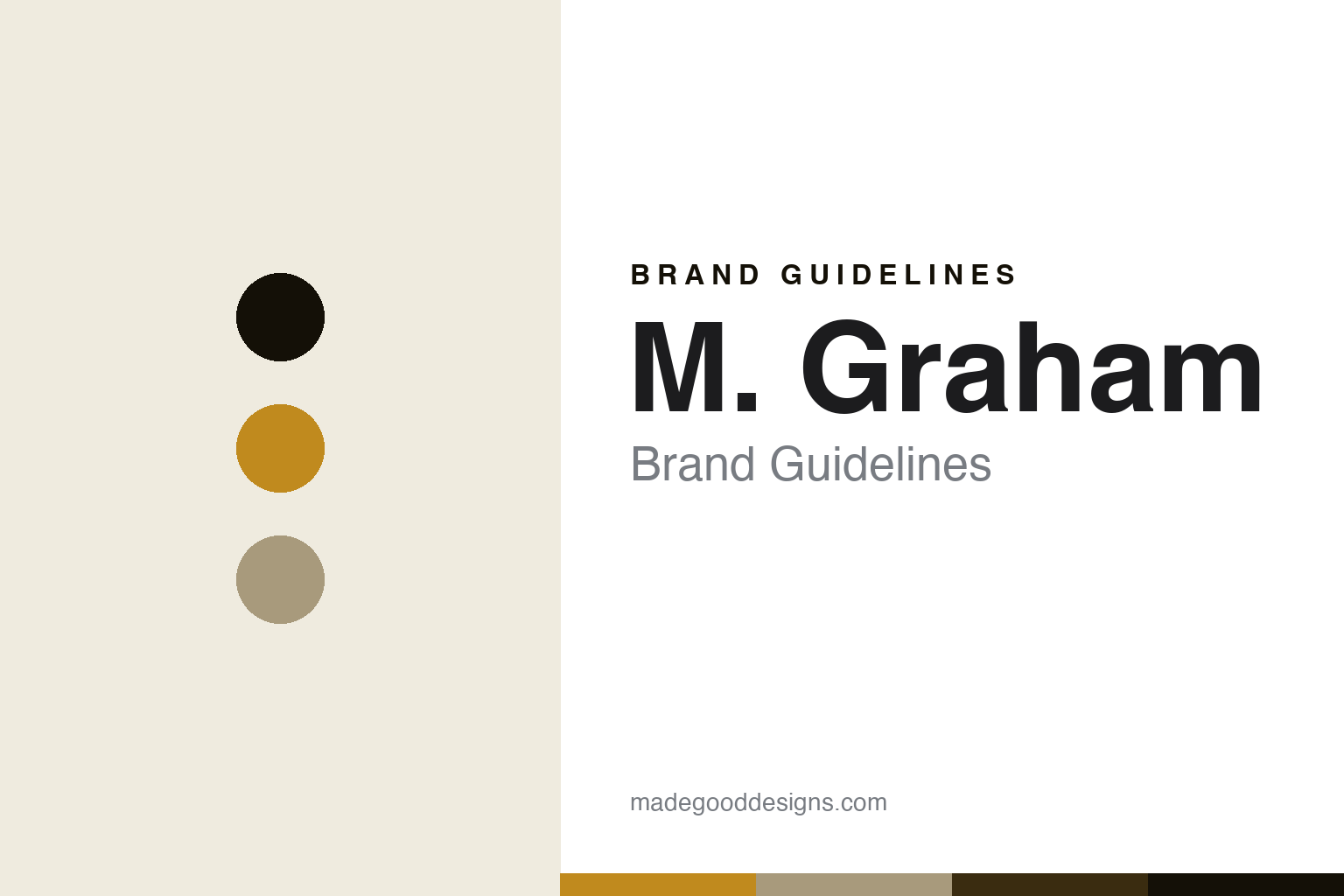
M. Graham lives in a honey-amber palette. Click a swatch to copy the hex.
M. Graham’s identity is warm, natural and considered — a honey amber, an ink, a sand, an umber, and a paper. The palette leans honey amber and sand: the register of a honey binder and a small workshop. It signals craft and chemistry over heritage or flash. The honest caveat: with no published brand hex, these values are an original, unofficial interpretation, not first-party colours — an abstract nod to honey, not a sampled paint.
The lesson is a honey-amber palette signals a binder-first, made-in-Oregon identity. M. Graham’s world is a small-batch, honey-and-walnut, US-made object. For designers, it is a reminder that a warm amber and a soft sand can carry a brand built on what a colour is mixed with — the gold of honey and the neutral of a bench. Because these tones can fail as small text, keep type dark and let the colour live in the accents, palette and band. The takeaways: choose the binder; leave out the fillers; make it small-batch; and treat any single hex as unofficial.
Typography
The register is a small-batch sans — clean, plain, honest.
M. Graham’s identity carries a clean, plain, honest spirit — a small maker, not a heritage marque. A small-batch sans captures the mood: even, unfussy and direct, the register of a workshop that talks about its binders. Set in a honey-amber palette, the small-batch sans feels clean and plain — exactly the personality M. Graham carries. It is honest rather than ornate, mirroring a straightforward, filler-free colour. (M. Graham’s real labels and marks are things we describe but do not reproduce, and the exact typeface is not ours to use.) Because it is not ours to use, the honest description is “a small-batch-sans spirit,” shown here in a stand-in. The type behaves like the maker: clean, plain and honest.
Aa
A small-batch-sans spirit — clean and plain. (Specimen set in Sora, a small-batch-sans STAND-IN; NOT the M. Graham wordmark or any label.)
The colour specialists
M. Graham stands for the colour defined by its binder.
M. Graham is a lesson in how a colour is made a specialty through its medium. A honey-amber palette, a small-batch sans and a honey-bound watercolour make one thing — a colour that behaves differently because of what binds it — the whole maker: warm, natural and considered. The honey binder is the differentiator, and the walnut oil is its twin. The point is a small house that chose two distinctive binders and built an identity on how they perform: watercolours that re-wet after months, oils that resist yellowing.
Put to work, the identity is a chosen difference as design. A colour house in this spirit would pick a specialty — a binder, a method — and make it the whole story, staying small and honest about scale rather than pretending to heritage. It would explain the chemistry plainly, because the difference is real and testable on the palette. A brand learning from it would see that a single well-chosen distinction is a durable identity — that “the honey watercolour that never dries hard” is a specific, memorable promise where a general claim of quality is not — and that being precise, Oregon small-batch, late-1990s, artist-founded, keeps the modest story credible. A brand learning from it would also resist overclaiming the distinction: honey and walnut oil are old ideas, and saying “we revived these at scale” is stronger and truer than implying they were invented here. The lesson M. Graham teaches is that a chosen binder can hold an identity: the honey gives it behaviour, and the walnut oil gives it clarity. The chemistry is the personality, and the re-wettable colour is the proof.
For designers and brand-builders, M. Graham opens this round of the colour specialists from the United States: pick one real difference, and make it the whole story. The lessons: choose the binder; leave out the fillers; stay small and say so; and never reproduce a protected label. It is also a reminder to stay precise: M. Graham is an independent small-batch Oregon maker whose watercolours are bound with honey and whose oils are ground in walnut oil — with the palette here an unofficial interpretation. M. Graham made the binder the identity — proof that one chosen difference can be the difference.
Explore & save
Keep M. Graham’s identity on hand — save it to a board in the Made Good inspiration library.
M. Graham identity set
Pin the honey-amber palette and the small-batch-sans register to your own board.