Marion Post Wolcott photographed the American South, New England and the West for a government agency at the end of the Depression. Her pictures look casual at first, people sitting on porches, waiting in line or crossing a snowy street, but many are built on a firm scaffold of verticals, diagonals and deep shadow. For photographers, art directors and layout designers, Marion Post Wolcott shows how architecture inside a picture can do the work of a grid.
One of her prints is flagged public domain in the museum databases this collection draws on, and it appears below; her other photographs are described in text only. For more public-domain images you can download and study, browse the MGD museum inspiration collection.
Who was Marion Post Wolcott?
She was born Marion Post in Montclair, New Jersey, in 1910, as the Smithsonian American Art Museum (SAAM), the International Center of Photography (ICP) and the Encyclopedia of the Great Plains all record. ICP and the Encyclopedia of the Great Plains say she studied at the New School for Social Research and New York University; ICP and SAAM add the University of Vienna.
The Encyclopedia of the Great Plains says she was introduced to photography on a visit to Vienna in 1933. The entry on her in Women in World History, published on Encyclopedia.com, says the Viennese photographer Trude Fleischmann, who taught her sister Helen, gave her a first small camera. Back in New York, ICP records workshops with Ralph Steiner, and Women in World History names Steiner and Paul Strand as mentors through the Photo League.
SAAM says she began freelancing for the Associated Press in 1935. ICP says she was freelancing for Life, Fortune and other magazines by 1936, and became a staff photographer for the Philadelphia Evening Bulletin in 1937. ICP and Women in World History agree that Paul Strand then introduced her to Roy Stryker, who ran the photographic section of the FSA.
The dates of her FSA work vary by source. ICP gives 1938 to 1942. The Encyclopedia of the Great Plains gives July 1938 to November 1941, and Women in World History says she resigned in February 1942. Both of those sources say she married Lee Wolcott on 6 June 1941; the Encyclopedia of the Great Plains describes him as a Department of Agriculture administrator. SAAM and ICP record that she then largely set photography aside to raise a family, later travelling and teaching abroad, before returning to photography with colour work; ICP dates that return to 1968, in California, and SAAM to 1975. She died in Santa Barbara, California, in 1990, as SAAM and Women in World History record.
Key works by Marion Post Wolcott
The photographs below are dated and placed by the museums that hold prints of them. All are gelatin silver prints.
- Coal miners’ children, Charleston, West Virginia, 1938. The Art Institute of Chicago holds a print of this early FSA picture.
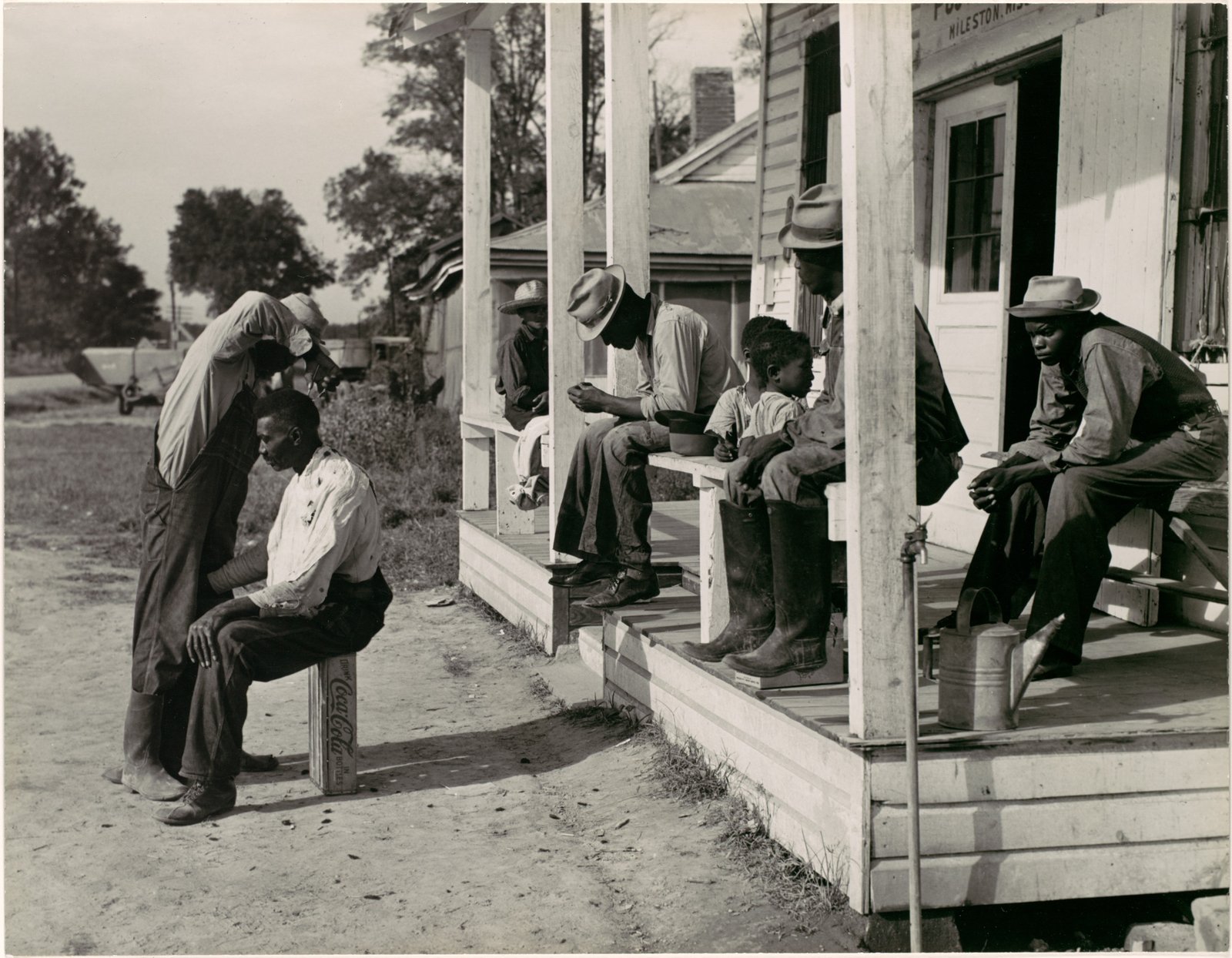
- Haircutting at the Marcella Plantation store and post office, Mileston, Mississippi, 1939. The Metropolitan Museum of Art’s print, about 25 by 32 centimetres, came with the Ford Motor Company Collection in 1987. The Met flags it public domain, and it is the image shown here.
- Movie theatre stairway, Belzoni, Mississippi, 1939. The Art Institute holds a print showing a man climbing an outside stair to a segregated entrance. The Hundred Heroines biography reports that she considered it the truest expression of what she was trying to do.
- Winter visitors and migrant workers, Florida, 1939. The Art Institute holds prints from both sides of the same season: brunch served at a private club in Miami, and migrant pickers playing checkers after a freeze near Homestead.
- Snowy Night, Woodstock, Vermont, 1940. The Met and the Cleveland Museum of Art both hold prints; Cleveland’s was printed about 1975. Neither is flagged public domain.
The Met also holds Satterfield Tobacco Warehouse, Liberty Cafe, Durham, North Carolina, 1939, and the Cleveland Museum of Art holds Sign Along Road to Marcella Plantation, 1939. Neither is flagged public domain, so both are described here only.
What to look at in the Mileston photograph
The picture splits into two zones. On the left, in open sunlight, a standing man cuts the hair of another seated on an upturned soft-drink crate. On the right, the store porch runs back into the frame, and a row of men and a child sit in its shade. The porch edge makes a long diagonal from the lower right toward the centre, carrying the eye from one zone to the other.
White porch posts cut the right half into vertical panels, almost like the columns of a page. Each panel holds one or two figures, so a crowded scene reads as a sequence. The deepest blacks sit under the porch and in the doorway; the lightest tones are the painted posts, the clapboard and the barber’s shirt. A painted sign at the top right names the post office, adding a line of lettering that anchors the place.
Nothing is posed in a line facing the camera. Heads turn in different directions, and the haircut on the left is the one clear action. That gives the picture a focal point while the porch supplies the context, a structure designers will recognise from editorial spreads that pair one strong image with a supporting band.
Technique and approach
The Encyclopedia of the Great Plains, in an entry by the historian F. Jack Hurley, says that in her Plains work of late 1941 she used roads, telephone poles, long trains and grain elevators as compositional devices to convey space and distance. The Mileston porch posts do the same job at close range.
ICP notes that because she joined the FSA late, Stryker often gave her assignments to complete projects begun by others, and that her photographs include wealthy and middle-class subjects as well as the poor people and migrant workers seen in most FSA work. SAAM describes her New England pictures as following Stryker’s documentary formula while merging old and new New England, and says her own social-activist inclination surfaces in her off-duty pictures.
Tones measured from the Mileston print
These values are measured from the Met’s scan of this print, using a six-colour quantisation, and show the warm grey of the gelatin silver image rather than any original pigment:
- Shadow under the porch: #1F221A
- Dark mid-tone: #55504A
- Mid grey: #77736C
- Light mid-tone: #A19E92
- Pale clapboard: #BEBAAE
- Sky and highlights: #DBD2C9
The scale is evenly spaced from dark to light, which is why the print reads clearly at small sizes. A six-step warm grey ramp like this works well for neutral interface colours or a muted print scheme. Test it in the colour palette generator, or sample other scans with the image colour picker.
How designers can borrow from Marion Post Wolcott
- Find the grid in the scene. Posts, window frames and doorways can divide a photograph into panels. When cropping, look for verticals that match your layout columns.
- Split the frame into light and shade. Mileston puts the action in sunlight and the context in shadow. A hero image with one bright zone gives type a calm place to sit on the dark side.
- Use a guiding diagonal. The porch edge carries the eye across the frame. A diagonal rule, road or crop line can guide readers from headline to image.
- Let signage set the scene. The small sign naming the post office tells you where you are without a caption. Found lettering in a photograph can carry place and period.
- Show both sides. ICP stresses that she photographed wealthy visitors as well as migrant workers. Paired images in contrast, side by side on a spread, can tell a story no single picture can.
Marion Post Wolcott and documentary photography
The Hundred Heroines biography describes her as a contemporary of Dorothea Lange, a fellow FSA photographer. Her attention to buildings and signs as evidence of place also invites comparison with Walker Evans, though her scenes are usually more crowded and more casual.
Frequently asked questions
Who was Marion Post Wolcott?
She was an American documentary photographer, born in Montclair, New Jersey, in 1910, who photographed rural America for the Farm Security Administration from 1938 into the early 1940s. She died in Santa Barbara, California, in 1990.
What did she photograph for the FSA?
Farm life and rural communities across the South, New England and the West, according to the Encyclopedia of the Great Plains and Women in World History, including plantation workers in Mississippi, winter visitors and migrant pickers in Florida, and snowy Vermont towns.
Where can I see her photographs?
The Metropolitan Museum of Art, the Art Institute of Chicago and the Cleveland Museum of Art all hold prints of the works named here. ICP also holds her work.
Are her photographs public domain?
It depends on the museum record. The Met flags its print of the Mileston haircut scene as public domain, while the Art Institute of Chicago, the Cleveland Museum of Art and the Met’s other prints named here are not flagged. Check each record before reusing an image.