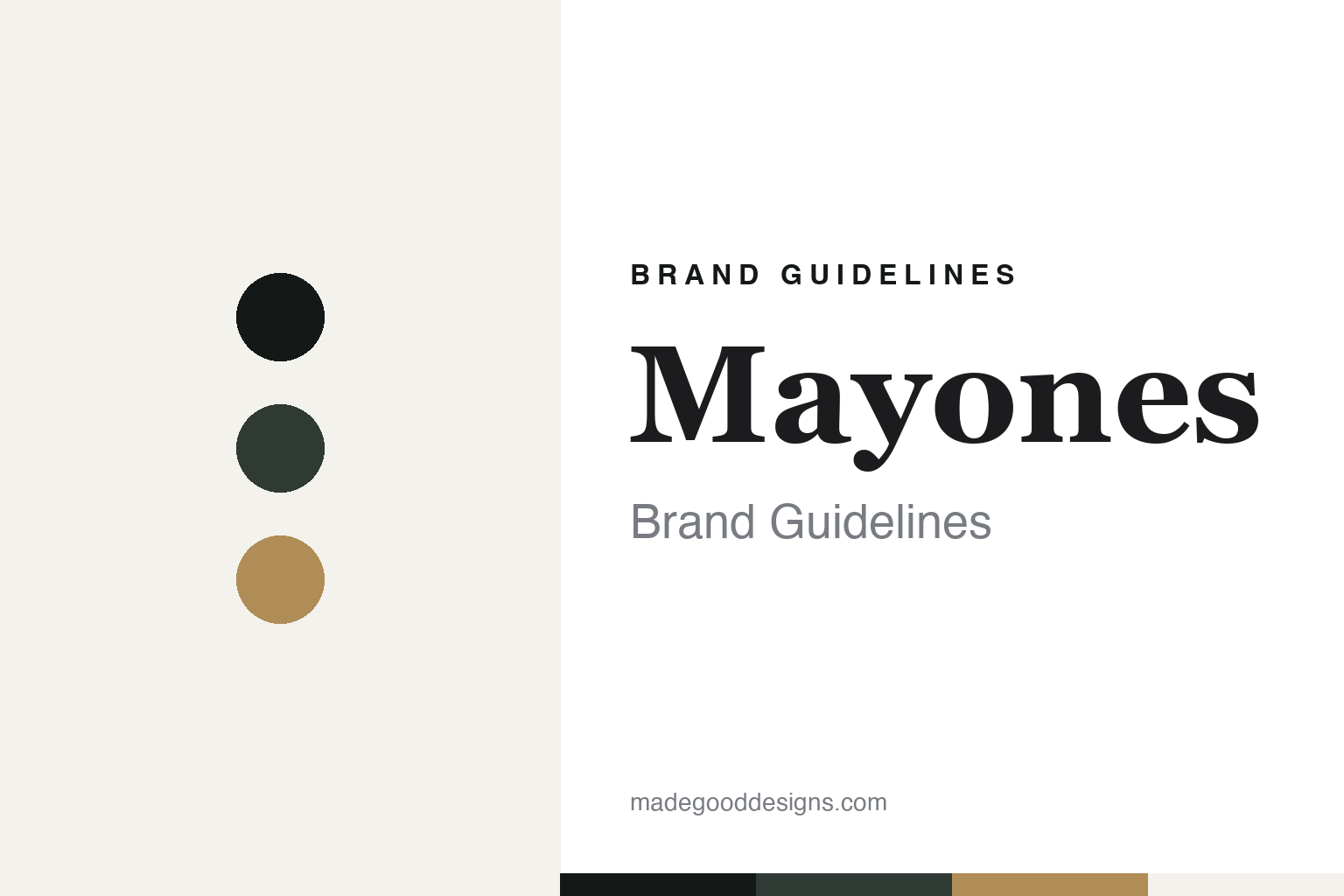
Mayones Brand Guidelines
The Gdańsk family workshop that began in a garage.
Aa
Two constants: a Mayones pine, ink and amber palette and a Classical serif register. Abstract homage — not a Mayones product or mark; no instrument, logo or headstock is reproduced.
A garage in Gdańsk
Two friends, martial law and home-made parts.
Mayones Guitars & Basses comes from Gdańsk, on Poland’s Baltic coast, and dates itself to 1982. Its founder was Zenon Dziewulski: the company’s own timeline captions a 1986 photograph of him at the Poznań music fair as “the founder of Mayones,” and Polish Wikipedia names him as the founder too. The company says it was started “by two friends” and soon became a family business owned by a married couple, Halina and Zenon Dziewulski.
The work began a little before the official date. The company’s timeline shows the first Mayones bass, made in a home garage in 1981, and in a 2019 interview published by the Chicago Music Exchange, a US dealer, their son Dawid Dziewulski said his father had started making the first instruments with a friend in early 1981.
The timing was hard. Poland was under martial law from December 1981 to 1983, and the country sat behind the Iron Curtain. Dawid Dziewulski told the dealer there were no suppliers, so the family had to cooperate with state military companies to get materials; Polish Wikipedia, drawing on the same interview, says they made their own tuners, bridges and pickups. The company’s timeline shows Halina Dziewulska hand-winding Mayones pickups in the mid-1980s, the first Mayones pickups in 1984, the first catalogue the same year, and a first advertisement in 1985.
Polish Wikipedia adds that the firm also made instruments under the name Flame. It says that after the fall of communism the company could improve its products and begin to catch up with makers abroad.
Colour
From Intermedia to Musikmesse and NAMM.
The company’s photo timeline traces how a garage workshop became an exporter. It shows Zenon and Halina Dziewulski at the Intermedia fair in Wrocław in 1992, a production hall in the early 1990s, the first prototype of the Maestro guitar in 1994 and an award at Intermedia for the BE5 bass in 1995. The first Custom Shop basses appear in 1998 and an early Setius guitar in 1999 — the same year, the timeline says, that Paul Reed Smith tried a Mayones guitar at the Musikmesse fair in Frankfurt.
The 2000s brought the Comodous and Patriot basses, a first stand at the NAMM Show in California in 2005, and a first CNC machine in 2006, all according to the timeline. In 2007, it says, a giant Setius stood outside the Hard Rock Cafe in Warsaw, with a wall of more than 700 Mayones bodies inside. In 2011 it records an “Outstanding Bass” award from Bass Gear Magazine at NAMM.
Players followed. The company’s pages and Polish Wikipedia list artists including Wes Borland of Limp Bizkit, Ruud Jolie of Within Temptation and Daniel Gildenlöw of Pain of Salvation; English Wikipedia, which flags its article as promotional, adds names such as Misha Mansoor of Periphery. In 2019 Guitar World interviewed Fit For An Autopsy’s Pat Sheridan about his custom Polish seven-string, and in July 2024 it reported the Jassper Nidra, the first signature guitar for the Polish guitarist Jakub Żytecki.
The family stayed in charge. The Chicago Music Exchange wrote in 2019 that the company was run by Halina Dziewulska and her sons Dawid and Tomasz, with about 40 employees, nearly half of them there for more than 20 years. Guitar World described Dawid Dziewulski in 2024 as co-owner and chief executive.
Typography
Design and documentation.
The seven makers in this guide build electric guitars for rock and metal players, but they are organised in very different ways.
Two belong to Fender. Jackson, founded by Grover Jackson in Glendora, California, in 1980, and Charvel, begun by Wayne Charvel as a repair shop in Azusa in 1974 and sold to Grover Jackson in 1978, have both been owned by Fender since 2002, English Wikipedia says, and it gives Scottsdale, Arizona, as the base of both.
Two are linked through one man. ESP grew from Electric Sound Products, a parts shop that Hisatake Shibuya opened in Tokyo in 1975. In 1987, English Wikipedia says — ESP’s own corporate history gives 1990 — Shibuya bought Schecter, which David Schecter had started as a repair and parts shop in Van Nuys, California, in 1976, and which now gives its custom shop’s home as Sun Valley, Los Angeles; the two have remained separate companies.
Kiesel, in Escondido, California, traces its heritage to the pickup company Lowell Kiesel founded in Southern California in 1946, which became Carvin, and took its present name when it split from Carvin in 2015. Mayones was founded in Gdańsk, Poland, in 1982 by Zenon Dziewulski, Polish Wikipedia says, and is run by the Dziewulski family.
Cort, based in Seoul, is the odd one out: a large share of its output, by its own account, carries other brands’ names, and it makes its guitars in factories it runs in Indonesia and China.
This guide sets out what can be checked about each brand — who founded it, who owns it, and what it says about where its products are made — and marks clearly what rests only on the company’s own word.
Aa
A classical serif — a family workshop on the Baltic. (Specimen set in Cormorant Garamond, a serif STAND-IN; NOT the Mayones logo.)
Mayones
A family workshop on the Baltic.
Mayones makes a strong claim about where its instruments are made: its website says they are “100% hand-crafted in Poland since 1982,” and Dawid Dziewulski told the Chicago Music Exchange they were “100% designed and made in Poland.” Independent reviews list the country of manufacture as Poland — Guitar World’s review of the Jabba 422 bass in September 2020 and MusicRadar’s review of the Federico Malaman Jabba Mala 5 in March 2020 both give “Made in: Poland” — though neither inspected the factory. The company also says that since 2013 every Mayones guitar and bass has been finished on a PLEK machine, the automated fret-dressing system; its own timeline pictures the machine being prepared for work in 2014.
The current range, on the company’s website, includes the Aquila, Duvell, Hydra, Legend, Jassper and Regius guitars and the Caledonius, Cali, Comodous, Jabba, NobleKing, Ori and Patriot basses, with a configurator and thousands of custom options. Dawid Dziewulski told the dealer in 2019 that a build usually took 11 to 15 months, and that the brand’s most recognisable element is its headstock designs. The company publishes a logo page asking that its mark not be distorted or recoloured, and that old Mayones logos no longer be used; it gives no colour values.
For a design guide, Mayones shows how a small maker can build an international name from one city and one family. Compare Strandberg, another European maker of modern guitars, and Kiesel, an American family business built on custom orders. For this guide we use a deep pine green, ink and amber with a serif, an unofficial interpretation; no product or logo is reproduced.
Explore & save
Keep Mayones’s identity on hand — save it to a board in the Made Good inspiration library.
Mayones identity set
Pin the Mayones pine, ink and amber palette and the Classical serif register to your own board.