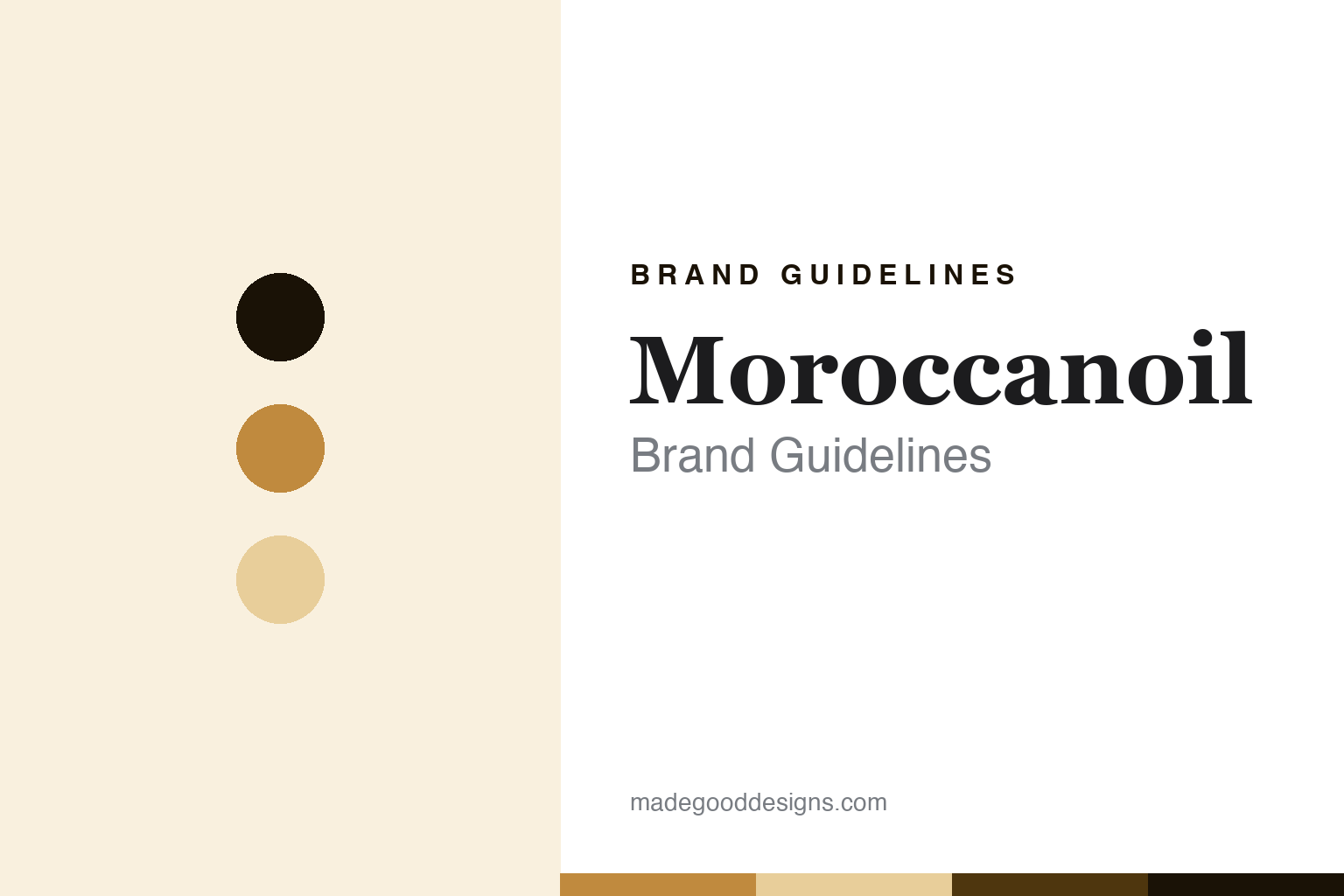
Moroccanoil Brand Guidelines
The argan-oil treatment that made a category.
Aa
Two constants: an amber-gold palette and an argan-oil-serif register. Abstract homage — not a Moroccanoil product or mark; not the turquoise-and-orange identity.
The argan-oil treatment that made a category
Moroccanoil is the argan-oil haircare brand built on one hero treatment — an ingredient-named house.
Moroccanoil brings the round an ingredient hero — the haircare brand built on a single argan-oil treatment, the Moroccanoil Treatment, which the brand credits with popularising an entire category. Moroccanoil makes haircare, and its answer to a round about the hero product is an oil in a bottle: one amber treatment so identified with the brand that the company took its name from the ingredient. A brand, oiled.
Its identity is the argan-oil treatment that made a category. Moroccanoil’s hero, its ingredient name and its geography are the story here. A brand, oiled. The argan-oil treatment that made a category.
(Honest notes, so the story stays precise, and the name stays accurate. Moroccanoil, at moroccanoil.com, makes haircare — shampoos, conditioners, masks, treatments and styling — plus body care and fragrance, its hero the argan-oil Moroccanoil Treatment, and we report its category-creator and efficacy language as the brand’s own marketing, not established fact. The brand as known today dates to around 2008, when Carmen and Ofer Tal renamed an earlier company, founded in 2003 in Tel Aviv by the Sabag brothers, and it is now headquartered in New York. On where it is made, a star theme of this round, the distinction matters: the argan oil is sourced from Morocco, but the finished products are, per reporting, manufactured in Israel, Italy and North America, not in Morocco, so sourcing is not manufacture. On the name, a cultural point: despite it, Moroccanoil is not a Moroccan company; it is an Israeli-founded, New-York-headquartered house named for its Moroccan-sourced ingredient, which we treat neutrally, like any ingredient-origin name. On ownership, it is privately held and independent. Its name and its turquoise-and-orange trade dress are IP we describe but do not reproduce; there is no official brand hex; these tones are an unofficial interpretation.)
Colour
Moroccanoil lives in an amber gold. Click a swatch to copy the hex.
Moroccanoil’s identity is warm, oiled and rich, and our stand-in palette is an amber gold, not the brand’s turquoise-and-orange — an amber gold, an ink, a wheat, a deep amber, and a paper. We choose an amber gold precisely because the turquoise-and-orange look is protected trade dress we do not borrow, and because amber reads as the oil itself. The palette leans amber gold and wheat: a warm register that nods to argan oil. The honest caveat: with no usable brand hex, these values are an original, unofficial interpretation, chosen to stay clear of the trade dress.
The lesson is an amber gold signals an oiled, rich identity — without borrowing the turquoise-and-orange. Moroccanoil’s world is a warm, made object. For designers, it is a reminder that a stand-in amber can evoke an oil while avoiding a brand’s exact identity. Because these tones can fail as small text, keep type dark and let the colour live in the accents, palette and band. The takeaways: lead with a hero; name the ingredient honestly; report claims as marketing; and never borrow the trade dress.
Typography
The register is an argan-oil serif — warm, editorial, rich.
Moroccanoil’s identity carries a warm, editorial, rich spirit — an oil brand, not a fashion. An argan-oil serif captures the mood: warm, editorial and confident, the register of a signature oil. Set in an amber-gold palette, the argan-oil serif feels warm and rich — exactly the personality Moroccanoil carries. It is an ingredient rather than a logo, mirroring an oil and a shine. (Moroccanoil’s real turquoise-and-orange packaging is a thing we describe but do not reproduce, and the exact typeface is not ours to use.) Because it is not ours to use, the honest description is “an argan-oil-serif haircare,” shown here in a stand-in. The type behaves like the brand: warm, editorial and rich.
Aa
An argan-oil-serif haircare — warm and rich. (Specimen set in Playfair Display, an argan-oil-serif STAND-IN; NOT the Moroccanoil logo or its turquoise-and-orange identity.)
The hero product
Moroccanoil stands for the argan-oil treatment that made a category.
Moroccanoil brings the round an ingredient hero. An amber-gold palette, an argan-oil serif and a signature treatment make one thing — the argan-oil treatment that made a category — the whole identity: warm, oiled and rich. The hero is the Treatment, and the ingredient is the name. The point is one amber oil so identified with the brand that the company took the ingredient for its name.
Put to work, the identity is a hero told straight, as design — with the ingredient named honestly and the turquoise-and-orange untouched. A maker in this spirit would lead with a hero, name the ingredient honestly, and report claims as marketing. A reader in this spirit would keep the facts right: Moroccanoil makes haircare built on the argan-oil Treatment; the brand as known dates to around 2008, when Carmen and Ofer Tal renamed a 2003 Tel Aviv company, now headquartered in New York; the argan oil is sourced from Morocco while the products are, per reporting, made in Israel, Italy and North America, not Morocco; despite the name it is not a Moroccan company but an Israeli-founded, ingredient-named house; and it is privately held and independent — and, in this round, the parent of Verb. Moroccanoil anchors the round’s ingredient-and-oil thread with Verb and Amika, and the independent side of the who-owns thread. The honest editorial moves are to date the brand to around 2008, to separate Moroccan sourcing from non-Moroccan manufacture, to treat the name as an ingredient-origin name, and to reproduce none of the trade dress. The lesson Moroccanoil teaches is that one ingredient hero can be a whole identity, and naming the ingredient honestly keeps it credible.
For designers and brand-builders, Moroccanoil continues the hero product: lead with a hero — and name the ingredient honestly. The lessons: let one ingredient hero carry the brand; be precise about sourcing versus manufacture; treat an ingredient-origin name neutrally, without implying a national brand; report category-creator language as your own; and never reproduce a signature colourway. It is also a reminder to stay precise: Moroccanoil is the argan-oil haircare brand built on one hero treatment, an ingredient-named house — with the palette here a deliberate non-brand interpretation. Read that way, Moroccanoil is less a bottle than an oil: one treatment, named. The lesson for a brand is that a hero and honest geography reinforce each other, and separating sourcing from manufacture keeps the story earned. Moroccanoil made the-argan-oil-treatment-that-made-a-category the identity — proof that one ingredient can name a house.
Explore & save
Keep Moroccanoil’s identity on hand — save it to a board in the Made Good inspiration library.
Moroccanoil identity set
Pin the amber-gold palette and the argan-oil-serif register to your own board.