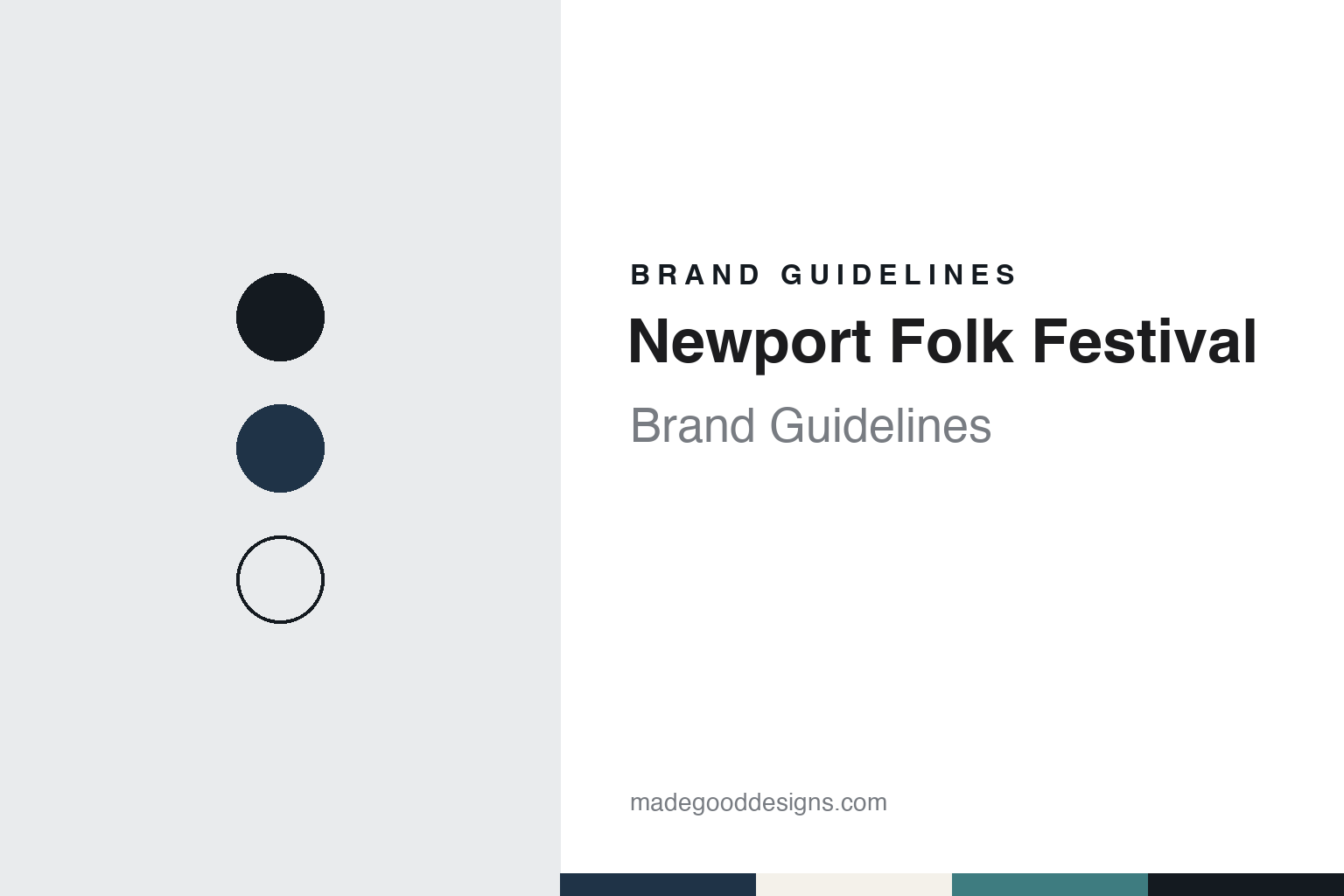
Newport Folk Festival Brand Guidelines
Rhode Island’s folk weekend at Fort Adams since 1959.
Aa
Two constants: a harbour navy, stone and sail white palette and a harbour serif register. Abstract homage — not a Newport Folk Festival poster or mark; no logo, poster or artwork is reproduced.
Newport, 1959
A folk weekend beside a jazz festival.
The Newport Folk Festival began in Newport, Rhode Island, in July 1959. English Wikipedia dates the first edition to 11 July 1959 and describes it as a counterpart to the Newport Jazz Festival, which the promoter George Wein had started in the town five years earlier; PBS NewsHour, reporting from the festival in August 2017, gave the same founding year and the same five-year gap. Wein, who also owned a jazz club in Boston, set up the folk event together with a music manager and several folk singers, English Wikipedia says.
The early festival moved and paused. It was held in 1959 and 1960, did not take place in 1961 or 1962, and then ran every year from 1963 to 1969, according to English Wikipedia. Its first home was Freebody Park in Newport, where it stayed until 1964; from 1965 to 1969 it used Festival Field, a site that has since been built over with apartments. The festival was not held in 1970 and stayed dormant for more than a decade.
The 1959 bill is remembered for an unannounced guest. English Wikipedia says the eighteen-year-old Joan Baez made a surprise debut that year, brought on stage as the guest of another singer, and live recordings of her later Newport sets, from 1963, 1964 and 1965, were issued as an album in 1996. Other albums recorded at the festival in its first decade came from blues and bluegrass players, several of them carrying the Newport name in their titles.
The revival came in 1985. Wein had brought his jazz festival back to Newport in 1981 at a new waterfront site, Fort Adams State Park, and his longtime producer persuaded him to restore the folk weekend there as well, English Wikipedia says. The folk festival has used Fort Adams ever since. The 2020 edition did not take place, and in 2021 the festival was held as two three-day events in July.
Colour
A non-profit, a state park and a July weekend.
Today the festival is run by a non-profit. Its website, read in November 2026, says the Newport Folk Festival is a production of Newport Festivals Foundation, Inc., a 501(c)(3) non-profit corporation, and its pages carry the line “A Newport Festivals Production.” The same foundation produces the Newport Jazz Festival, its website says. English Wikipedia says the folk festival was founded as a not-for-profit, became a for-profit event in the mid-1980s and announced its return to non-profit status under the foundation in 2011; PBS NewsHour described Wein in 2017 as chairman of the foundation, “now set up as a nonprofit.”
The site is a state park on the harbour. In 2018 the State of Rhode Island announced that its Department of Environmental Management, the agency that manages the state’s parks and beaches, had entered a 25-year licence agreement with the foundation that July for the presentation of the jazz and folk festivals at Fort Adams. The festival’s own information pages say there is no camping at the park, and that gates open in the morning with music starting before midday.
The weekend falls in late July. The 2026 edition ran from 24 to 26 July, the festival website says. The festival grew from two days to three in 2013, according to English Wikipedia. PBS NewsHour in 2017 described a three-day event of some 10,000 people spread over four stages; English Wikipedia now names five, among them the Fort Stage facing the harbour, the Harbor Stage, the Quad Stage and a Bike Stage powered by people riding stationary bikes.
The festival’s producer for most of the past two decades has been Jay Sweet. English Wikipedia says Wein hired him in 2008, and PBS NewsHour introduced him as the festival’s executive producer when it reported from Fort Adams in 2017.
Typography
Music festivals in the United States.
Music festivals in the United States usually take their names from somewhere or something particular: a city, a park, an island, a television programme, an idea or a short coined word. Austin City Limits Music Festival borrowed the name of a public-television concert series; Governors Ball kept the name of the island where it began even after it moved. Long names are soon cut down to initials or nicknames — ACL Fest, Gov Ball — and posters, wristbands and websites often pair that short form with a year.
Behind the names stand different kinds of organiser. Some festivals are run by promoters and festival companies, a number of which sit inside larger live-entertainment groups; others are run by non-profit foundations or produced in partnership with park foundations and city departments, which grant the use of public land each year. The organiser is rarely the face of the festival, but its name appears in the small print and in the trade press.
The setting is part of the identity. A festival may fill a city park, a polo ground, a motor speedway, a waterfront or a fairground for one weekend or several, laid out with a number of stages, food areas drawn from local restaurants, art installations and markets, and often a children’s area. When a festival changes venue, the new place name usually joins the dates in the line that sits beside the festival name.
Each year brings a new lineup poster, with headliners set in large type above rows of smaller names, and an edition key visual that changes from year to year. Around these, a steady wordmark, the place and the dates hold the identity together. This guide looks at how each festival handles that balance, using only what dated sources and the festivals’ own pages show.
Aa
A bookish harbour serif for a festival with six decades of programmes. (Specimen set in Libre Caslon Text, a serif STAND-IN; NOT the Newport Folk Festival logo.)
Newport Folk
A line-up told in instalments.
The festival’s identity rests less on a single poster than on the way it releases its line-up. English Wikipedia says that, unlike most festivals, Newport Folk “rolls out” its line-up over the course of the year instead of publishing one poster on one day, and that tickets have tended to sell out before the line-up is announced. PBS NewsHour reported the same in 2017, saying the festival sold out “before anyone knows who’s performing.” Unannounced sets are part of the format: English Wikipedia lists surprise appearances in most years from 2015 to 2022, and a 2015 closing programme, titled 65 Revisited, whose performers were kept secret until it began.
The festival also tells its own story. Its website runs a series called Folktales, with pieces dated from November 2023 onwards on subjects such as how the first festival came about and a 1964 gathering of blues musicians at Newport. Broadcast has been part of the picture for two decades: the radio station WMVY began streaming the festival in 2005 and NPR Music joined it in 2008, English Wikipedia says.
The setting carries much of the visual weight. English Wikipedia describes the Fort Stage looking out over Newport harbour and the Claiborne Pell Bridge, and PBS NewsHour in 2017 described “three days of sun and wind, sailboats and seagulls” on a spit of land in Narragansett Bay. The festival’s name, town and month have stayed the same since 1959, while its venue, organiser and length have changed.
For a design guide, Newport Folk Festival shows how a festival can keep its name, its town and its month for more than six decades while much around them changes. Compare its sister event, the Newport Jazz Festival, and the Monterey Jazz Festival, another long-running American festival tied to its place. For this guide we use a harbour navy, a weathered stone and a sail white with a serif, an unofficial interpretation; no product or logo is reproduced.
Explore & save
Keep Newport Folk Festival’s identity on hand — save it to a board in the Made Good inspiration library.
Newport Folk Festival identity set
Pin the Newport Folk Festival harbour navy, stone and sail white palette and the harbour serif register to your own board.
Source & notes
Frequently Asked Questions
What font can I use to match the Newport Folk Festival look?
This guide describes Newport Folk Festival’s type as “A bookish harbour serif for a festival with six decades of programmes”. Its type specimen is set in Libre Caslon Text from Google Fonts as a stand-in; Libre Caslon Text is not Newport Folk Festival’s own lettering.
What colours are in the Newport Folk Festival palette?
This guide’s Newport Folk Festival palette is Harbour navy #1F3347, Fort stone #B9AE9C, Sail white #F4F1EA, Bay teal #3E7C80 and Ink #141A20. The tones are the guide’s own unofficial interpretation, not official Newport Folk Festival hex codes.
When was Newport Folk Festival founded?
Newport Folk Festival was founded in 1959, in Newport, Rhode Island.
Who founded Newport Folk Festival?
Newport Folk Festival was founded by George Wein in 1959.