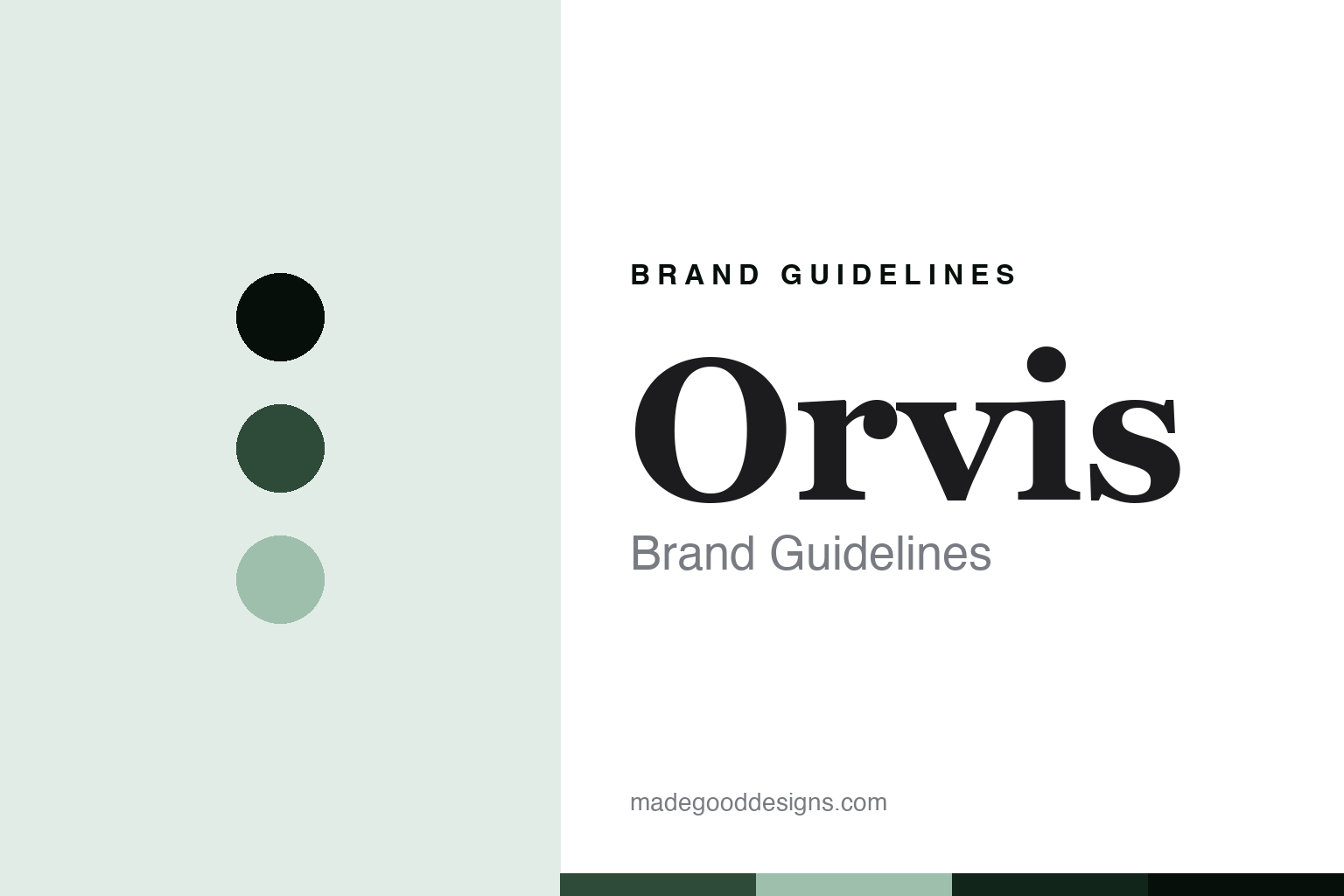
Orvis Brand Guidelines
American fly rods since 1856.
Aa
Two constants: a river-green palette and a heritage-serif register. Abstract homage — not an Orvis product or mark.
American fly rods since 1856
Orvis is the American fly-fishing house of 1856, family-owned, building its fly rods in Manchester, Vermont.
Orvis opens the round as its elder — the oldest name in American fly fishing, and one of the oldest mail-order houses in the country. Orvis makes fly rods and reels, flies and fly-fishing gear, alongside a broad outdoor and dog business. Its answer to how a maker becomes a name is heritage plus a home rod shop: hold a fly-fishing lineage from 1856 and build the rods in Vermont, where the company began. A fly rod, made in Vermont.
Its identity is American fly rods since 1856. Orvis’ fly rods, its Vermont rod shop and its family ownership are the work it is known for. A rod, made in the USA. American fly rods since 1856.
(Honest notes, so the story stays precise. Orvis — the Orvis Company, at orvis.com — makes fly rods such as its Helios line, reels including the Battenkill and the milestone CFO of 1972, flies and fly-fishing gear, plus a wide outdoor, apparel and dog business. It was founded in 1856 by Charles F. Orvis in Manchester, Vermont, and is described as the oldest mail-order retailer in the United States. On where it is made — a theme of this round — Orvis builds its fly rods in the USA, at the Manchester, Vermont rod shop, a genuine heritage strength; the honest limit is that “made in USA” applies to the rods, while much of the apparel and some tackle is imported, so we do not claim the whole catalogue is American-made. On ownership, it is family-owned, by the Perkins family since 1965, led today by Simon Perkins, a third-generation chief executive; and we note honestly that Orvis ended its long-running print catalogue in 2024 and has been reducing its store count. It gives five per cent of pre-tax profits to conservation. Its name and marks are IP, described but never reproduced, and there is no official brand hex; these tones are an unofficial interpretation. This is design commentary and does not promote any product.)
Colour
Orvis lives in a river-green palette. Click a swatch to copy the hex.
Orvis’ identity is heritage, made and outdoorsy — a river green, an ink, a sage, a deep green, and a paper. The palette leans river green and sage: the register of trout water and a Vermont rod shop. It signals a heritage fly-fishing house. The honest caveat: with no published brand hex, these values are an original, unofficial interpretation, not first-party colours.
The lesson is a river-green palette signals a heritage, made-in-Vermont identity. Orvis’ world is a heritage, outdoor object. For designers, it is a reminder that a deep river green and a soft sage can carry a fly-fishing house — the colour of the water it fishes. Because these tones can fail as small text, keep type dark and let the colour live in the accents, palette and band. The takeaways: hold a lineage; build the rods at home; be honest about imported lines; and treat any single hex as unofficial.
Typography
The register is a heritage serif — storied, made, outdoorsy.
Orvis’ identity carries a storied, made, outdoorsy spirit — a 170-year house, not a newcomer. A heritage serif captures the mood: traditional, warm and American, the register of the oldest name in fly fishing. Set in a river-green palette, the heritage serif feels storied and made — exactly the personality Orvis carries. It is a lineage plus a rod shop rather than a logo, mirroring a rod built in Vermont. (Orvis’ real wordmark, and its product names, are things we describe but do not reproduce, and the exact typeface is not ours to use.) Because it is not ours to use, the honest description is “a heritage-serif spirit,” shown here in a stand-in. The type behaves like the house: storied, made and outdoorsy.
Aa
A heritage-serif spirit — storied and made. (Specimen set in Cormorant Garamond, a heritage-serif STAND-IN; NOT the Orvis logo.)
The tackle makers
Orvis stands for American fly rods since 1856.
Orvis opens the round as its elder. A river-green palette, a heritage serif and a Vermont rod shop make one thing — American fly rods since 1856 — the whole identity: heritage, made and outdoorsy. The Vermont-built rods are the differentiator, and the 170-year lineage is the meaning. The point is the oldest name in American fly fishing, still family-owned, still building rods where it began.
Put to work, the identity is heritage plus a home rod shop, told straight, as design. A maker in this spirit would hold a lineage and build the rods at home — fly rods, in Vermont. A reader in this spirit would keep the honest limits: “made in USA” applies to the rods, while much of the apparel and some tackle is imported; and the print catalogue ended in 2024 as the company downsized its stores. Orvis opens the round’s heritage thread as its oldest house, its where-made thread at the made-at-home end with Sage, Islander and Hardy’s reels, and its who-owns-it thread at the family end with Islander and Vision. The honest editorial moves are to date the founding to 1856, to confine the made-in-USA claim to the rods, and to keep the Perkins family ownership current. The lesson Orvis teaches is that heritage plus a rod shop can hold an identity: the Vermont making gives it substance, and 170 years keep it credible.
For designers and brand-builders, Orvis opens the tackle makers: hold a lineage — and build the rods at home. The lessons: carry a heritage; make the core product in-country; be honest about imported lines; keep the family ownership current; and never reproduce a logo. It is also a reminder to stay precise: Orvis is the American fly-fishing house of 1856, family-owned, building its fly rods in Manchester, Vermont — with the palette here an unofficial interpretation. Read that way, Orvis is less a catalogue than a Vermont rod shop with a 170-year memory: a family that still builds the rod where Charles Orvis started, and tells you honestly what it imports. Orvis made American-fly-rods-since-1856 the identity — proof that a rod, honestly made, can be the difference.
Explore & save
Keep Orvis’s identity on hand — save it to a board in the Made Good inspiration library.
Orvis identity set
Pin the river-green palette and the heritage-serif register to your own board.