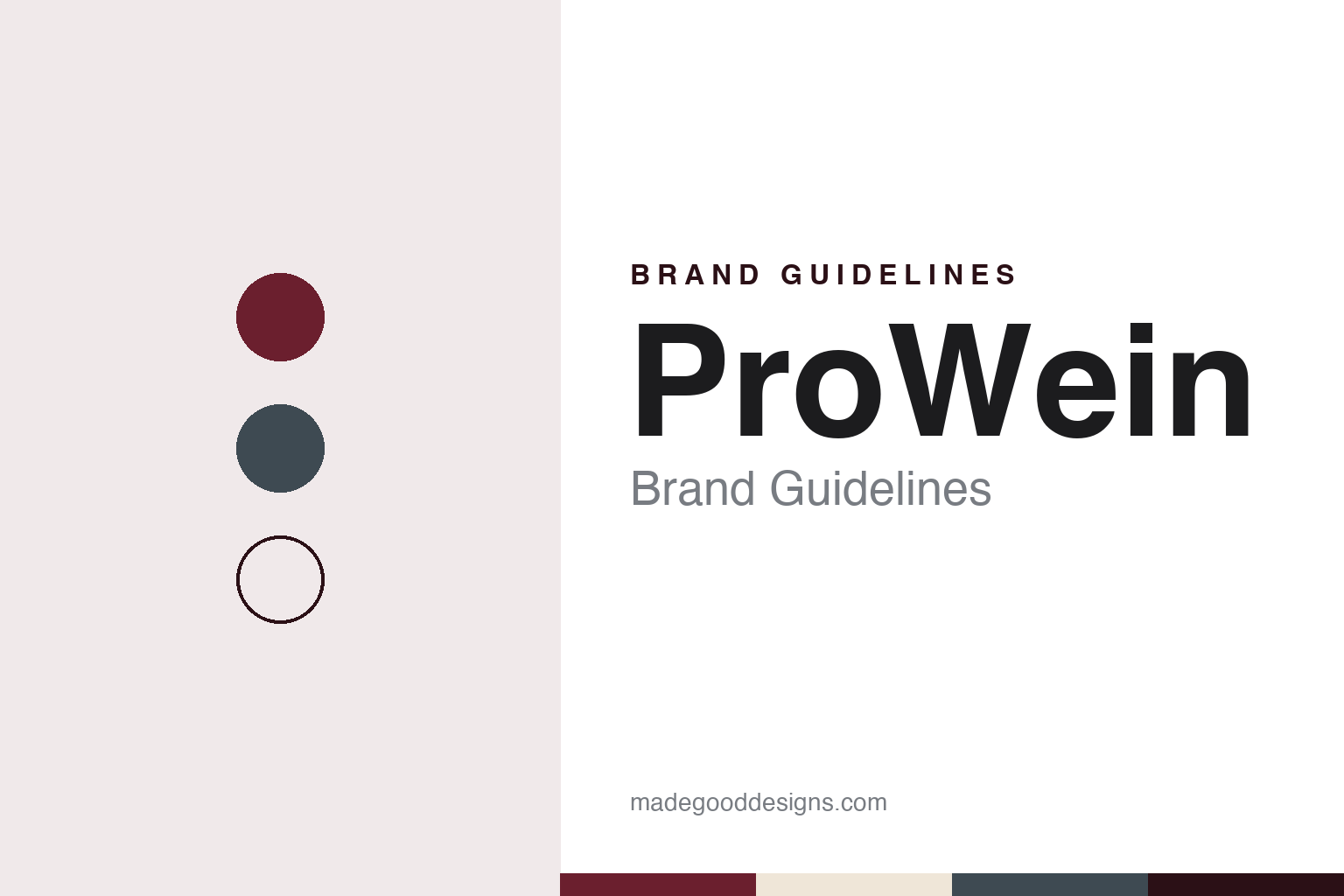
ProWein Brand Guidelines
The Düsseldorf wine and spirits fair that began as ProVins.
Aa
Two constants: a ProWein claret, slate and cream palette and a Trade-fair sans register. Abstract homage — not a ProWein product or mark; no logo, key visual or signage is reproduced.
ProVins
A French name and a single hall.
ProWein began in Düsseldorf in February 1994, under a French name, ProVins. The Buyer, writing for the fair’s 25th edition in March 2019, reported that 321 exhibitors took part in that opening show, all of them fitting into a single hall of the city’s exhibition centre. They came from Germany, France, Greece, Italy, Austria, Portugal, Spain and Hungary, with Colombia the only country from outside Europe, and only about 250 visitors came from abroad, most of them from France. The German hospitality title Tageskarte, writing for the same anniversary in 2019, gave the opening figures as 321 suppliers of wine, sparkling wine and spirits from nine countries, one hall and 1,517 visitors.
The organiser then and now is Messe Düsseldorf, the city’s trade-fair company. German Wikipedia describes it as running ProWein with the aim of giving an international overview of wine, and records the fair as held in Düsseldorf each March since 1994. The Deutsches Weininstitut, the German wine sector’s promotion body, is named as the fair’s honorary sponsor — in German, its ideeller Träger — in a report by the hospitality site Hogapage in May 2022.
The name changed in 1997. That year, The Buyer reported, ProVins became ProWein, swapping the French word for wines for the German Wein, and a logo was introduced that the magazine said was still in use in 2019. The 1997 edition was also the one that passed 1,000 exhibitors, with 25 countries represented. The German winegrowers’ association VDP, in a retrospective on its own website, dates its own stand at the fair to the same year: a 12-square-metre system booth booked as a trial. By 2014, the association says, 141 of its members were showing together on 1,300 square metres, and from 2008 it took part in ProWein goes City, the fair’s evening programme in town.
Colour
March in Düsseldorf.
The fair settled into a March slot. German Wikipedia records editions on 24–26 March 2013, 23–25 March 2014, 15–17 March 2015 and 10–12 March 2024, each over three days, and lists the organiser’s figures: 3,395 exhibitors from 51 countries and 36,417 visitors in 2010, and 6,615 exhibitors from 60 countries and 58,502 visitors in 2017. By 2019, The Buyer reported, the fair filled 16 halls with nearly 6,500 exhibitors from 67 countries and recorded 61,500 visitors from 142 countries; it noted that only 14 per cent of visitors had come from outside Germany as recently as 2002, against 54 per cent in 2019. That anniversary edition ran from 17 to 19 March, Tageskarte reported.
Exhibitors are grouped in the halls by country. Tageskarte described almost every wine-growing region as represented and placed in the halls by nation in 2019, alongside about 400 spirits suppliers and a Champagne Lounge for about 50 Champagne houses.
After a break of three years, the fair returned from 15 to 17 May 2022, in May rather than March. Hogapage reported about 5,700 exhibitors from 62 countries in 13 halls and more than 38,000 trade visitors from 145 countries, and noted a new hall concept. The fair went back to March in 2023, with an edition on 19–21 March.
The organiser’s figures for 2026, published after the fair of 15–17 March, were 3,400 exhibitors from 63 nations and 31,000 trade visitors from 105 countries. Messe Düsseldorf described that edition as part of a “strategic reorientation,” with a hall concept of clear segments and shorter distances. It named Frank Schindler as director of ProWein since October 2025 and quoted Marius Berlemann, chief operating officer of Messe Düsseldorf. The spirits section, ProSpirits, filled two halls with about 500 exhibitors from 50 countries, the organiser said, and a city programme, ProWein City Vibes, staged 64 events around Düsseldorf.
Typography
Design and documentation.
Food and wine trade fairs tend to present themselves through a short name. Some are acronyms built from a longer title, such as SIAL, from the French Salon International de l’Alimentation, or Anuga, from the German words for a general food and luxury-goods exhibition. Others pair a word with a country or a city, as FOODEX JAPAN does, and many editions are announced simply as the name followed by the year.
Most of these fairs are business events rather than public shows. Their halls are aimed at producers, importers, wholesalers, retail buyers and caterers, and admission usually depends on trade registration. German Wikipedia says Anuga dropped its last public day in 1975, and FOODEX JAPAN’s organiser says entry is limited to people from the trade.
Behind each fair stands an organiser of a particular kind: an exhibition company, a trade association, a group of producer or hospitality bodies, or a fair company owned by a city or region. Halls are often arranged in two ways at once, by product area and by country, with national pavilions placed beside sector halls for drinks, dairy, frozen food or fine food. Some fairs have grown into networks of sister events abroad under the same name.
The visual side usually follows the same pattern. A wordmark is kept from one edition to the next, while the key visual, the poster image and the colour of the year can change with each edition. For a design guide, that combination of a steady name and a changing seasonal look offers a clear pattern to study, and the colours and type in these guides are our own interpretation rather than official assets.
Aa
A trade-fair sans — ProWein, a name kept since 1997. (Specimen set in Archivo, a sans STAND-IN; NOT the ProWein logo.)
ProWein
One root, two spellings.
The fair now presents itself as the “International Trade Fair for Wines and Spirits.” Its website, viewed in November 2026, divides the offer into wines, sparkling wines, ProSpirits, no- and low-alcohol wine, accessories, hardware and software, trade literature, services, mineral water, bulk wine and white label. Named zones sit inside the halls: Sparkling Visions; ProWein Zero+, for no- and low-alcohol drinks; the ProWein Agora talk stage; a Champagne Lounge; Organic Visions, which the organiser describes as covering organic wines, certifications and specialised producers; and a Discovery Zone for owner-operated producers showing to an international trade audience in Düsseldorf for the first time.
The name has also travelled, with one letter changed. Messe Düsseldorf’s sister events abroad are styled ProWine, in English. German Wikipedia records ProWine China in Shanghai and ProWine Asia in Singapore and Hong Kong from 2015, with ProWine Asia held in Singapore from 24 to 27 April 2018. The ProWein World website, viewed in November 2026, lists ProWine Shanghai, ProWine Hong Kong, ProWine Singapore, ProWine São Paulo, ProWine Mumbai and ProWine Tokyo. For designers the pattern is plain to see: one wordmark root, a German form for the home fair and an English form for the editions abroad.
For a design guide, ProWein shows how a trade fair can keep one logo for more than twenty years, by The Buyer’s account, while its halls, zones and sister events multiply around it. Compare Messe Düsseldorf, the exhibition company behind it, and Vinitaly, the Verona wine fair held each April. For this guide we use a deep claret, a slate and a warm cream with a sans, an unofficial interpretation; no product or logo is reproduced.
Explore & save
Keep ProWein’s identity on hand — save it to a board in the Made Good inspiration library.
ProWein identity set
Pin the ProWein claret, slate and cream palette and the Trade-fair sans register to your own board.
Source & notes
Frequently Asked Questions
What font can I use to match the ProWein look?
This guide describes ProWein’s type as “A trade-fair sans — ProWein, a name kept since 1997”. Its type specimen is set in Archivo from Google Fonts as a stand-in; Archivo is not ProWein’s own lettering.
What colours are in the ProWein palette?
This guide’s ProWein palette is Claret #6B1F2E, Cellar ink #2B1016, Slate #3E4A52, Cork cream #EFE6D8 and Paper #F8F6F2. The tones are the guide’s own unofficial interpretation, not official ProWein hex codes.
When was ProWein founded?
ProWein was founded in 1994 (as ProVins), in Düsseldorf, Germany.