Raspberry Pi Brand Guidelines
A tiny $35 computer with a raspberry for a logo — a UK charity’s bid to get a generation coding again.
Aa
Two constants: a raspberry-red-and-green palette and a friendly rounded sans. Abstract homage — not the Raspberry Pi fruit logo.
The $35 computer
Raspberry Pi set out to teach a generation to code.
Raspberry Pi is a lesson in a mission-driven product that changed a category. It comes from the Raspberry Pi Foundation, a UK educational charity based in Cambridge, England, conceived around 2008 and registered as a charity in 2009 by six founders including Eben Upton (the primary visionary and now CEO). Upton, then a Cambridge computer-science director of studies, was reacting to a decline in programming skills among applicants. The first board launched in February 2012. (Honest caveats: no official brand hex is published on the trademark page, so the colours below are observed; and the wordmark typeface is undocumented.)
The mission was clear and radical: build a tiny, cheap computer — targeted at around $35 (some models near $25) — to revive hands-on computer-science teaching and inspire kids to code and tinker, explicitly modelled on the 1980s BBC Micro that Upton grew up with. It worked spectacularly: tens of millions of boards (over 60 million by 2022) have sold, beloved not just by schools but by makers, hobbyists and industry worldwide. (Two myths to avoid: it’s not an Apple/US product — it’s British — and “Pi” refers to Python, the programming language, not to π the number.)
The structure is worth understanding: the Raspberry Pi Foundation (the charity, focused on education) and Raspberry Pi Ltd (the commercial arm that makes the hardware), with Raspberry Pi Holdings listing on the London Stock Exchange in 2024 (the Foundation remaining the majority owner). The product line runs from the Pi 1 to the Pi 5, the low-cost Pi Zero, and the Pico microcontroller. The identity is charming: a stylised raspberry fruit — clustered red circles with a white highlight, topped by green leaves. A little computer with a big purpose.
Colour
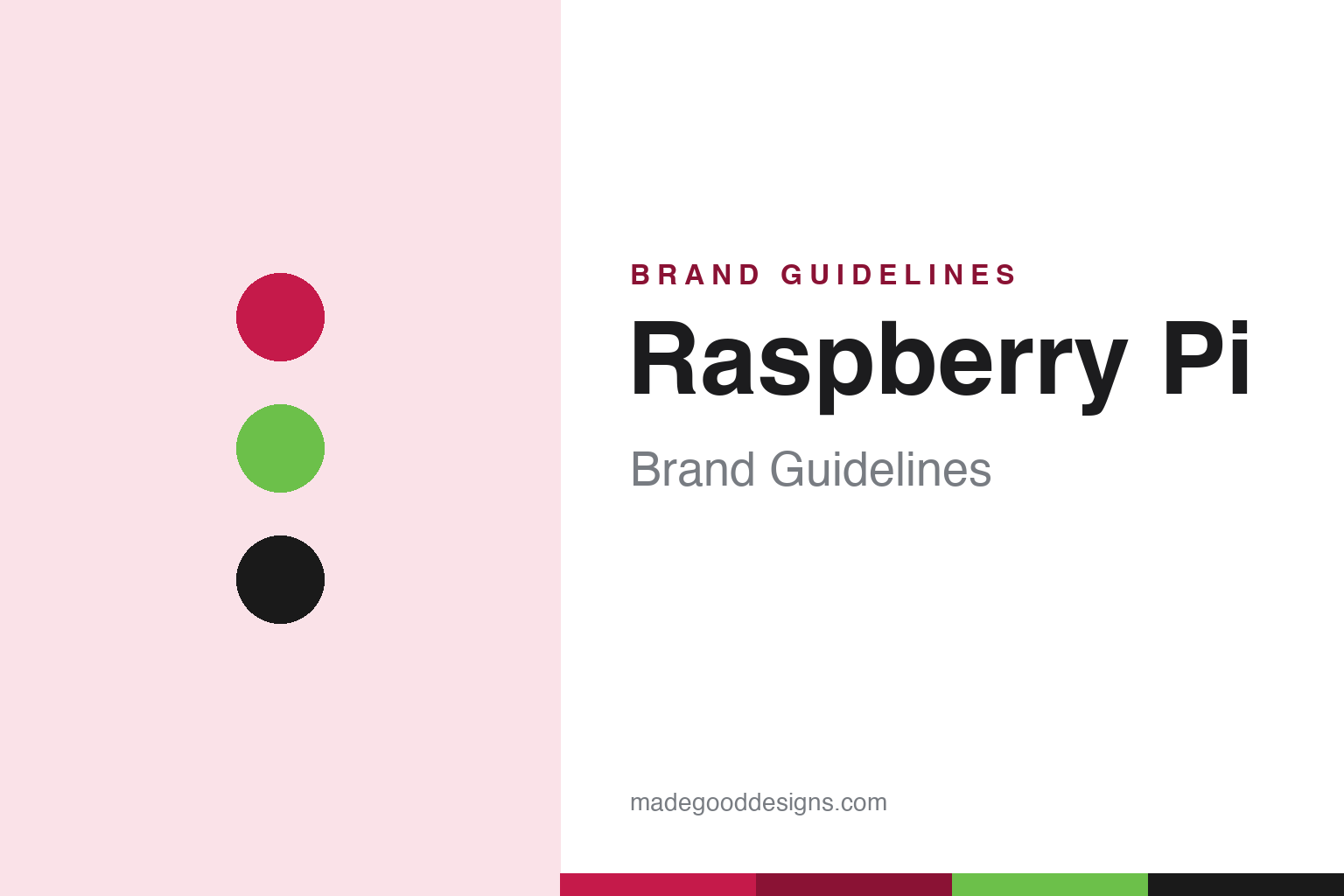
Raspberry Pi lives in raspberry red and green. Click a swatch to copy the hex.
Raspberry Pi’s palette is literal and lovable: raspberry red (the fruit’s body) and leaf green (its leaves), with black and white. The red reads as warm, friendly and approachable, while the green adds a fresh, natural, playful note — together they feel welcoming and un-intimidating, exactly right for a product meant to invite kids and beginners into computing. It’s a cheerful, distinctive scheme that stands apart from the cold blues and greys of most tech, matching the brand’s friendly, educational mission. The honest caveat: Raspberry Pi publishes no official brand hex on its trademark page — the red (community-cited near #C51A4A) and green (near #6CC04A) here are observed approximations.
The lesson is a friendly, literal palette lowers the barrier. Raspberry Pi’s red-and-green (from the fruit) feels warm and approachable, inviting beginners in. For designers, it’s a reminder that a friendly, human palette can make intimidating subjects (like coding) feel accessible. The takeaways: choose warm, welcoming colours to lower the barrier to entry (the raspberry red and green); tie the palette to a memorable idea (the fruit); and treat specific hexes as approximate when no official spec is published.
Typography
The wordmark is a friendly rounded sans — approachable and educational.
Raspberry Pi’s identity leans on a friendly, approachable feel — a rounded sans paired with the charming raspberry-fruit logo (clustered red circles with white highlights and green leaves). The soft, rounded letterforms read as warm, welcoming and beginner-friendly, matching a charity whose whole purpose is to invite kids and newcomers into coding, and the fruit logo makes the brand playful and memorable rather than intimidating. (There’s wit in the name too: “Pi” is for Python, following a tradition of fruit-named computers like Apple and Acorn.) The identity feels human and encouraging — exactly the “anyone can learn this” personality the brand wants. (Because the exact wordmark face is undocumented, the honest description is “a rounded sans,” not a named font.) The type behaves like the brand: friendly, approachable and educational.
Aa
A friendly rounded sans — approachable and educational. (Specimen set in Baloo 2, a rounded sans in the spirit of the Raspberry Pi identity; the real wordmark face is undocumented.)
A mission that scaled
Raspberry Pi reached far beyond the classroom.
Raspberry Pi is a lesson in a focused charitable mission creating a runaway product. The goal was narrow and idealistic — get more kids coding, cheaply — but by nailing a genuinely useful, genuinely affordable little computer, Raspberry Pi reached far beyond classrooms into the hands of makers, hobbyists, artists and engineers worldwide, selling tens of millions and spawning a global community. The friendly identity (the fruit logo, the warm palette, the approachable tone) kept it feeling welcoming to newcomers even as it became serious industrial hardware. And the charity-plus-company structure let it fund its educational mission from commercial success. It’s proof that a clear, human mission can produce both social impact and a beloved brand.
For designers and brand-builders, Raspberry Pi offers a clear takeaway: a focused mission plus a friendly, approachable identity can turn an idealistic project into a global brand. The lessons: solve a real problem cheaply and well (the ~$35 computer); keep the identity warm and welcoming to lower barriers (the fruit logo, red-and-green); and let structure serve the mission (charity + commercial arm). It’s also a reminder to keep the facts precise — Raspberry Pi comes from a UK education charity (the Raspberry Pi Foundation, Cambridge) founded around 2008–2009 by Eben Upton and others, launched its first ~$35 board in February 2012 (inspired by the BBC Micro), sold tens of millions, is structured as the Foundation plus Raspberry Pi Ltd (LSE-listed 2024), and uses a raspberry-fruit logo (“Pi” for Python). Raspberry Pi’s mission scaled — proof that a human purpose can build both impact and a brand.
Explore & save
Keep Raspberry Pi’s identity on hand — save it to a board in the Made Good inspiration library.
Raspberry Pi identity set
Pin the red-and-green palette and the rounded-sans spirit to your own board.