Razor Brand Guidelines
An aluminium scooter built to cross a factory floor.
Aa
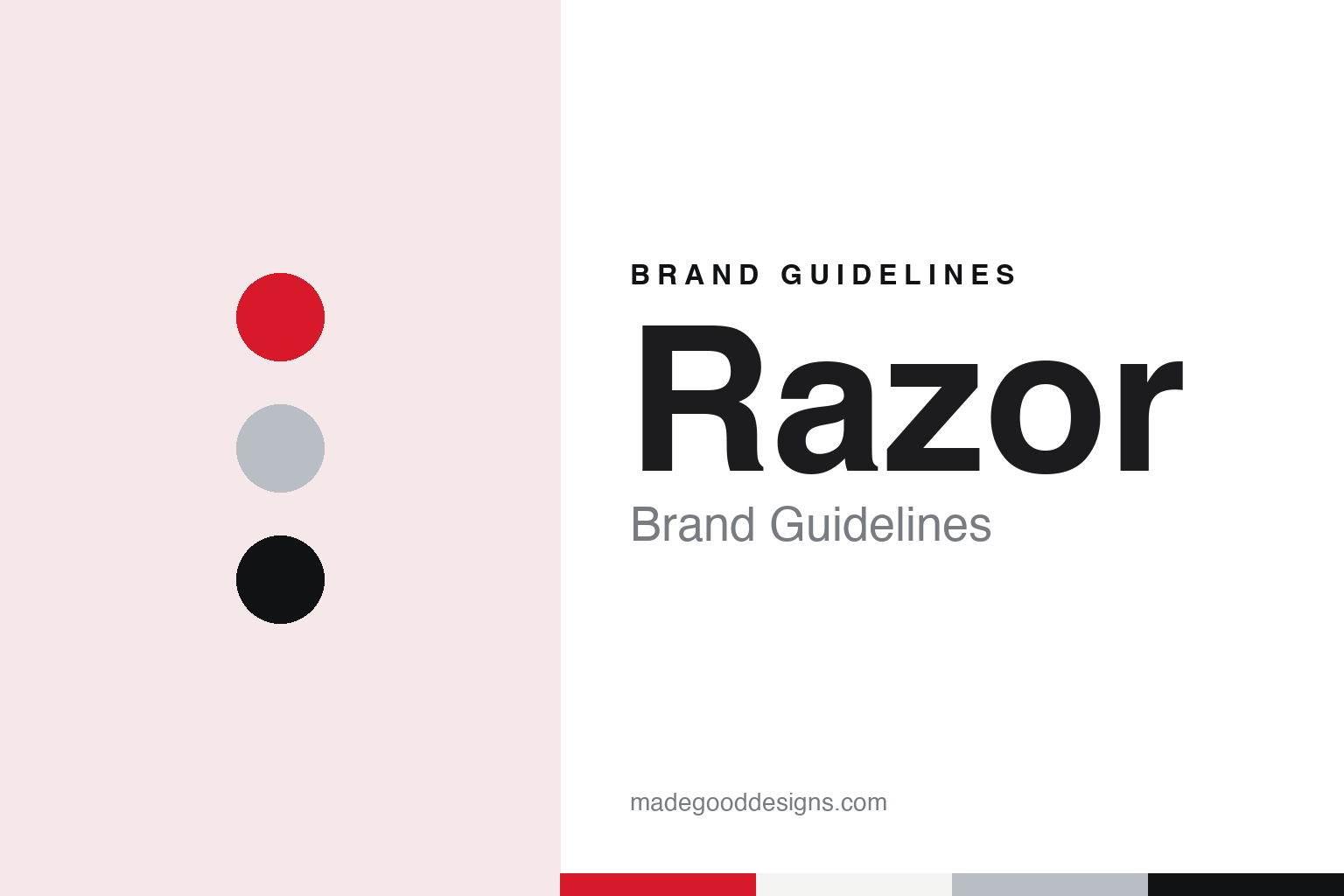
Two constants: a razor red, aluminium and deck black palette and a squared technical sans register. Abstract homage — not a Razor product or mark; no scooter, decal or logo is reproduced.
A faster way across the factory
A bicycle-parts maker, an engineer and a prototype.
The Razor scooter began in Taiwan. The Taipei Times reported in September 2000 that Gino Tsai, president of J.D. Corp, a maker of aluminium bicycle parts, wanted something smaller than a bike and easier than walking to get around his factory floor, and put the company’s research and development team to work. BusinessWeek, profiling Tsai in January 2001, described him as a mechanical engineer and placed the factory in Chang Hua, Taiwan.
The Taipei Times traced the design through three generations. The first had a steel base and rubber wheels and was too heavy to carry; the second added electric power but still weighed too much and needed charging. The third, with polyurethane wheels and a base of aircraft-grade aluminium, was the compact, carryable version that went on sale. BusinessWeek summed up the result as a sleek aluminium frame and neon-coloured wheels added to an old toy.
The launch came almost by accident, the Taipei Times said. Tsai rode the prototype around the NSGA World Sports Expo in Chicago in July 1998, where JD was showing its bicycle parts, and the US retailer Sharper Image placed the first order. In January 1999 JD showed the scooter at the Hong Kong Toys and Games Fair, where a Japanese importer of European cars, Atras Auto, took notice and placed an order that April, promoting the scooter in Tokyo as a fashion accessory rather than as sporting goods.
The same report, published in September 2000, said the scooter had suddenly become popular on the streets of New York, Tokyo and Europe, and that JD’s main concern had become raising production quickly enough to keep up. English Wikipedia likewise records that the first Razor scooter was made by JD and distributed by The Sharper Image.
Colour
A Californian company to carry the name.
In the United States, the scooter found its early following among young riders in California. The Taipei Times reported that a user group called Razor Team had sprung up in Los Angeles, that JD, by Tsai’s own admission unsure of the US market, asked the group to act as its American agent, and that in May the group accepted and formed a company called Razor USA. The paper credited that adoption by trend-setting Californians with fixing the scooter’s youthful image.
English Wikipedia gives the corporate version: Razor USA LLC was founded in Cerritos, California, in 2000 by Carlton Calvin and the JD Corporation, and it remains headquartered in Cerritos. BuzzFeed News described Calvin in November 2015 as the founder and president of Razor USA. The company’s current website footer is signed by Razor USA LLC.
The scooter itself became the template for the range. English Wikipedia describes the basic design as an aluminium frame with polyurethane wheels and a hinged rear fender that the rider presses with a foot to brake, with a handlebar and head tube that fold when a quick-release latch is opened. Razor’s A model became the base for later variations with suspension, larger wheels or a wheelie bar, and BusinessWeek reported in 2001 that Tsai had already designed battery-operated, longer and shorter versions.
Typography
Design and documentation.
The brands in this group make kick scooters and bicycles for children and adults. Names in this field sit at different points in the trade: some are still run by the people or families who started them, while others have passed through several owners, and a single name may be sold through specialist bike shops, sporting-goods chains, toy shops and large general retailers at the same time.
A scooter or bike brand’s identity is often carried less by any single product than by a name, a model line and a badge, because the company behind the name may have changed hands, moved its production or widened its range far beyond where it began. That makes some plain questions worth asking of each name: who started it, who owns it now, and where its scooters or bikes are designed, made and assembled.
Each guide separates what independent sources record from what the company says about itself — its founding story, its owners over time, where its products are made and how its name and models have been presented — and marks plainly what rests only on the company’s own word.
Aa
A squared, technical display sans. (Specimen set in Russo One, a squared-sans STAND-IN; NOT the Razor logo.)
Razor
From one scooter to a catalogue of things with wheels.
Razor has since built a wide family of ride-ons around the name. The corporate-history timeline the company published on its website dates the Scream Machine to 2002, its first electric scooters to 2003, the Pro Model kick scooter to 2005, the RipStik caster board to 2007 and the side-to-side PowerWing to 2008. The same timeline says the company launched the Vapor and Pony Royale brands in 2012 and that Team Razor, its exhibition riding team, gave demonstrations at the X Games in Los Angeles that year; English Wikipedia adds that the team completed a Team Razor Cross Country Tour in October 2013. The timeline also dates the creation of a new electric ride-on category to 2004, and Wikipedia lists RipStik, Sole Skate and Pocket Pros among the brands Razor owns. Its range also takes in the Crazy Cart drift kart and the Pocket Mod.
In 2015 Razor moved into self-balancing boards. BuzzFeed News reported that November that Razor USA had taken an exclusive licence to inventor Shane Chen’s patent for a two-wheel, self-balancing personal vehicle, after an earlier deal with Mark Cuban fell through, and planned to sell the result as the Hovertrax. Katherine Mahoney, the company’s vice president of marketing, told the outlet that the Hovertrax was “a progressive extension of Razor’s commitment to innovation in ride-on products”. Calvin told the outlet that Razor made things with one wheel in front of the other, which he said balances the rider like a bicycle. English Wikipedia adds that Razor-branded bicycles, skateboards and helmets are made under licence by Kent International.
For a design guide, Razor shows how a material can become a brand: bare aluminium, a short, sharp name and bright wheels set against a folding frame. Compare the balance-bike company in our Strider brand guidelines and the Chicago wagon company in our Radio Flyer brand guidelines. For this guide we use razor red, aluminium and deck black with a squared technical sans, an unofficial interpretation; no product or logo is reproduced.
Explore & save
Keep Razor’s identity on hand — save it to a board in the Made Good inspiration library.
Razor identity set
Pin the Razor red, aluminium and deck black palette and the squared technical sans register to your own board.