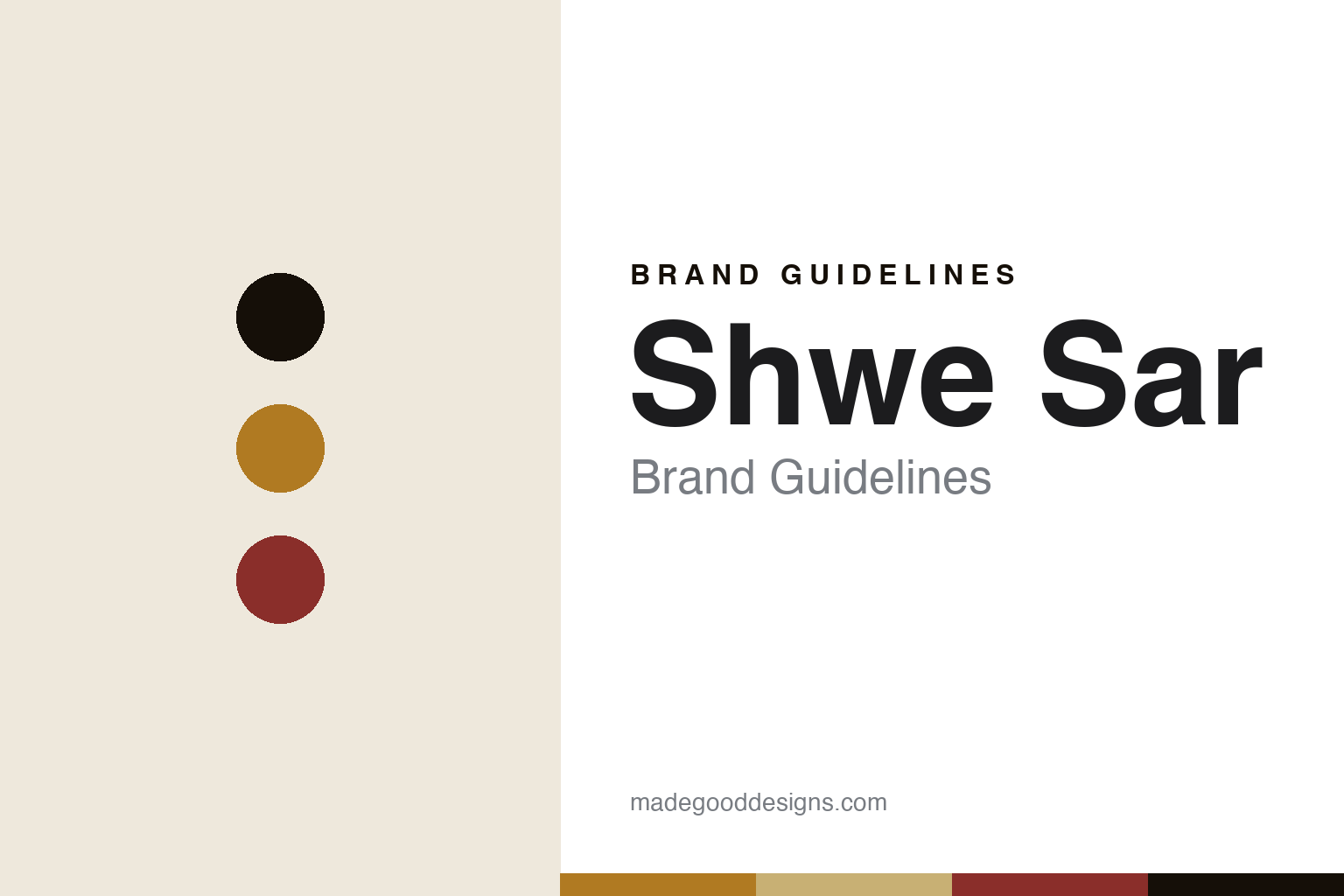
Shwe Sar Brand Guidelines
The Pathein parasol.
Aa
Two constants: a saffron-ochre palette and a warm sans register. Abstract homage — not a parasol, its painted motifs, or any sacred umbrella.
The Pathein parasol
Shwe Sar makes the hand-painted Pathein cotton parasol of Myanmar, by hand.
Shwe Sar is a lesson in a hand-painted parasol as the identity. In Pathein, in Myanmar’s Ayeyarwady delta, family workshops make the Pathein parasol — a bamboo-framed umbrella with a cotton canopy, hand-painted with flowers and then oiled and sun-dried to shed the rain — both a bright decorative sun-parasol and a working umbrella. Shwe Sar is a named workshop within that living craft. Its answer to how a place makes the umbrella is a delta craftsman’s: bamboo, cotton, a brush and days of sun. A parasol, painted and oiled by hand.
Its identity is the hand-painted Pathein parasol. Shwe Sar’s bamboo frames, its hand-painted cotton canopies and its Pathein home are the craft it belongs to. A tradition, made a signature. A colourful parasol known across Myanmar.
(Honest notes, so the story stays precise, and with respect for a cultural craft. The Pathein umbrella craft is a long-standing tradition of home-based workshops in Pathein, and Shwe Sar is a named workshop within it; we do not assert a specific founder or founding date for the workshop, which is not documented, and we frame the piece around the living Pathein craft rather than hard claims about a single shop’s current trading. It is genuinely hand-made in Pathein, from bamboo and cotton, hand-painted and oil-and-sun waterproofed. One important cultural note: the Burmese word for umbrella also names the sacred finial that crowns Buddhist pagodas and, historically, the white umbrella of royalty — this piece is strictly about the secular decorative Pathein parasol and reproduces no sacred or royal imagery, and no painted motif. There is no brand hex; these tones are a respectful, unofficial interpretation. This is design commentary and does not promote any product.)
Colour
Shwe Sar lives in a saffron-ochre palette. Click a swatch to copy the hex.
Shwe Sar’s identity is warm, painterly and Burmese — a saffron ochre, an ink, a straw, a vermilion, and a cream. The palette leans saffron and vermilion: the register of a bright, oiled cotton parasol, evoked rather than copied. It signals craft and colour over show. The honest caveat: there is no brand hex for a village craft, so these values are a respectful, unofficial evocation — not any sampled motif or sacred colour.
The lesson is a saffron palette signals a warm, painterly identity. Shwe Sar’s world is a bamboo-and-cotton, hand-painted, made-in-Pathein object. For designers, it is a reminder that a saffron ochre and a vermilion can evoke a delta folk craft — the ochre of an oiled canopy and the vermilion of a painted bloom — without reproducing any specific design. Because these tones can fail as small text, keep type dark and let the colour live in the accents, palette and band. The takeaways: honour the craft; keep it hand-painted; never copy the motifs or sacred imagery; and treat any single hex as unofficial.
Typography
The register is a warm sans — friendly, humane, unfussy.
Shwe Sar’s identity carries a friendly, humane, unfussy spirit — a folk craft, not a corporate object. A warm sans captures the mood: soft, even and approachable, the register of a delta workshop. Set in a saffron-ochre palette, the warm sans feels friendly and humane — exactly the personality the craft carries. It is unfussy rather than slick, mirroring a hand-painted, oiled parasol. (Shwe Sar’s real painted motifs, and any sacred umbrella imagery, are things we describe but do not reproduce, and the exact typeface is not ours to use.) Because it is not ours to use, the honest description is “a warm-sans spirit,” shown here in a stand-in. The type behaves like the craft: friendly, humane and unfussy.
Aa
A warm-sans spirit — friendly and humane. (Specimen set in Hanken Grotesk, a warm-sans STAND-IN; NOT any Shwe Sar wordmark, painted motif or sacred umbrella.)
The umbrella around the world
Shwe Sar stands for the hand-painted Pathein parasol.
Shwe Sar is a lesson in a hand-painted delta craft. A saffron palette, a warm sans and a painted cotton canopy make one thing — the Pathein parasol — the whole story: warm, painterly and Burmese. The craft is the differentiator. The differentiator is a genuinely local hand process: split bamboo, cotton, hand-painting, and days of oil and sun to make it shed the delta rain, done in home workshops that have made it for generations.
Told with respect, the identity is a craft as design. A maker or brand-builder learning from Shwe Sar and the Pathein craft would see the value of a hand-made, place-rooted object and the care outsiders owe it: honour the tradition on its own terms, keep the making by hand and at home, and — for those outside the culture — never reproduce its motifs, and never borrow the sacred or royal umbrella that shares its name. The lesson the Pathein parasol teaches is that a hand craft can hold an identity: the painting gives it beauty, and the delta making gives it meaning. The craft is the personality, and the painted, oiled canopy is the proof.
For designers and brand-builders, Shwe Sar closes this round about the umbrella around the world on the craft pole: honour a living hand-craft, keep it secular and abstract, and never copy it. The lessons: respect the tradition; keep it hand-painted; separate it from the sacred; and treat any palette as respectful evocation. It is also a reminder to stay precise: Shwe Sar is a named workshop within the living hand-painted Pathein cotton-parasol craft of Myanmar, made by hand in Pathein — with the palette here a respectful, unofficial interpretation. Shwe Sar made the painted parasol the identity — proof that a hand-craft can be the difference.
Explore & save
Keep Shwe Sar’s identity on hand — save it to a board in the Made Good inspiration library.
Shwe Sar identity set
Pin the saffron-ochre palette and the warm-sans register to your own board.