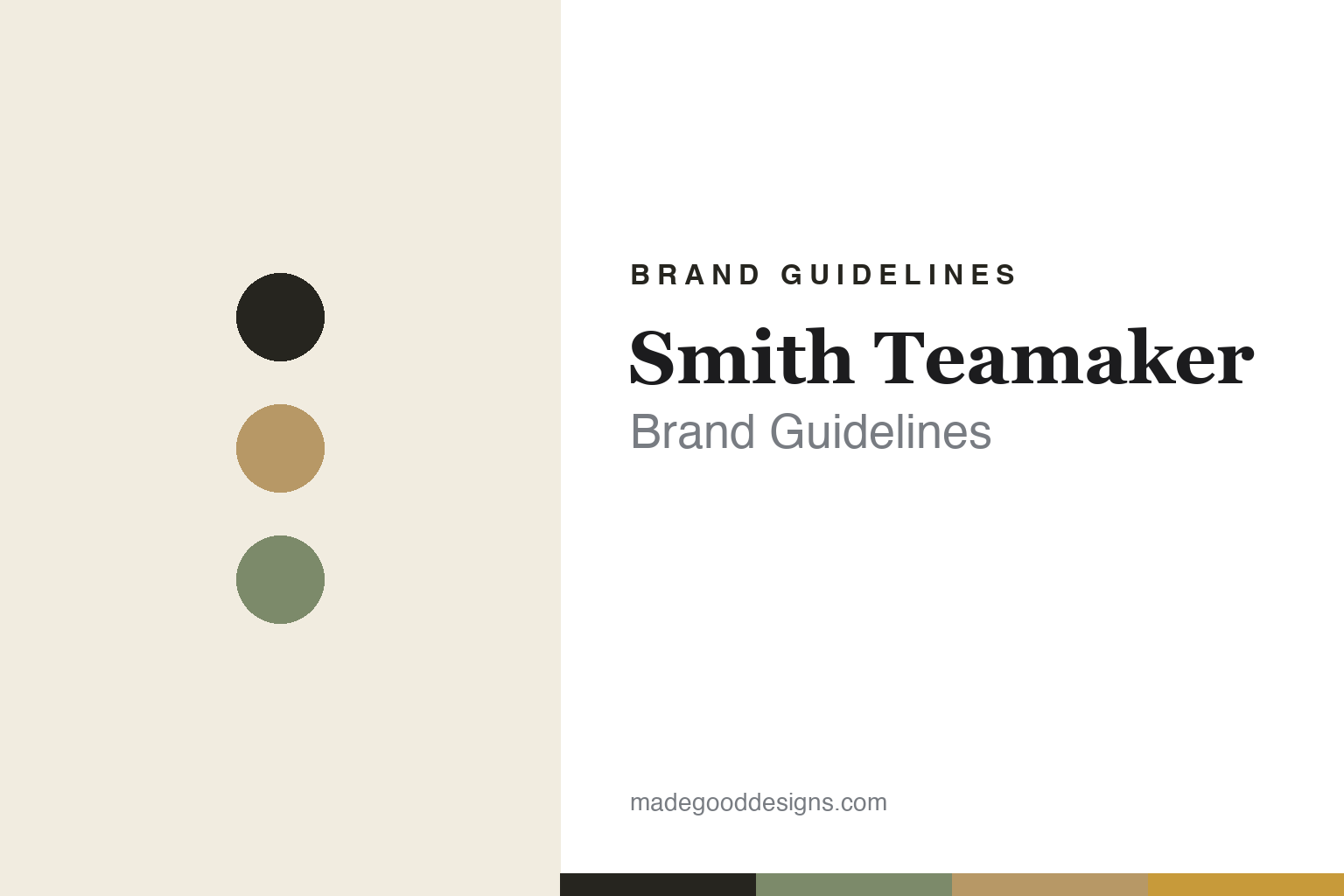
Smith Teamaker Brand Guidelines
Portland’s craft tea maker.
Aa
Two constants: a muted, natural palette and a craft slab. Abstract homage — not the Smith Teamaker wordmark or logo.
The most uncommon name in tea
Steven Smith did it three times.
Smith Teamaker is a lesson in a founder’s legend as a brand. The company was founded in 2009 in Portland, Oregon — in a Northwest Portland blacksmith’s shop — by Steven Smith and his wife Kim DeMent Smith. Smith was a legend: he had co-founded Stash Tea in 1972 and founded Tazo in 1994, which he sold to Starbucks in 1999. Smith Teamaker was his third act — a return to small-batch craft.
The brand makes full-leaf tea in sewn sachets with a system of numbered blends, positioned as a craft “teamaker.” Its best-known blend is Lord Bergamot, its take on Earl Grey. The New York Times said Smith did for tea what craft brewers did for beer and artisanal vintners did for wine.
(Honest notes: the company was founded in 2009 — the “Since 1949” you may see is Steven Smith’s birth year, not a founding date; he co-founded Stash, he did not do it alone; he died in 2015, and the company continues under Kim DeMent Smith; and the Japanese-acquisition story belongs to Stash, not Smith Teamaker. No official brand hex is published.)
Colour
Smith lives in a muted, natural palette. Click a swatch to copy the hex.
Smith Teamaker’s identity is craft, muted and apothecary-modern — a charcoal ink, a kraft tan, a muted sage, an off-white, and a bergamot gold. The look leans on desaturated, natural tones with restrained typographic labels and prominent blend numbers, like a maker’s laboratory. It signals a serious, small-batch craft house rather than a mass-market box. The honest caveat: with no published brand hex, these tones are an original, unofficial interpretation, not first-party values.
The lesson is muted naturals plus numbers read as craft. Smith’s world feels like a workshop. For designers, it is a reminder that a restrained, kraft-and-charcoal palette with a numbering system can make tea feel like a considered, catalogued craft, matching a brand built by a maker who treated blending as a discipline. The takeaways: keep the palette muted and natural; let blend numbers and clean labels carry the system; and treat any single hex as unofficial — using the charcoal for small text so the naturals stay calm.
Typography
The wordmark spirit is a craft slab — sturdy and considered.
Smith Teamaker’s identity carries a craft, considered, maker spirit — a “Smith” wordmark paired with the founder’s signature and blend numbers. A craft slab captures the mood: it is sturdy and honest, the register of a workshop that takes tea seriously but not itself. Set against muted naturals, the craft slab feels grounded and deliberate — exactly the “most uncommon name in tea,” “Taste, always” personality Smith carries. It is workmanlike rather than fussy, mirroring a small-batch maker. (Smith’s real wordmark is a trademark we describe but do not reproduce, and the exact typeface is not something we assert.) Because the specific mark is not ours to use, the honest description is “a craft slab spirit,” not the Smith logo. The type behaves like the brand: sturdy, considered and craft.
Aa
A craft slab spirit — sturdy and considered. (Specimen set in Roboto Slab, a slab serif; NOT the Smith Teamaker logo, which is a trademark.)
A maker’s discipline as the difference
Smith stands for the craft of the maker.
Smith Teamaker is a lesson in founder credibility made visible. It did not need to invent a story; its founder had already built two landmark tea brands before returning to craft. Smith Teamaker turned that discipline into a maker’s identity — numbered blends, full-leaf sourcing, a workshop aesthetic — so the packaging reads as seriously as the tea. The differentiator is credibility: when the maker is a legend, the craft can be the whole brand.
For designers and brand-builders, Smith offers a clear takeaway: a maker’s identity is strongest when it looks like a workshop. The lessons: keep the palette muted and natural; use numbers and clean labels to signal a catalogued craft; and let a genuine founder story carry the authority. It is also a reminder to stay accurate: Smith Teamaker was founded in 2009 (not 1949), Steven Smith co-founded Stash and founded Tazo, and the company continues under Kim DeMent Smith — with the palette here an unofficial interpretation. Smith made a maker’s discipline visible — proof that craft credibility can be the difference.
Explore & save
Keep Smith Teamaker’s identity on hand — save it to a board in the Made Good inspiration library.
Smith Teamaker identity set
Pin the muted, natural palette and the craft-slab spirit to your own board.