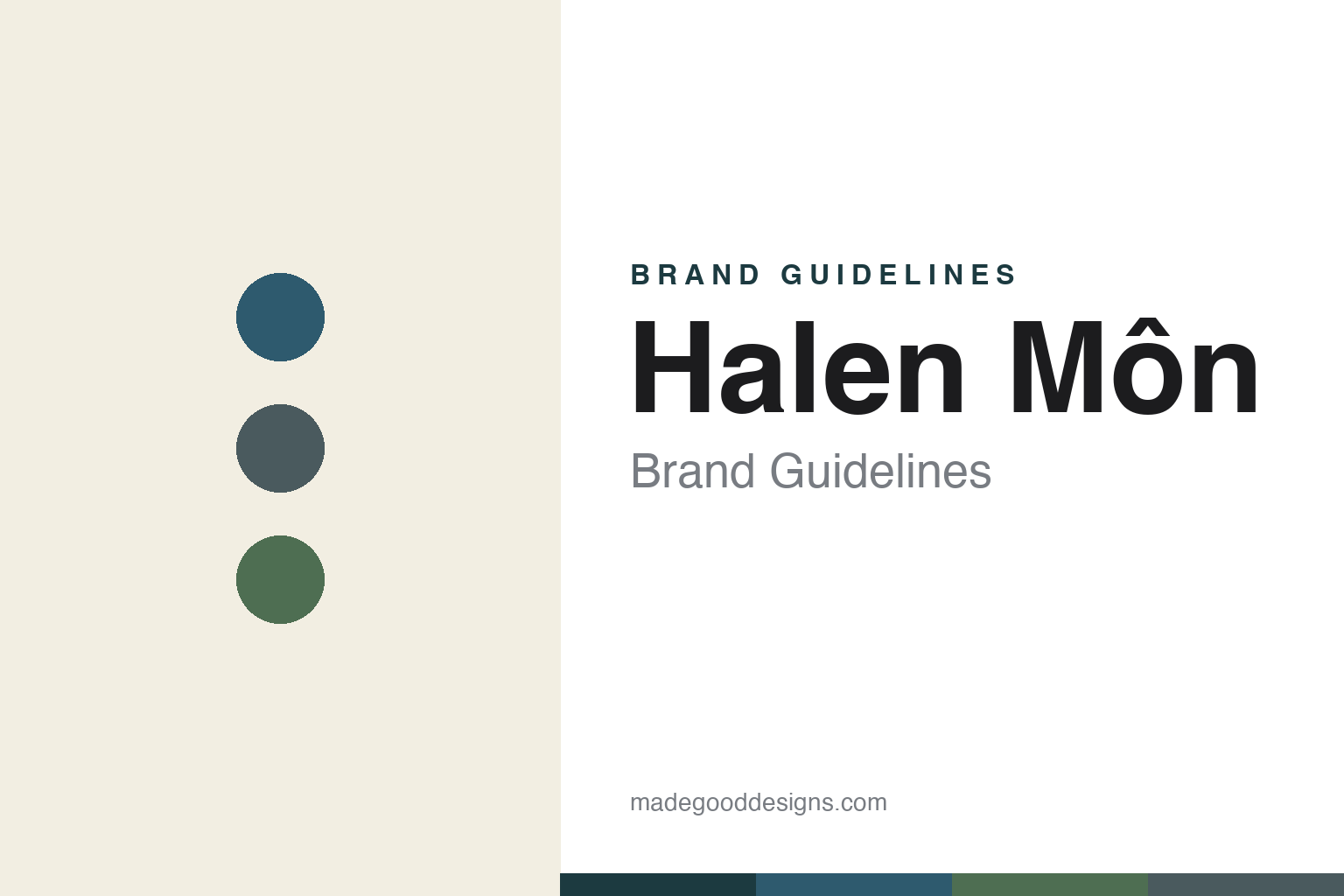
Halen Môn Brand Guidelines
Anglesey sea salt, protected by PDO.
Aa
Two constants: a coastal, refined palette and a refined sans. Abstract homage — not the Halen Môn wordmark or logo.
Anglesey salt
Halen Môn is protected by name.
Halen Môn is a lesson in place as a protected asset. Made on the Isle of Anglesey (Ynys Môn), Wales, on the Menai Strait — “Halen Môn” is Welsh for “Anglesey Salt” — it was founded in 1997 by Alison and David Lea-Wilson (the couple behind the Anglesey Sea Zoo), who were later appointed MBE. Its flagship is a delicate flake sea salt, a fleur de sel from filtered Menai Strait seawater.
Its headline credential is legal: Protected Designation of Origin (PDO) status, granted in the EU in 2014 under the name “Anglesey Sea Salt / Halen Môn” — meaning only salt from this place and process can carry the name. Alongside the pure flake it makes smoked and flavoured salts, and its identity is proudly bilingual Welsh and English.
(Honest notes: the PDO year is 2014 — a later 2020/21 UK date is just the Brexit register carry-over, not a new award; various celebrity/royal usage stories are widely repeated but we don’t assert them; it is an independent, family-owned business; and no official brand hex is published.)
Colour
Halen Môn lives in a coastal, refined palette. Click a swatch to copy the hex.
Halen Môn’s identity is coastal, refined and Welsh — a Menai blue, a slate grey, a Welsh green, a cream, and a deep teal. The palette reads like the place: the blues and greys of the Menai Strait, a Welsh green, clean neutrals. It signals a premium, design-led, place-rooted finishing salt rather than a commodity. The honest caveat: with no published brand hex, these tones are an original, unofficial interpretation, not first-party values.
The lesson is coastal, refined colour reads as premium provenance. Halen Môn’s world is elegant and rooted. For designers, it is a reminder that a restrained, coastal palette plus bilingual, place-proud branding can make a finishing salt feel both premium and authentic, matching a PDO-protected product. The takeaways: draw the palette from the actual place; keep it refined and minimal; and treat any single hex as unofficial — using the deep teal for small text so the coastal tones stay calm.
Typography
The wordmark spirit is a refined sans — elegant and bilingual.
Halen Môn’s identity carries an elegant, refined, place-proud spirit — a “Halen Môn” wordmark with prominent Welsh-language branding (blend names like Pawb and Popeth, the visitor centre Tŷ Halen). A refined sans captures the mood: it is clean and considered, the register of a design-led premium brand. Set against a coastal palette, the refined sans feels elegant and authentic — exactly the bilingual, Anglesey-rooted personality Halen Môn carries. It is refined rather than loud, mirroring minimalist, provenance-led packaging. (Halen Môn’s real wordmark is a trademark we describe but do not reproduce, and the exact typeface is not something we assert.) Because the specific mark is not ours to use, the honest description is “a refined sans spirit,” not the Halen Môn logo. The type behaves like the brand: elegant, refined and place-proud.
Aa
A refined sans spirit — elegant and place-proud. (Specimen set in Jost, a refined geometric sans; NOT the Halen Môn logo, which is a trademark.)
Protected provenance as the difference
Halen Môn stands for a protected place.
Halen Môn is a lesson in turning place into a defensible asset. It did not just claim provenance; it protected it legally with PDO status, so the Anglesey name is a credential no competitor can borrow. That legal moat, paired with a genuinely design-led, bilingual identity, makes the brand both premium and authentic. The differentiator is protected provenance: when the place is legally yours, the story is uncopyable.
For designers and brand-builders, Halen Môn offers a clear takeaway: a strong provenance deserves a design-led, place-rooted identity. The lessons: build the palette and language from the real place (Anglesey, Welsh); keep the design refined and minimal; and let a genuine credential (PDO) carry the premium. It is also a reminder to stay accurate: Halen Môn was founded in 1997, won PDO status in 2014, and is family-owned — with the palette here an unofficial interpretation, and unverified celebrity claims left aside. Halen Môn protected its place — proof that provenance can be the difference.
Explore & save
Keep Halen Môn’s identity on hand — save it to a board in the Made Good inspiration library.
Halen Môn identity set
Pin the coastal, refined palette and the refined-sans spirit to your own board.