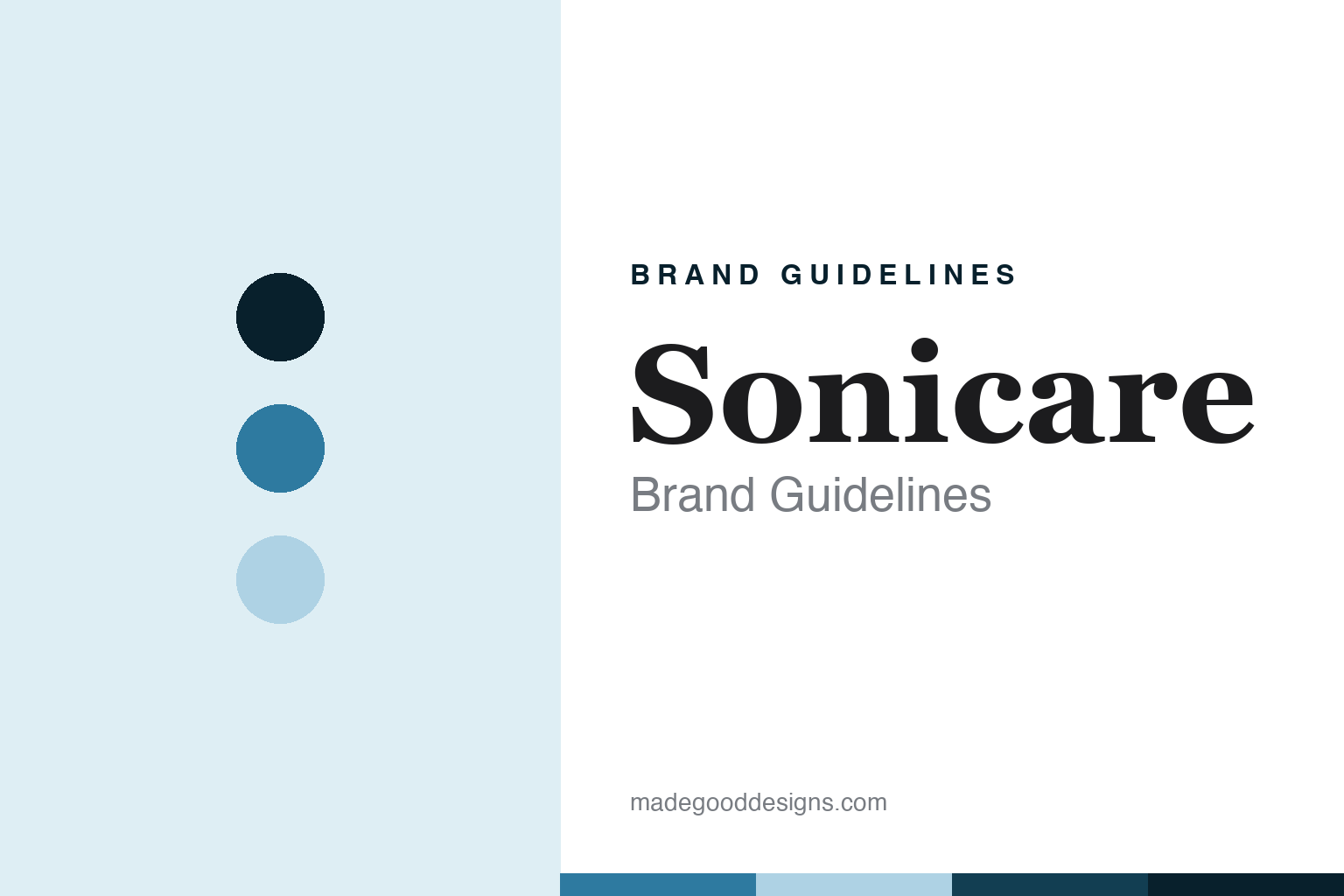
Sonicare Brand Guidelines
The Philips sonic pioneer.
Aa
Two constants: a sonic-cyan palette and a sonic-serif register. Abstract homage — not a Sonicare product or mark; no toothbrush, brush head or logo is reproduced.
The Philips sonic pioneer
Sonicare is the Philips-owned brand, born a US university spin-out, whose side-to-side sonic drive defines the other side of the category.
Sonicare brings the round its sonic node — the Philips brand that owns the other great camp of power brushing, the high-frequency side-to-side sweep. Its answer to a round about who owns the toothbrush and where it is made is a corporate one with academic roots: a Philips brand, born as a US university spin-out and long made in Washington State.
Its identity is the Philips sonic pioneer. The Philips ownership, the university-spin-out origin and the side-to-side sonic drive are the story here. A toothbrush, sonic. The Philips sonic pioneer.
(Honest notes, so the ownership, the origin and the technology are framed accurately. Sonicare sells sonic power toothbrushes as its heroes — the DiamondClean, ProtectiveClean and 9900 Prestige — and we report its technology language as its own. On the technology, the defining contrast: Sonicare uses a piezoelectric transducer to drive a high-frequency side-to-side motion, on the order of tens of thousands of strokes a minute, with inductive charging and magnetic replaceable heads — the direct counterpart to Oral-B’s round oscillating-rotating head. On the origin, a genuine one: the product was introduced in 1992 by GEMTech, formed in 1987 by the entrepreneur David Giuliani with University of Washington professors David Engel and Roy Martin, and the company later became Optiva before Philips, so it is a US university spin-out, unlike the round’s Chinese newcomers. On ownership, the point that matters: Philips acquired it in 2000 and renamed it Philips Sonicare in 2003, so it is a sub-brand of a giant, not a standalone. On where it is made: historically Washington State, at Snoqualmie and Auburn, with some current production offshore, so we hedge the exact mix. Its designs, the Philips and Sonicare names, the DiamondClean name and the Philips blue are IP we describe but do not reproduce; these tones are an unofficial interpretation.)
Colour
Sonicare lives in a sonic cyan. Click a swatch to copy the hex.
Sonicare’s identity is clinical, sonic and established — a sonic cyan, an ink, a pale sky, a deep marine, and a paper. The palette leans sonic cyan and pale sky: a clean, clinical register that nods to a high-frequency sonic sweep rather than a loud logo colour, and deliberately not to the Philips blue. It signals the Philips sonic pioneer — clinical, sonic and established. The honest caveat: with no adopted brand hex, and with the Philips blue treated as trade dress, these values are an original, unofficial interpretation, not first-party colours.
The lesson is a sonic cyan signals a clinical, established identity. Sonicare’s world is a brush that hums at a high frequency and sweeps side to side. For designers, it is a reminder that a clean sonic cyan and a soft pale sky can carry a hardware brand — a clinical tone held as colour, never the Philips blue. Because these tones can fail as small text, keep type dark and let the colour live in the accents, palette and band. The takeaways: name Philips and 2000; credit the GEMTech university spin-out and 1992; lead with side-to-side sonic; contrast it with Oral-B; and place manufacturing in Washington State, hedged.
Typography
The register is a sonic serif — clinical, sonic, established.
Sonicare’s identity carries a clinical, sonic, established spirit — a research-born authority, not an upstart. A sonic serif captures the mood: precise, refined and confident, the register of a clinically-positioned brand. Set in a sonic-cyan palette, the sonic serif feels clinical and established — exactly the personality Sonicare carries. It behaves like a made, clinical thing rather than a loud logo, mirroring a sonic-wave arc and an enamel sheen. (Sonicare’s real products and the names are things we describe but do not reproduce, and the exact typeface is not ours to use.) Because it is not ours to use, the honest description is “a sonic-serif brand,” shown here in a stand-in. The type behaves like the brand: clinical, sonic and established.
Aa
A sonic-serif brand — clinical and established. (Specimen set in Cormorant, a sonic-serif STAND-IN; NOT the Sonicare logo or the Philips blue.)
The electric toothbrush
Sonicare stands for the Philips sonic pioneer.
Sonicare brings the round its sonic node. A sonic-cyan palette, a sonic serif and a 1992 origin make one thing — the Philips sonic pioneer — the whole identity: clinical, sonic and established. The Philips ownership is the frame, and the side-to-side sonic drive is the signature. The point is the other great camp of power brushing, born in a university and owned by a giant, in a round about who owns the toothbrush and where it is made.
Put to work, the identity is the brand told straight, the ownership named and the origin credited. A brand in this spirit would name Philips and 2000, credit the GEMTech spin-out and 1992, and lead with side-to-side sonic. A reader in this spirit would keep the facts right: Sonicare sells DiamondClean and Prestige sonic brushes as heroes; it is a Philips brand, acquired in 2000 and renamed Philips Sonicare in 2003; it began as a 1992 University-of-Washington spin-out via GEMTech; its side-to-side sonic drive contrasts with Oral-B; and it is historically made in Washington State. Sonicare sits sixth in the round, after BURST. The honest editorial moves are to name Philips and 2000, to credit the university spin-out and 1992, to lead with sonic, to contrast it with Oral-B, and to place manufacturing in Washington State, hedged.
For designers and brand-builders, Sonicare continues the electric toothbrush: own the other signature mechanism inside a giant — and honour a genuine research origin. The lessons: a category can split into two mechanisms, and owning one — here side-to-side sonic — is a durable identity; a research or university origin is a real credibility asset worth telling; a brand acquired by a giant should be named as a sub-brand honestly; and a signature colour is trade dress to describe, not reproduce. It is also a reminder to stay precise: Sonicare is the Philips-owned brand, born a US university spin-out, whose side-to-side sonic drive defines the other side of the category — with the palette here an unofficial interpretation and no adopted Philips blue. The hook is that pairing: with Oral-B, Sonicare splits power brushing in two — the round oscillating head versus the high-frequency sonic sweep — and unlike its rival it began in a University of Washington spin-out in 1992 before Philips bought it in 2000, a research-born pioneer now inside a giant. Read that way, Sonicare is less a single product than a Philips sonic pioneer: clinical, sonic, established. The lesson for a brand is that a signature mechanism and a genuine origin story reinforce each other, and naming Philips keeps the story earned. Sonicare made the-Philips-sonic-pioneer the identity — proof that a mechanism and an origin can carry a round.
Explore & save
Keep Sonicare’s identity on hand — save it to a board in the Made Good inspiration library.
Sonicare identity set
Pin the sonic-cyan palette and the sonic-serif register to your own board.