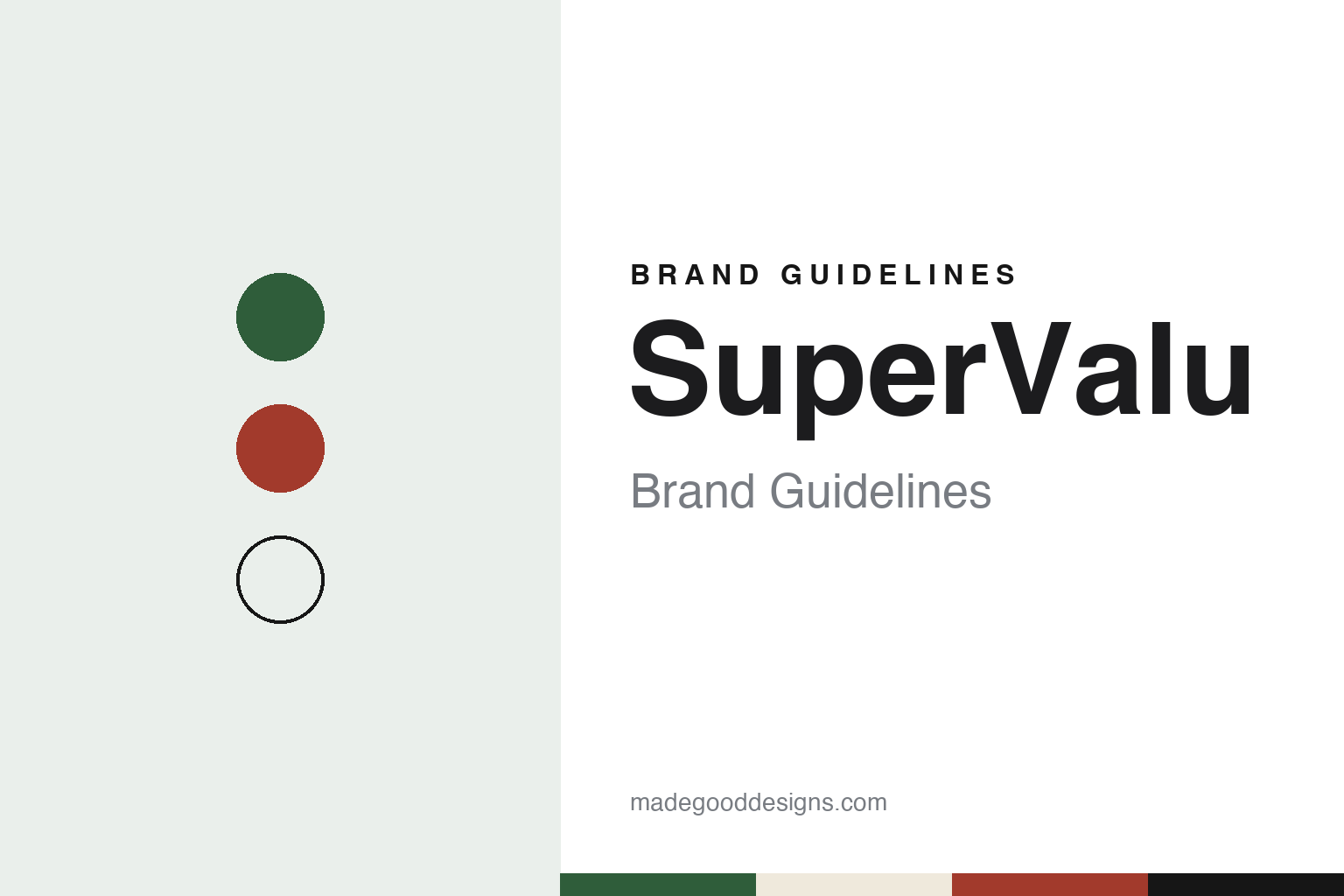
SuperValu Brand Guidelines
One name over independently owned shops across Ireland.
Aa
Two constants: a pasture green, harvest red and oat palette and a market serif register. Abstract homage — not a SuperValu product or mark; no logo, sign or pack is reproduced.
From VG to SuperValu
A Cork wholesaler and the independent grocer.
This guide covers SuperValu in Ireland, the supermarket brand of the Cork food group Musgrave, not the former American grocery wholesaler of the same name. The Irish SuperValu is a network of supermarkets across the island of Ireland, each owned by an independent retailer and trading under the shared name.
Musgrave dates its own start to 1876, when the brothers Thomas and Stuart Musgrave opened a grocery shop on North Main Street in Cork. Its timeline says the family firm opened a second shop on Grand Parade in 1887 and, by the middle of the twentieth century, had built a wholesale business supplying shops, pubs and hotels in Cork and Munster. In 1958, by Musgrave’s date, it set up a voluntary trading group for independent grocers under the VG name; English Wikipedia dates the VG chain to 1960.
SuperValu grew out of that group, and its founding is dated two ways. English Wikipedia gives 27 June 1968, saying SuperValu was formed from the larger shops in the VG chain, beginning with sixteen supermarkets mainly in Munster, while the smaller VG shops became Centra. Musgrave’s own timeline says SuperValu and Centra were “formally established” in 1979, replacing the VG brand.
A November 1990 feature in the Irish grocery trade magazine Checkout, republished in 2015, describes the thinking behind the split. In 1978, it said, Musgraves was serving the VG and Shoprite groups and decided to create two retail formats: SuperValu, to pursue the “trolley” business, and Centra, to chase the “bag and basket” trade. The magazine presented this as a common standard and a clear target for independent grocers.
Colour
Independently owned, one name above the door.
SuperValu is a symbol group. English Wikipedia describes each supermarket as independently owned, with the owner trading under the SuperValu format and selling the chain’s own-brand products, and notes that SuperValu shops tend to be larger than the convenience formats of symbol groups such as Centra, Gala and Spar. Musgrave describes its retail brands in similar terms, as run by local retail partners, many of them family-run businesses, and says its retail brands support thousands of independent retailers across the island of Ireland and in Spain.
English Wikipedia also records how Musgrave grew the network: by buying shops itself and then leasing them to franchisees, including some of the H Williams shops after that chain’s insolvency in 1987, the L&N shops in 1995 and Wellworths outlets in Northern Ireland in 1996, which traded briefly as Wellworths-SuperValu. For many years SuperValu also ran supermarkets inside larger Roches Stores branches, under the name “SuperValu at Roches Stores.” Musgrave’s timeline says SuperValu and Centra were established in Northern Ireland during the 1990s.
The most visible change came with Superquinn. The Irish Times reported on 8 August 2013 that Musgrave, which had acquired Superquinn in October 2011, would rebrand its 24 supermarkets under the SuperValu banner from February 2014. Superquinn had been founded by Feargal Quinn in 1960, with its first store in Dundalk, the paper noted, and Quinn told the paper: “even if it’s only the Superquinn sausages that stay, well, that’s something.” English Wikipedia says the rebranding was completed in February 2014, and Musgrave’s timeline says Superquinn was fully integrated into SuperValu by that year.
Typography
Signs, bags and owners.
Irish retailers present themselves first through the shopfront. A name above the door, a logo on the carrier bag and a consistent colour scheme travel from one branch to the next, whether the shop is a city-centre department store, an out-of-town supermarket or a convenience shop on a village street. Many chains publish their own account of these elements on their corporate pages, alongside the story of their founders and owners.
The formats vary widely. Department stores, supermarkets and symbol-group convenience shops sit beside DIY and garden sheds, electrical stores, bookshops and newsagents, and sports chains. Some sell food, fashion and homeware under one roof; others concentrate on a single category and repeat the same layout, fittings and signage in every branch they open.
Ownership shapes the identity too. Some chains are family-owned and privately held; some are symbol groups, in which a wholesaler supplies a shared name, format and own-brand range to shops run by independent retailers; and some belong to larger retail groups at home or abroad. Each structure leaves its own mark on how a brand is applied: a single owner sets every sign directly, while a symbol group relies on shared standards that many separate owners follow.
Own brands and services carry the identity beyond the shop floor. Retailers name their own labels, food ranges, loyalty schemes, gift cards and delivery services, and those names appear on packaging, receipts, apps and websites. This guide draws on the companies’ own published material and on dated independent reporting, and its colours and type are an unofficial interpretation rather than any official brand standard.
Aa
A warm market serif for a shared shop name. (Specimen set in Fraunces, a serif STAND-IN; NOT the SuperValu logo.)
SuperValu
“Real Food, Real People.”
Today SuperValu sits inside a wider Musgrave portfolio. Musgrave lists its retail brands as SuperValu, Centra, Donnybrook Fair, Frank and Honest, Daybreak and Mace, with the grocery brand Dialprix in Spain. Its timeline says it entered Spain in the 1990s by acquiring Dialsur of Alicante, bought the food hall Donnybrook Fair in 2018, and runs its wholesale and foodservice business under names such as Musgrave MarketPlace. English Wikipedia notes that SuperValu’s former shops in Spain now trade as Dialprix. Musgrave describes itself as a family-owned business since its foundation and marked its 150th anniversary in 2026. Its timeline also records a new Musgrave logo, introduced for the company’s 140th anniversary, that drew on a chairman’s signature from 1902.
The SuperValu name is carried through its services. On its own website in November 2026 the chain uses the line “Real Food, Real People”, runs a loyalty scheme called Real Rewards, with an app and a card, and offers home shopping, gift cards and an insurance service under the same name. Its about page describes SuperValu as part of the Musgrave Group and stresses that the stores are independently owned. Individual stores can carry an owner’s name with the brand: Musgrave’s 150th-anniversary gallery includes Pettitt’s SuperValu in County Wicklow, pictured in 2024.
The model sets a particular design task: one name, one format and one own-brand range shared by shops whose owners are local business people. The Checkout feature of 1990 framed it as a common standard for independent grocers, and the 2013 Superquinn decision reported by The Irish Times moved two dozen more supermarkets under the single SuperValu sign rather than keeping a second banner.
For a design guide, SuperValu shows how a symbol group holds a shared identity across independently owned shops: a single name and own-brand range from Musgrave, with a local owner behind each door. Compare it with Dunnes Stores, the family-owned chain that also began in Cork, and with Spar, another symbol group. For this guide we use pasture green, harvest red and oat with a serif, an unofficial interpretation; no product or logo is reproduced.
Explore & save
Keep SuperValu’s identity on hand — save it to a board in the Made Good inspiration library.
SuperValu identity set
Pin the SuperValu pasture green, harvest red and oat palette and the market serif register to your own board.
Source & notes
Frequently Asked Questions
What font can I use to match the SuperValu look?
This guide describes SuperValu’s type as “A warm market serif for a shared shop name”. Its type specimen is set in Fraunces from Google Fonts as a stand-in; Fraunces is not SuperValu’s own lettering.
What colours are in the SuperValu palette?
This guide’s SuperValu palette is Pasture green #2F5D3A, Ink #161616, Oat #EFE9DC, Harvest red #A23A2C and Paper #FAF8F3. The tones are the guide’s own unofficial interpretation, not official SuperValu hex codes.
When was SuperValu founded?
SuperValu was founded in 1968 (Wikipedia) / 1979 (Musgrave), in Munster, Ireland.
Who owns SuperValu?
SuperValu is owned by Musgrave Group, Cork. SuperValu is known for Real Rewards; “Real Food, Real People”.