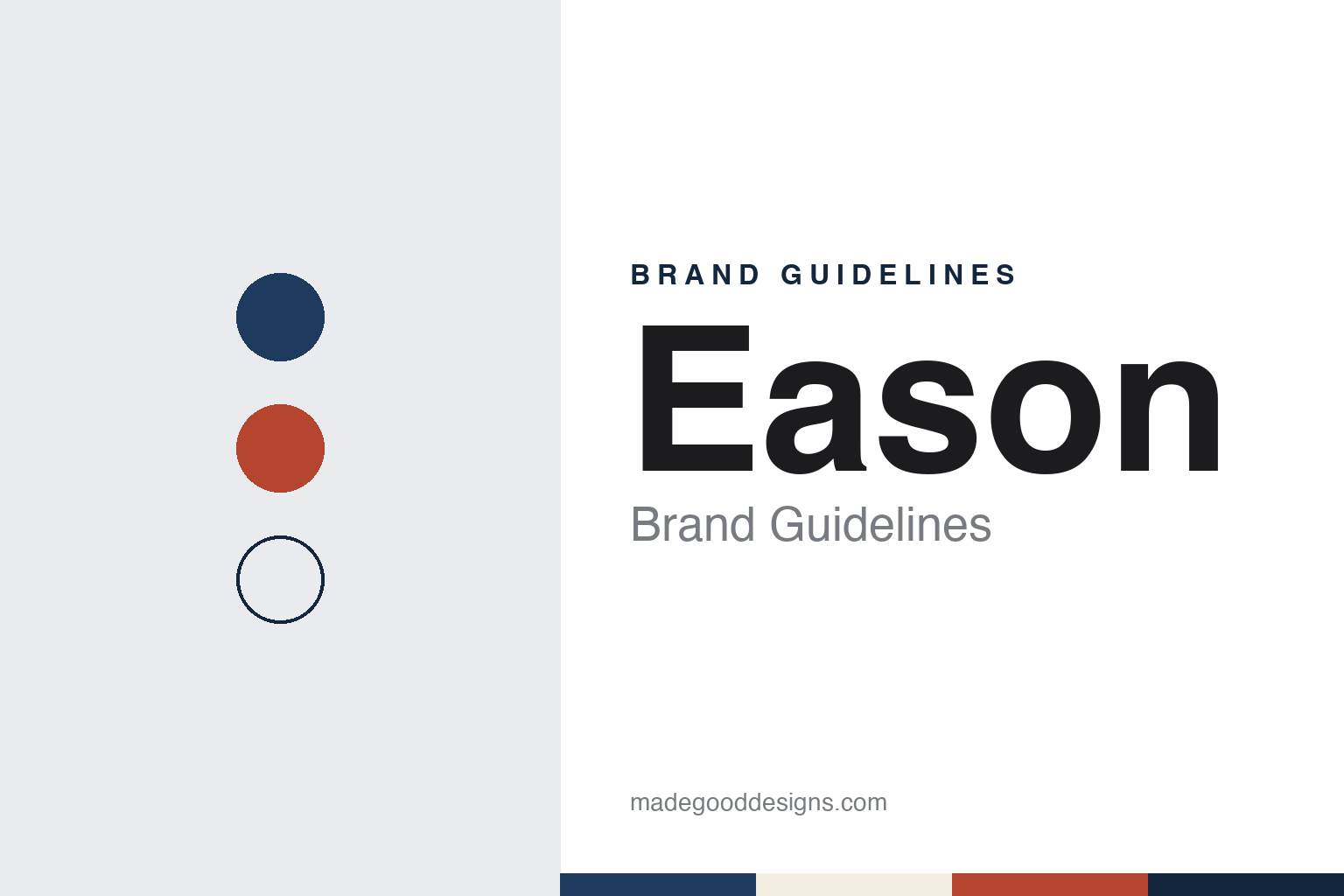
Eason Brand Guidelines
The Dublin bookseller and newsagent bought from W.H. Smith in 1886.
Aa
Two constants: a navy, cream and brick-red palette and a bookshop serif register. Abstract homage — not an Eason product or mark; no shop sign, logo or carrier bag is reproduced.
Charles Eason
A manager buys the business he ran.
Eason’s story as an Irish company begins in 1886, when Charles Eason, who ran the Irish business of the English bookseller and newsagent W.H. Smith, bought that business from it. The Irish Times reported in February 2001 that W.H. Smith had sold its Irish business to Charles Eason in 1886 and had not traded anywhere on the island since; that year it agreed terms for a shop in Belfast’s Donegall Place. English Wikipedia describes Eason as a W.H. Smith manager who wrote to the company asking to buy it out, and in August 2014 The Irish Times described that 1886 letter, still kept in the company’s own archive.
The firm traded as Eason & Son, and the family stayed with it. The same 2014 article describes an illustrated book presented to Charles Eason II in 1925 to mark his fiftieth year with the firm. A full company history, Eason & Son: A History by the historian L. M. Cullen, was published in Dublin in 1989. The flagship shop is on Dublin’s O’Connell Street; in October 2024 The Irish Times described it as a shop on three trading floors and as one of only two shops, with Blanchardstown, that the company still owned rather than leased.
Ownership has stayed private and widely spread. In 2014 The Irish Times reported 235 shareholders, made up of five families and staff; in October 2024 it put the number at about 230 family shareholders and noted that the shares are not publicly traded, despite the “plc” in the company’s name. The trading company today is Eason Retail PLC, headquartered in Swords, County Dublin, according to English Wikipedia. In June 2025 the paper reported that the board had looked at several options over two years, including a trade sale of the business, before offering a share buyback to holders who wanted to sell; about 30 per cent of shareholders took part, and the main shareholder families did not, it reported.
Colour
Books, news, franchises and airports.
Eason sells books, stationery, cards, gifts, newspapers and magazines, English Wikipedia says, and for much of its history it was a wholesaler as well as a retailer. It merged its Irish newspaper and magazine distribution with John Menzies to form EM News Distribution, and Menzies Distribution bought Eason’s share in 2017, Wikipedia says. In 2010, after the bookseller Hughes & Hughes went into receivership, Eason took over its licences for five units at Dublin Airport’s Terminal 1 and two at Cork Airport, RTÉ News reported in March 2010; Wikipedia says Eason lost the tender for those airport shops in 2013.
From the mid-2000s Eason also let franchisees run shops under its name. The Irish Times counted 29 franchise outlets in 2014, within a network of 65 own and franchise stores. In August 2019 the paper reported that Eason would take back six franchised shops — in Kilkenny, Clonmel, Balbriggan, Maynooth, Arklow and Ennis — bringing its company-run network to 40, seven of them in Northern Ireland, while the same franchisees kept two Eason shops in Connolly and Kent railway stations. In September 2025 it reported that Eason had bought its franchised store in Shannon, County Clare, and had added outlets in Blackpool, in Cork, and in the Parkway centre in Limerick.
The range has been edited as well as widened. In 2014 The Irish Times described two in-store concepts, Easonology, for puzzles and games, and Department 51, for teenage readers, and quoted the chain’s slogan, “Whatever you’re into, get into Eason.” By October 2024 the company had cut its magazine range, from more than 2,000 titles, by about 40 per cent, and had stopped selling tobacco, lottery tickets and mobile top-ups, the paper reported. It described the business as three trading arms: the Eason shops, the Eason online shop and Dubray.
Typography
Irish retail, as the companies present it.
Irish retailers present themselves first through the shopfront. A name above the door, a logo on the carrier bag and a consistent colour scheme travel from one branch to the next, whether the shop is a city-centre department store, an out-of-town supermarket or a convenience shop on a village street. Many chains publish their own account of these elements on their corporate pages, alongside the story of their founders and owners.
The formats vary widely. Department stores, supermarkets and symbol-group convenience shops sit beside DIY and garden sheds, electrical stores, bookshops and newsagents, and sports chains. Some sell food, fashion and homeware under one roof; others concentrate on a single category and repeat the same layout, fittings and signage in every branch they open.
Ownership shapes the identity too. Some chains are family-owned and privately held; some are symbol groups, in which a wholesaler supplies a shared name, format and own-brand range to shops run by independent retailers; and some belong to larger retail groups at home or abroad. Each structure leaves its own mark on how a brand is applied: a single owner sets every sign directly, while a symbol group relies on shared standards that many separate owners follow.
Own brands and services carry the identity beyond the shop floor. Retailers name their own labels, food ranges, loyalty schemes, gift cards and delivery services, and those names appear on packaging, receipts, apps and websites. This guide draws on the companies’ own published material and on dated independent reporting, and its colours and type are an unofficial interpretation rather than any official brand standard.
Aa
A bookshop serif for a reading-room register. (Specimen set in Source Serif 4, a serif STAND-IN; NOT the Eason logo.)
Eason
Two shop brands, one private company.
The group now runs two shop brands. In February 2020 Eason Retail agreed to buy Dubray Books, a family-owned bookseller with eight shops, RTÉ News reported; Dubray was founded in Bray, County Wicklow, in 1973, was owned by the Barry family from 1988, and was to keep its own name as a separate division within Eason. In 2023 Dubray took over the Gutter Bookshop, with shops in Temple Bar and Dalkey, The Irish Times reported in October 2023, and by October 2024 the paper counted 15 Dubray shops beside 38 Eason book stores.
The company has also given things up. Wikipedia says it sold its British Bookshops & Sussex Stationers chain in south-east England to Endless in May 2009. In 2018 Eason began separating its shops from its property: the retail and property arms became separate companies in March 2019, and in October 2020 the shareholders of Eason Holdings plc, the property company, approved its voluntary liquidation, The Irish Times reported. In July 2020 Eason told staff it would not reopen its seven shops in Northern Ireland, which had been closed since March that year, BBC News reported; The Irish Times listed the exit from Northern Ireland in 2024 among the changes of recent years, and Eason now trades in the Republic of Ireland.
For a design guide, Eason shows how one family-held name can hang above a three-floor city flagship, a shopping-centre unit and a franchised railway-station shop at once, while a second, separately branded bookshop chain is run beside it. Compare Arnotts, another long-established Dublin city-centre retailer, and Dunnes Stores, an Irish family-owned chain. For this guide we use a deep navy, newsprint cream and a warm brick red with a serif, an unofficial interpretation; no product or logo is reproduced.
Explore & save
Keep Eason’s identity on hand — save it to a board in the Made Good inspiration library.
Eason identity set
Pin the Eason navy, cream and brick-red palette and the bookshop serif register to your own board.
Source & notes
Frequently Asked Questions
What font can I use to match the Eason look?
This guide describes Eason’s type as “A bookshop serif for a reading-room register”. Its type specimen is set in Source Serif 4 from Google Fonts as a stand-in; Source Serif 4 is not Eason’s own lettering.
What colours are in the Eason palette?
This guide’s Eason palette is Reading-room navy #1F3A5F, Night ink #14263D, Newsprint cream #F3EDE2, Brick red #B5452F and Paper #F9F7F2. The tones are the guide’s own unofficial interpretation, not official Eason hex codes.
When was Eason founded?
Eason was founded in 1886 (W.H. Smith’s Irish business bought by Charles Eason), in Dublin, Ireland.
Who founded Eason?
Eason was founded by Charles Eason in 1886 (W.H. Smith’s Irish business bought by Charles Eason).