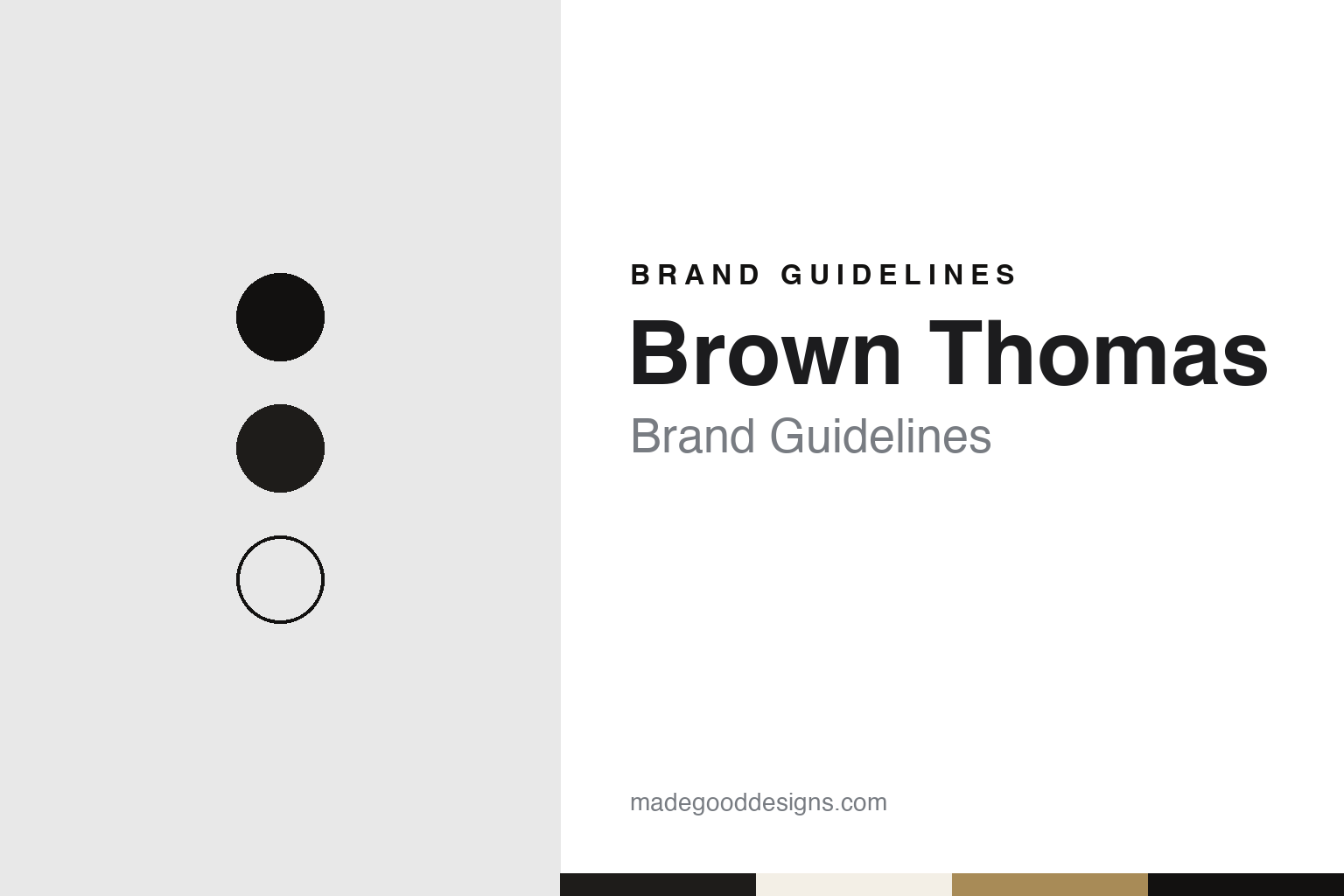
Brown Thomas Brand Guidelines
The Grafton Street department store group since the 1840s.
Aa
Two constants: a Brown Thomas black, ivory and gold palette and a Store serif register. Abstract homage — not a Brown Thomas product or mark; no shopfront, logo or carrier bag is reproduced.
Grafton Street
A draper and haberdasher on Dublin’s shopping street.
Brown Thomas is a department-store business on Dublin’s Grafton Street. The company dates itself to 1849 and names its founders as Hugh Brown and James Thomas. English Wikipedia gives 1848: it says Brown opened at number 16 Grafton Street that year, expanded into number 17 with Thomas the following year, and had taken in number 15 as well by the mid-1850s. The company says the business began trading as a general draper and haberdasher and later gained a Victorian façade designed by the Irish architect William Caldbeck.
The shop also has a place in literature. In James Joyce’s Ulysses, Leopold Bloom lingers at the windows of “Brown Thomas silk mercers,” looking at silks and stockings, a passage the company quotes on its own history page.
Ownership changed several times in the twentieth century. English Wikipedia and the company both say that Harry Gordon Selfridge, the American-born owner of Selfridges in London, bought Brown Thomas in 1919. Wikipedia says the store was run as a branch of Selfridge Provincial Stores until 1933, when it was sold to John McGuire, who had made his name at the Dublin department store Clerys; the company names the buyer as John McGuire & Sons. The company also says a Dior boutique opened inside the store in 1950.
The Weston family arrived next. English Wikipedia says the company went public on the Irish Stock Exchange in the 1960s, that Galen Weston bought a share in it in 1971, and that he bought the rest of the shares in 1983, when Brown Thomas became private again. The company says the Westons took over its leadership in the 1970s and began with renovations of the Grafton Street store. Reporting the family’s sale of the business in December 2021, The Irish Times said the Westons had owned Brown Thomas since the 1980s.
Colour
Switzers, the move across the street and new owners.
The biggest change to the shop itself came from across the street. An RTÉ News report broadcast on 23 November 1990, now in the RTÉ Archives, said Brown Thomas, then owned by Galen Weston, was to buy the Switzer Group, whose Grafton Street department store belonged to the Al Fayed brothers, the owners of Harrods in London. The report noted that Brown Thomas also ran the fashion chain A-Wear. The company dates the Switzers purchase to 1991. English Wikipedia says the group also brought Cashs of Cork, Moons of Galway and Todds of Limerick, and that all three were renamed Brown Thomas between 1998 and 2000.
Brown Thomas then crossed Grafton Street. The company says the two shops merged into one four years after the Switzers purchase, that Marks & Spencer bought its old premises, and that Brown Thomas moved into the former Switzers building, where it still trades. English Wikipedia dates the move to February 1995. A younger offshoot, BT2, sold more casual fashion; Wikipedia says its Grafton Street branch closed in August 2016, and that the A-Wear chain was sold to a management team in 2007.
In February 2022 Brown Thomas opened a store in Dundrum Town Centre in south Dublin, on two floors of the former House of Fraser outlet. The Irish Times reported the store at 62,000 sq ft, said the BT2 shop in Dundrum had closed as part of the move while BT2 in Blanchardstown stayed open, and listed new services including a dress-rental scheme called Rent It! and a handbag trade-in scheme called Full Circle. The company’s store pages now list five locations: Grafton Street, Dundrum, Cork, Limerick and Galway.
Ownership moved abroad in the 2020s. On 24 December 2021 The Irish Times reported that Brown Thomas and Arnotts, the Dublin department store the Westons had acquired in 2015, were being sold with the rest of the Selfridges group to a 50-50 joint venture of Thailand’s Central Group and Austria’s Signa Holding. In November 2023 the paper reported that Signa Holding had filed for insolvency proceedings in Vienna, and that Central Group had said earlier that month it held majority control of Selfridges. On 7 October 2024 The Irish Times reported that Saudi Arabia’s Public Investment Fund had agreed with Central Group to take 40 per cent of Selfridges Group’s operating and property companies, with Central keeping 60 per cent; English Wikipedia describes the two as joint owners of Brown Thomas.
Typography
Signs, bags and owners.
Irish retailers present themselves first through the shopfront. A name above the door, a logo on the carrier bag and a consistent colour scheme travel from one branch to the next, whether the shop is a city-centre department store, an out-of-town supermarket or a convenience shop on a village street. Many chains publish their own account of these elements on their corporate pages, alongside the story of their founders and owners.
The formats vary widely. Department stores, supermarkets and symbol-group convenience shops sit beside DIY and garden sheds, electrical stores, bookshops and newsagents, and sports chains. Some sell food, fashion and homeware under one roof; others concentrate on a single category and repeat the same layout, fittings and signage in every branch they open.
Ownership shapes the identity too. Some chains are family-owned and privately held; some are symbol groups, in which a wholesaler supplies a shared name, format and own-brand range to shops run by independent retailers; and some belong to larger retail groups at home or abroad. Each structure leaves its own mark on how a brand is applied: a single owner sets every sign directly, while a symbol group relies on shared standards that many separate owners follow.
Own brands and services carry the identity beyond the shop floor. Retailers name their own labels, food ranges, loyalty schemes, gift cards and delivery services, and those names appear on packaging, receipts, apps and websites. This guide draws on the companies’ own published material and on dated independent reporting, and its colours and type are an unofficial interpretation rather than any official brand standard.
Aa
A store serif — the Grafton Street register. (Specimen set in Playfair Display, a serif STAND-IN; NOT the Brown Thomas logo.)
Brown Thomas
A façade, a window and a carrier bag.
Brown Thomas trades as one of a pair. The Irish Times described Brown Thomas Arnotts in 2022 as the holding company for the two Dublin department stores, and the company says its Encore loyalty scheme, launched in 2023, lets customers earn and spend points across Brown Thomas and Arnotts, online and in store. The company says it launched brownthomas.com in 2013 and an app in 2014.
Its visual identity is carried by the building and the street more than by any published guideline. The company’s own history points to the Victorian façade, to its Christmas window displays on Grafton Street and to its carrier bags. The Irish Times noted in 2022 that the top-hat-wearing doorstaff familiar from Grafton Street would also stand at the Dundrum entrance. The name itself has stayed constant through every change of owner, and the Cork, Galway and Limerick stores took it on when the older Switzer Group names were dropped. The tones and type in this guide are our own interpretation.
For a design guide, Brown Thomas shows how a department store can hold one street, one name and one shop window through owners from Selfridge to the Westons to Central Group. Compare Arnotts, its sister store under the same owners, and Dunnes Stores, another Irish department-store chain. For this guide we use a near-black, an ivory and a muted gold with a serif, an unofficial interpretation; no product or logo is reproduced.
Explore & save
Keep Brown Thomas’s identity on hand — save it to a board in the Made Good inspiration library.
Brown Thomas identity set
Pin the Brown Thomas black, ivory and gold palette and the Store serif register to your own board.
Source & notes
Frequently Asked Questions
What font can I use to match the Brown Thomas look?
This guide describes Brown Thomas’ type as “A store serif — the Grafton Street register”. Its type specimen is set in Playfair Display from Google Fonts as a stand-in; Playfair Display is not Brown Thomas’ own lettering.
What colours are in the Brown Thomas palette?
This guide’s Brown Thomas palette is Grafton black #1E1C1A, Ink #121110, Ivory #F3EFE6, Muted gold #A88B57 and Paper #FAF8F3. The tones are the guide’s own unofficial interpretation, not official Brown Thomas hex codes.
When was Brown Thomas founded?
Brown Thomas was founded in 1849 (company); 1848 (English Wikipedia), in Grafton Street, Dublin.
Who founded Brown Thomas?
Brown Thomas was founded by Hugh Brown and James Thomas in 1849 (company); 1848 (English Wikipedia).
Who owns Brown Thomas?
Brown Thomas is owned by Selfridges Group (Central Group, PIF).