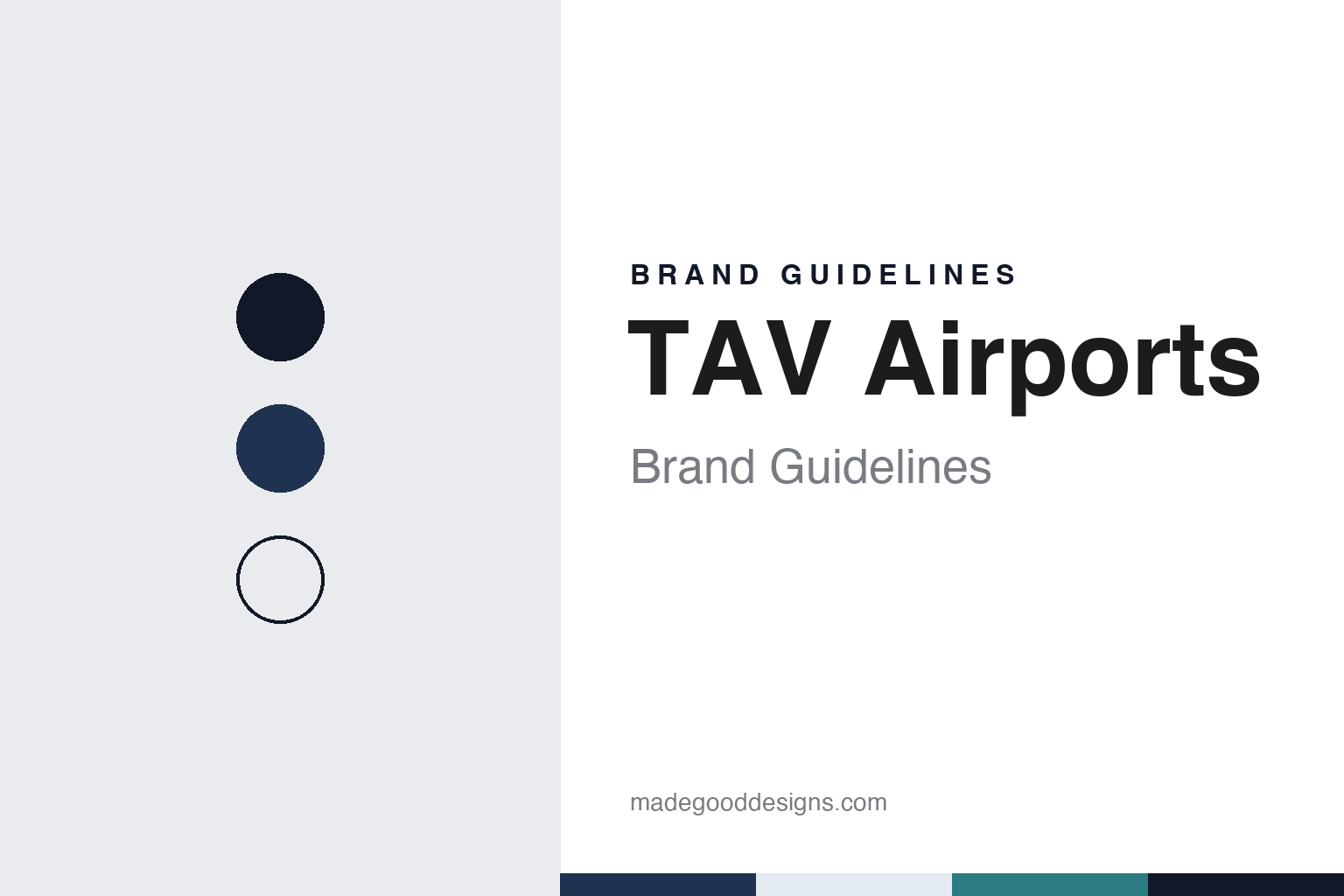
TAV Airports Brand Guidelines
A 1997 Istanbul terminal venture, now part of Groupe ADP.
Aa
Two constants: a TAV Airports deep blue and teal palette and an Open geometric sans register. Abstract homage — not a TAV Airports asset or mark; no logo, sign or terminal design is reproduced.
Tepe and Akfen
A terminal tender, a joint venture and a letter T.
TAV Airports began in 1997 in Istanbul. Turkish Wikipedia says the company was formed that year as a partnership of Bilkent Holding and Akfen Holding after it won the tender for the international terminal at Istanbul’s Atatürk Airport, and that the T in the name stands for Tepe İnşaat, Bilkent’s construction company. English Wikipedia describes the same founding as a joint venture of Tepe Construction, Akfen and Airport Consulting Vienna. The company’s own timeline dates the start of its operations at Istanbul Atatürk to 2000, and says the airport grew from about 10 million passengers to a place among the top ten airports in the world by 2018.
The building side and the airport side later went separate ways. In 2006, Turkish Wikipedia says, the group was reorganised into two companies: TAV Havalimanları Holding, the airport operator this guide covers, and TAV İnşaat, the construction company. The operator’s shares were first listed on the Istanbul stock exchange on 23 February 2007, under the ticker TAVHL, both the English and Turkish Wikipedia articles say.
Growth came through concessions. Companies like TAV, a 2016 Reuters report carried by Hürriyet Daily News explained, bid for the right to run an airport for a set number of years rather than buying the property itself. TAV’s timeline counts ten airports by 2010, after moves into Georgia, Tunisia and North Macedonia and three more airports in Türkiye. The same February 2016 report described how TAV’s contract to run Atatürk, then the home base of Turkish Airlines, was heading for expiry, and how the tender to run Istanbul’s new airport had gone to a consortium led by the Turkish group Limak. Atatürk does not appear in the list of airports TAV runs today.
Colour
Groupe ADP, in two steps.
The French connection came in two stages. On 12 March 2012, English Wikipedia says, TAV announced the planned sale of 38 percent of its share capital to Aéroports de Paris, the Paris operator now known as Groupe ADP; TAV’s timeline lists that 38 percent purchase under 2012. On 9 June 2017, Hürriyet Daily News reported, Akfen signed an agreement to sell its remaining 8.12 percent stake to ADP, taking the French group to 46 percent; ADP said it would then fully consolidate TAV in its financial statements, and Akfen’s chairman said TAV would remain a Turkish company with its listing in Istanbul.
By September 2017 the larger stake was in place. A Hürriyet Daily News report of 12 September 2017 described ADP’s holding as having risen to 46 percent, and set out an eleven-member board: five members nominated by Groupe ADP, one each nominated by the founding shareholders Tepe and Sera Yapı, and four independents. The same report said Tepe and Sera had sold a small part of their shares to foreign institutional buyers while keeping their seats. TAV’s ownership page, dated 31 December 2024, lists Groupe ADP first, Tepe İnşaat second and the free float third, and a 2024 Hürriyet Daily News report described TAV Airports as “a member of Groupe ADP.”
The portfolio kept changing around the loss of Istanbul. In June 2017 TAV and Al Rajhi Holding Group signed an agreement with Saudi Arabia’s General Authority of Civil Aviation to run the Yanbu, Qassim and Hail airports for 30 years, Hürriyet Daily News reported. In February 2018 TAV agreed to buy IC İçtaş’s 49 percent stake in the company running Antalya Airport, becoming a partner of the German operator Fraport with co-control; the paper quoted TAV as saying the move came four years after it had shifted strategy to make up for the expected closure of Atatürk. TAV’s timeline lists that Antalya agreement and a portfolio of 15 airports under 2018, and the extension of the Antalya and Ankara concessions beyond 2050 under 2022.
Central Asia followed. TAV holds 85 percent of the company that acquired Almaty Airport in Kazakhstan in 2021, alongside the Kazakhstan Infrastructure Fund, Hürriyet Daily News reported on 2 June 2024; the first passengers used Almaty’s new terminal on 1 June 2024, arriving from London, and the company said it raised the airport’s yearly capacity to more than 14 million passengers.
Typography
How airport operators present themselves.
An airport operator presents itself in two registers at once. Passengers meet the airport: its name, its signs, its terminals and its departure boards. Investors, governments and partner cities meet the operator: the company that holds the concession, publishes traffic figures and announces new terminals. Many operators keep these two faces apart, with a passenger-facing airport name and a separate corporate name for the group behind it.
Inside the terminal, the identity is carried mostly by wayfinding. Signs are set in a clear sans-serif, in short words with arrows and pictograms, and colour is used to separate departures, arrivals, transfers and ground transport. Some operators describe their signage as a system in its own right: VINCI Airports, for example, says its customer signage and furniture come in several ranges, so that each airport in its network can choose items to suit its size and budget.
Online, the airport becomes a guide to places. Route maps, destination pages and airline lists show where a traveller can fly, while terminal and runway photography, often taken at dawn or dusk, gives the airport a recognisable image. Retail, dining and parking pages present the terminal as a place to spend time, and some operators extend this into an “airport city” of hotels, offices and transport links around the runways.
The corporate layer is plainer. Owners and concession holders publish newsrooms, traffic reports, logo downloads and press photography, and they describe their airports by passenger numbers, routes and terminal projects, with dates. For designers, the category shows how one identity can work at walking pace for a hurried traveller and, at the same time, as a sober record for shareholders and the public authorities that grant the concessions.
Aa
An open geometric sans for a group name that sits behind many airports. (Specimen set in Plus Jakarta Sans, a sans STAND-IN; NOT the TAV Airports logo.)
TAV Airports
Fifteen airports, eight countries, one group name.
Today TAV Airports says it runs 15 airports in eight countries. In Türkiye its list covers Ankara Esenboğa, İzmir Adnan Menderes, Antalya, Milas-Bodrum and Gazipaşa-Alanya; abroad it names Zagreb in Croatia, Tbilisi and Batumi in Georgia, Almaty in Kazakhstan, Riga in Latvia, Skopje and Ohrid in North Macedonia, Madinah in Saudi Arabia, and Enfidha-Hammamet and Monastir in Tunisia. The company gives 113 million passengers for 2025 and more than 45,000 people across the group, and says it works through subsidiaries at every point of the airport value chain: ground handling, retail, food and beverage, hospitality and information technology. Its awards page names group companies including ATÜ Duty Free, BTA, Havaş, TAV Operation Services and TAV Technologies.
The company describes itself as “a brand that transformed the airport experience,” and states its purpose as “Welcome passengers, operate and imagine airports, in a responsible way and all around the world.” Its awards page says that in 2025 Ankara Esenboğa, İzmir Adnan Menderes, Milas-Bodrum and Skopje were ranked in Airports Council International’s Airport Service Quality awards, and that with Ohrid and Almaty joining in 2025, every airport in its portfolio is now certified under ACI EUROPE’s Airport Carbon Accreditation programme. Those are the company’s own statements about third-party schemes.
The group name and the airport names work at different levels. Passengers in Ankara or Tbilisi meet the airport’s own name first, while TAV Airports is the corporate name on investor pages, concession agreements and press releases, and Groupe ADP sits above it as the controlling shareholder. That layering is why TAV’s own website reads like a group site: airports, services and an investor section, rather than flight information.
For a design guide, TAV Airports shows how an operator’s name can sit quietly behind airports in eight countries, each keeping its own identity. Compare Groupe ADP, its controlling shareholder, and Aena, another listed operator that runs airports at home and abroad. For this guide we use a harbour deep blue and a gate teal with an open geometric sans, an unofficial interpretation; no product or logo is reproduced.
Explore & save
Keep TAV Airports’s identity on hand — save it to a board in the Made Good inspiration library.
TAV Airports identity set
Pin the TAV Airports deep blue and teal palette and the Open geometric sans register to your own board.