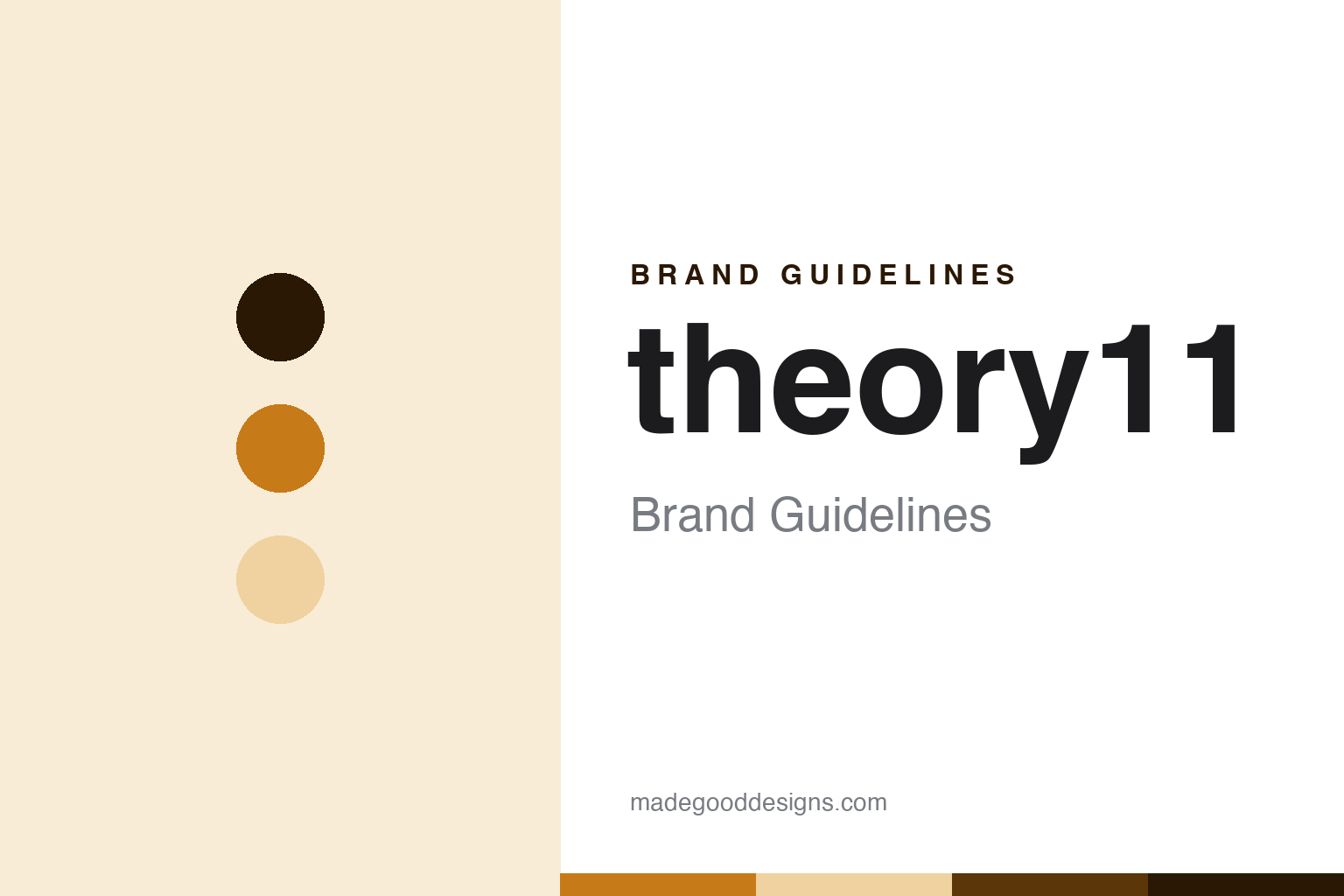
theory11 Brand Guidelines
The independent printed by the giant’s factory.
Aa
Two constants: a theory11-amber palette and a collector-sans register. Abstract homage — not a theory11 product or mark; no card, foil or logo is reproduced.
The independent printed by the giant’s factory
theory11 is the founder-led US deck brand (Jonathan Bayme, 2007; the luxury collector decks) that stays independent yet has its cards printed by USPCC, the very maker Cartamundi now owns.
theory11 follows Fournier as the round’s independent node — a founder-led brand that owns its designs but not its factory, and so lives one step from the giant the round keeps circling. Its answer to a round about who owns the deck is the nuance: an independent brand, a Cartamundi-owned printer.
Its identity is the independent printed by the giant’s factory. The 2007 founding, the collector decks and the USPCC printing are the story here. Independent, but printed by the giant. The independent printed by the giant’s factory.
(Honest notes, so the founding, the ownership, a nuance and the products are framed accurately. theory11 sells premium collector decks as its heroes; we report its language as the brand’s own. On founding: theory11, spelled lowercase with the digit 11, is a US company founded on 31 August 2007 by Jonathan Bayme, and its base is Charleston, South Carolina, so we say US-based rather than New York. On ownership: it is independent and privately held by Bayme, with no acquisition on record. On a nuance: its cards are printed by USPCC, which we attribute as reported, so the independent brand’s printer is the very maker Cartamundi now owns, an irony worth a line. On the products: premium and collector decks, magic and cardistry, puzzles and board games, with documented collaborations including a Derren Brown deck in 2019, the “Box One” board game with Neil Patrick Harris in 2020, a Whitney Museum deck with Shantell Martin in 2021, a Harry Potter jigsaw in 2024 and a Beatles deck in 2025, and other lines such as Monarchs and licensed decks reported but attributed. Its designs and the theory11 name are IP we describe but do not reproduce; there is no official brand hex; these tones are an unofficial interpretation.)
Colour
theory11 lives in a theory11 amber. Click a swatch to copy the hex.
theory11’s identity is independent, collector and premium — a theory11 amber, an ink, a pale amber, a deep umber, and a paper. The palette leans theory11 amber and deep umber: a warm, premium register that stands in for a luxury collector deck rather than a loud logo colour, though its own flagships lean black and gold. It signals the independent printed by the giant’s factory — independent, collector and premium. The honest caveat: with no official brand hex, these values are a premium, unofficial interpretation, not first-party colours.
The lesson is a theory11 amber signals an independent, premium identity. theory11’s world is the collector shelf and the cardist’s hands. For designers, it is a reminder that a warm amber and a pale amber can carry an independent, premium brand — a premium tone held as an accent, not a product shot. Because a warm hue can fail as small text, keep type dark and let the colour live in the accents, palette and band. The takeaways: date the founding to 2007 and name Jonathan Bayme; say US-based, not New York; keep the brand independent but the printer USPCC; and attribute the deck list.
Typography
The register is a collector sans — independent, collector, premium.
theory11’s identity carries an independent, collector spirit — a founder’s premium deck brand. A collector sans captures the mood: clean, modern and refined, the register of a luxury card maker. Set in a theory11-amber palette, the collector sans feels current and considered — exactly the personality theory11 carries. It behaves like a made, finished thing rather than a loud logo, mirroring a foil-ring and a court-dot. (theory11’s real products and the name are things we describe but do not reproduce, and the exact typeface is not ours to use.) Because it is not ours to use, the honest description is “a collector-sans brand,” shown here in a stand-in. The type behaves like the brand: independent, collector and premium.
Aa
A collector-sans brand — current and considered. (Specimen set in Jost, a collector-sans STAND-IN; NOT the theory11 logo or products.)
The playing-card node
theory11 stands for the independent printed by the giant’s factory.
theory11 sits fifth in the round as its independent node. A theory11-amber palette, a collector sans and a 2007 founding make one thing — the independent printed by the giant’s factory — the whole identity: independent, collector and premium. The 2007 founding is the pitch, the collector decks are the substance, and the USPCC printing is the frame. The point is an independent brand with a Cartamundi-owned printer, in a round about who owns the deck.
Put to work, the identity is the brand told straight, the base corrected and the nuance kept. A brand in this spirit would date the founding to 2007 and name Jonathan Bayme, say US-based not New York, keep the brand independent but the printer USPCC, and attribute the deck list. A reader in this spirit would keep the facts right: theory11 makes collector decks; it was founded in 2007 by Bayme; it is independent; and its cards are printed by USPCC. theory11 sits after Fournier and before Modiano. The honest editorial moves are to date the founding, to correct the base, to keep the nuance, and to attribute the list.
For designers and brand-builders, theory11 carries the playing-card node: separate owning a brand from owning a factory. The lessons: a brand can be independent yet depend on a giant’s plant, here theory11 printed by USPCC; a founding is dated to 31 August 2007 by Jonathan Bayme, spelled lowercase with the digit 11, US-based in Charleston, South Carolina rather than New York; an ownership is kept accurate, independent and privately held by Bayme with no acquisition on record; a nuance is kept, that its cards are printed by USPCC, attributed as reported, so the independent brand’s printer is the very maker Cartamundi now owns; and a product list is attributed, premium and collector decks, magic and cardistry, with documented collaborations including Derren Brown in 2019, “Box One” with Neil Patrick Harris in 2020, the Whitney deck with Shantell Martin in 2021, a Harry Potter jigsaw in 2024 and a Beatles deck in 2025, and lines such as Monarchs reported. It is also a reminder to stay precise: theory11 is the independent, USPCC-printed collector brand of the card aisle — with the palette here an unofficial interpretation. The hook is that standing: theory11 is the independent printed by the giant’s factory, the founder-led US deck brand from Jonathan Bayme in 2007, the luxury collector decks, that stays independent yet has its cards printed by USPCC, the very maker Cartamundi now owns. Read that way, theory11 is less a single deck than the independent printed by the giant’s factory: independent, collector, premium. The lesson for a brand is that separating owning a brand from owning a factory reinforces the honesty, and dating the founding keeps it earned. theory11 made the-independent-printed-by-the-giant the identity — proof that an independent can anchor a node.
Explore & save
Keep theory11’s identity on hand — save it to a board in the Made Good inspiration library.
theory11 identity set
Pin the theory11-amber palette and the collector-sans register to your own board.