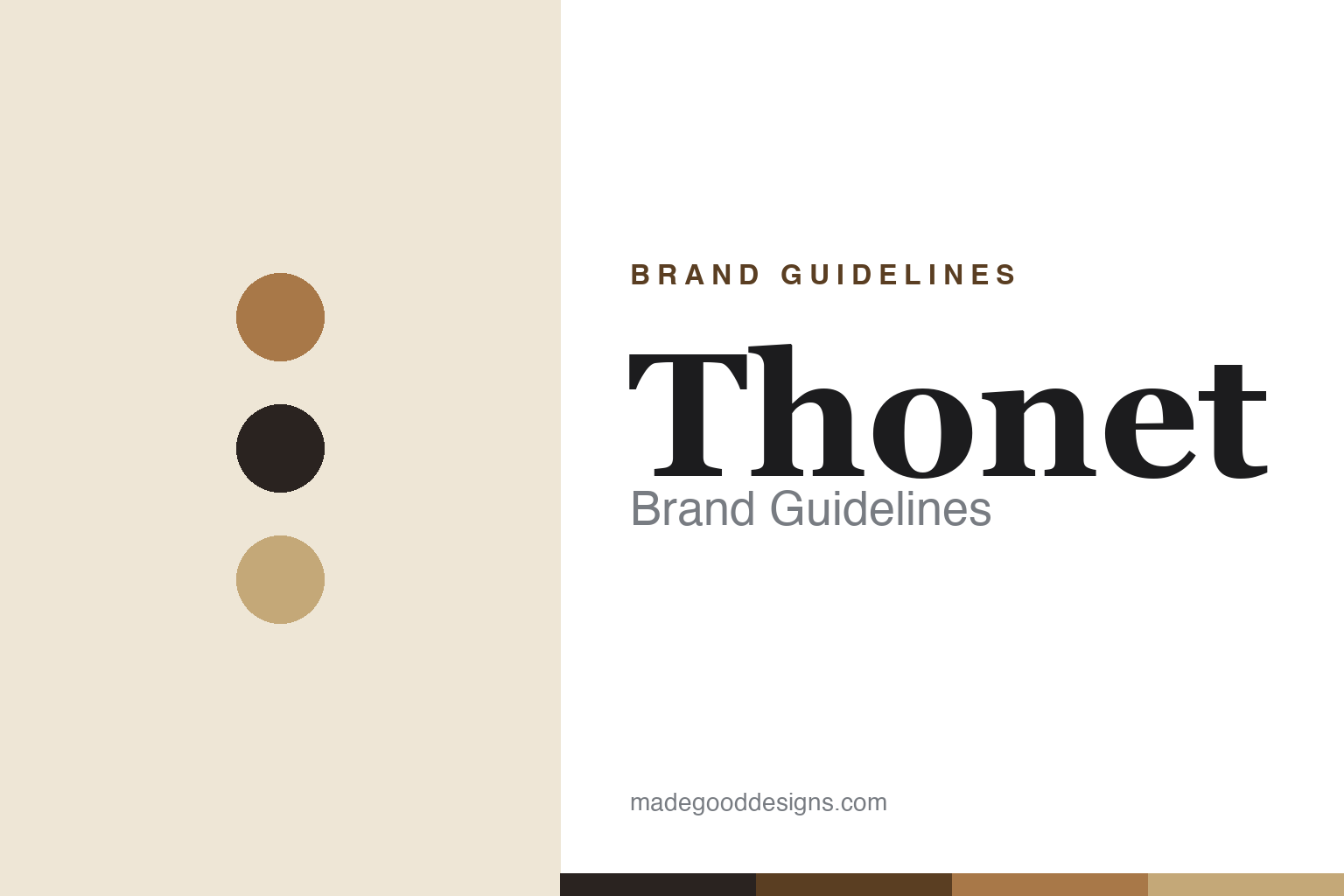
Thonet Brand Guidelines
Bent from beech — the coffee-house chair that became the first mass-produced furniture, flat-packed since 1859.
Aa
Two constants: a warm beech-and-black bentwood palette and a refined heritage serif. Abstract homage — not the Thonet wordmark.
Bent from beech
Thonet mass-produced the chair.
Thonet is a lesson in industrialising a chair. Its founder, Michael Thonet (born 1796 in Boppard, Germany), was a cabinetmaker who set up on his own in 1819 and pioneered bentwood furniture. (An honest note: his earliest breakthroughs used laminated, glued bent veneer; the mature solid steam-bending technique came later, after he moved to Vienna.) In 1853 he transferred the firm to his sons as “Gebrüder Thonet” (Thonet Brothers). (Two more notes: no official brand hex is published, and the wordmark typeface is undocumented.)
The icon is the Chair No. 14 (Model No. 14), introduced in 1859 — the “Vienna coffee-house chair.” It was made from just six pieces of steam-bent beech, ten screws and two nuts, and is often called the world’s first mass-produced piece of furniture. Its genius was logistics as much as form: 36 disassembled chairs fit into a one-cubic-metre box — flat-pack shipping a century before IKEA. It won a gold medal at the 1867 Paris Exposition, Le Corbusier praised it, and roughly 50 million were sold between 1859 and 1930 (with millions more since).
Thonet’s second act was modernism. It became a key manufacturer of the Bauhaus-era tubular-steel cantilever chairs — Marcel Breuer’s Cesca (from 1927–28) and Mart Stam’s cantilever designs. (Two honest notes: keep the model numbers straight — Breuer’s Cesca is B32/B64, now numbered S32/S64, while Mart Stam’s plain cantilever is S33/S43 — and the cantilever concept is generally credited to Mart Stam.) A final honest, important caveat: the family firm split, and today Thonet GmbH (the German company, in Frankenberg, with Thonet descendants still involved) is entirely separate from TON (a Czech company that operates the historic Moravian bentwood factory) — they are not the same company. Bent from beech.
Colour
Thonet lives in warm beech and black. Click a swatch to copy the hex.
Thonet’s identity leans on a warm, heritage bentwood palette — the honey and amber tones of steam-bent beech, walnut and darker stained woods, with black. The palette reads as crafted, timeless and European — the colours of a Vienna café and 165 years of woodworking rather than fashion — matching a brand built on bentwood craft and design history. It’s a warm, material-led palette that signals heritage and quality. The honest caveat: Thonet publishes no official brand hex, so the beech, walnut and near-black here are an original, unofficial interpretation of its materials, not first-party values.
The lesson is a warm bentwood palette signals craft and heritage. Thonet’s beech-and-black world reads as timeless and European. For designers, it’s a reminder that natural wood tones can convey design history and craft. The takeaways: use warm wood tones for bentwood heritage; let the material lead; and treat specific hexes as unofficial when the palette is wood-based.
Typography
The wordmark is a refined heritage serif — timeless and European.
Thonet’s identity carries a refined, heritage, European spirit — a clean “Thonet” wordmark whose classic letterforms read as timeless, crafted and design-historical. A refined heritage serif captures the mood: it feels like a Vienna café and a 19th-century workshop, matching a brand that invented mass-produced furniture and shaped modern design. Set against a warm beech-and-black palette, the type feels timeless and European — exactly the bentwood-heritage personality Thonet cultivates. It’s refined and classic rather than modern or loud, mirroring the elegant bentwood chairs. Because the exact wordmark face isn’t publicly documented, the honest description is “a refined heritage serif spirit,” not a named font. The type behaves like the brand: refined, heritage and European.
Aa
A refined heritage serif spirit — timeless and European. (Specimen set in Spectral, a refined serif in the spirit of the Thonet identity; the real face is undocumented.)
Process as the difference
Thonet invented the flat-pack.
Thonet is a lesson in manufacturing process as design innovation. The Chair No. 14’s genius wasn’t only its elegant bentwood form — it was the system behind it: a chair engineered from a handful of standardised, steam-bent parts that could be made in volume, shipped flat (36 to a box), and assembled anywhere. That’s a profound idea — Thonet essentially invented mass-produced, flat-pack furniture in 1859, a full century before it became the modern norm — and it shows that a breakthrough in how something is made can be as important as how it looks. The same process-led thinking carried into modernism, when Thonet industrialised the tubular-steel cantilever chairs of the Bauhaus. The lesson is that rethinking manufacturing and logistics — standardised parts, mass production, flat-pack shipping — can be a design innovation in its own right, one that democratises good design by making it affordable and available. Thonet didn’t just design a chair; it designed a way to make and ship chairs. Innovate the process, and you change the product forever.
For designers and brand-builders, Thonet offers a clear takeaway: innovation in process and logistics can be as powerful as innovation in form. The lessons: engineer for manufacture and shipping (standardised bent parts, flat-pack); let process democratise good design (affordable, mass-produced); and keep evolving the method (bentwood, then tubular steel). It’s also a reminder to keep the facts precise — Thonet was founded by Michael Thonet, pioneered bentwood, introduced the Chair No. 14 in 1859 (the first mass-produced furniture), manufactured the Bauhaus tubular-steel classics, and today Thonet GmbH is separate from the Czech firm TON. Thonet invented the flat-pack — proof that process can be the difference.
Explore & save
Keep Thonet’s identity on hand — save it to a board in the Made Good inspiration library.
Thonet identity set
Pin the bentwood palette and the heritage-serif spirit to your own board.