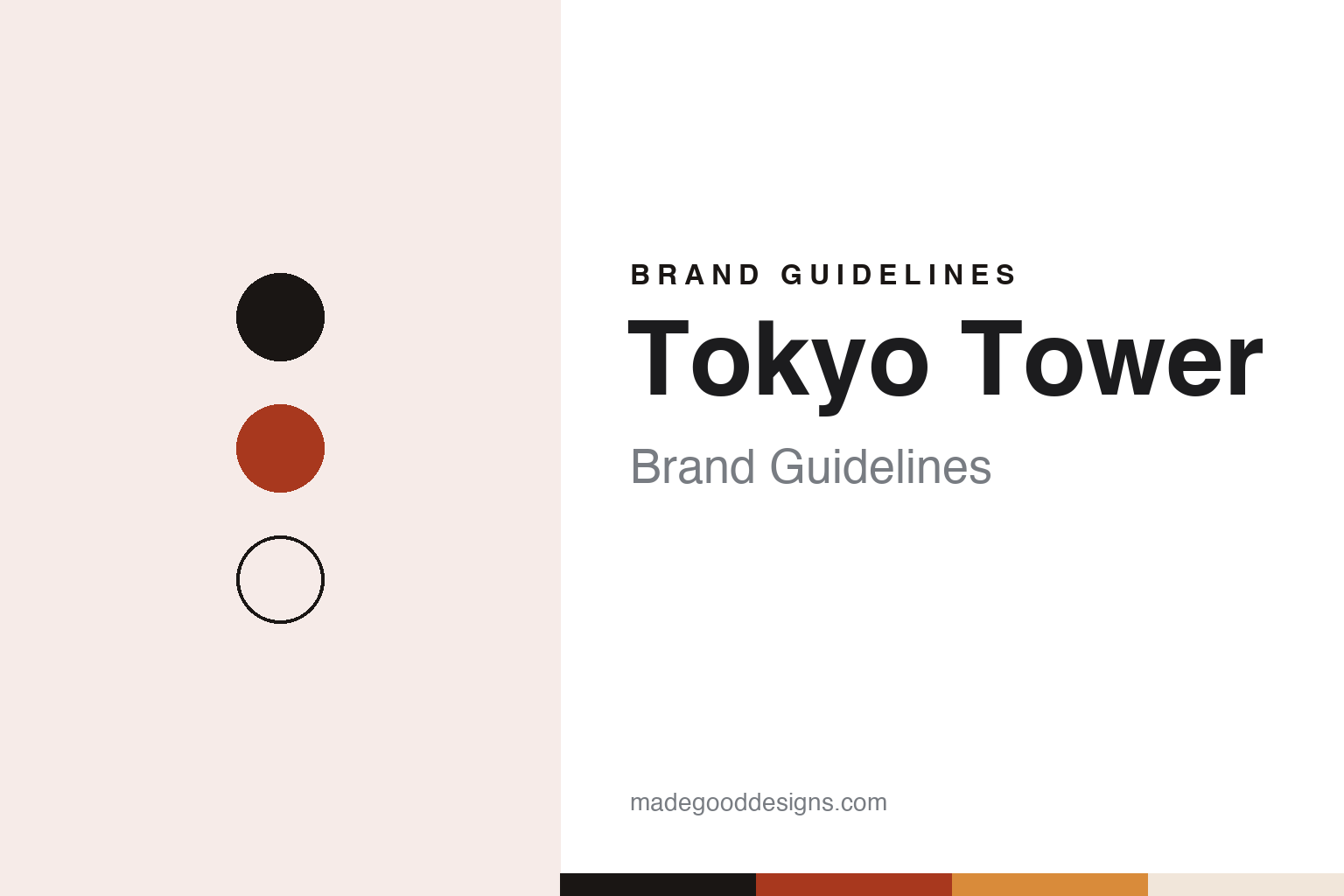
Tokyo Tower Brand Guidelines
Minato’s 333-metre red-and-white tower since 1958.
Aa
Two constants: a vermilion, amber and white palette and a Showa mincho serif register. Abstract homage — not a Tokyo Tower asset; no logo, mascot or lighting design is reproduced.
Nippon Denpato
One tower for every channel.
Tokyo Tower is a lattice broadcasting and observation tower in Shiba Park, in Tokyo’s Minato ward, near the temple Zōjōji. It opened to the public on 23 December 1958 and stands 333 metres high, Nippon.com reported in a December 2022 profile, which adds that at the time it was the tallest freestanding tower in the world, ahead of the Eiffel Tower. Time Out Tokyo says the resemblance to the Paris tower is deliberate, and so is the extra 13 metres.
The tower solved a broadcasting problem. TV Tokyo’s business programme Cambria Palace, in a June 2022 report, explained that in the 1950s each Tokyo station built its own mast, so viewers had to turn their aerials whenever they changed channel, and the masts cluttered the skyline. The Ministry of Posts and Telecommunications proposed a single combined broadcasting tower, and the newspaper publisher Hisakichi Maeda, founder of the Nihon Kogyo Shimbun, the forerunner of the Sankei Shimbun, took it on. With backing from business circles he set up Nippon Denpato, the Japan Radio Tower company, in 1957. The company’s own history gives its founding as May 1957, the opening of the tower in 1958 and the start of television transmissions from it in 1959.
The designer was the architect and engineer Tachū Naitō. TV Tokyo reported that he produced more than 10,000 drawings by hand in about three months, without calculators, and that the Takenaka Corporation built the tower in about a year and a half, largely by hand, with rivets heated, thrown and caught in metal tubes before being hammered home. Nippon.com quoted Naitō describing the result as “stability without waste,” “a beauty created by numbers.”
The company has since changed its name twice. Its corporate history records a change to Tokyo Tower in December 2018 and to TOKYO TOWER Co., Ltd., written in capitals, in October 2019. It describes its business as running a combined broadcasting tower, a tourist facility and property leasing, and TV Tokyo described it in 2022 as a private company led by Shin Maeda, its president since 2005, who also heads the Mother Farm tourist farm in Chiba.
Colour
International orange and two lights.
The colours are not a free choice. Nippon.com explained that the tower’s red and white bands, with a red technically described as “international orange,” are required under Japan’s Civil Aeronautics Act for structures above a certain height.
Night is a separate identity. The company’s history dates the tower’s lighting to January 1989, when a new illumination system was completed and the “Tokyo Tower” light-up, now called the Landmark Light, was switched on. TV Tokyo reported that the scheme was designed by the lighting designer Motoko Ishii, who chose to light the structure itself from below rather than trace its outline with bulbs. Nippon.com describes the Landmark Light as orange for most of the year and silver in summer, from 180 lamps that are replaced by hand twice a year, with the change of season marked at Tanabata in July.
A second scheme followed. The company dates the Diamond Veil to December 2008, for the tower’s 50th anniversary, and its successor, the Infinity Diamond Veil, to November 2019. Nippon.com says the newer system uses 268 LED lights that can run many patterns, with monthly colours on Monday evenings, while TV Tokyo gave the example of a sky blue for May. On full-moon nights the upper half is switched off so the moon can be seen, both outlets reported. Around Boys’ Day in May, 333 carp streamers hang in front of the tower, Nippon.com adds.
The tower’s place in the city’s memory is partly cinematic. Nippon.com notes that it appears under construction in the 2005 film Always: Sunset on Third Street and finished in its 2007 sequel.
Typography
Towers, decks and their owners.
Observation towers and decks across Asia-Pacific and the Gulf are owned and run by a wide mix of businesses: railway groups, broadcasters, property developers and listed leisure companies. Some are broadcasting towers in their own right; others are decks at the top of office or mixed-use buildings. This guide looks at how each one presents itself, in plain terms and with dates where sources give them.
The names, logos and mascots are usually published by the operators themselves. Tokyo Skytree, for example, introduced a mascot called Sorakara and staff uniforms designed by the textile designer Akira Minagawa, Monocle reported in 2012, while Tokyo Tower’s company history records each renaming of its decks and of the company itself. Where an architect or engineer is credited, this guide names them only as a dated source does.
Lighting is a large part of the identity for several of them. Tokyo Tower’s Landmark Light dates from 1989 and its LED Infinity Diamond Veil from 2019, according to the company, and Tokyo Skytree’s Iki, Miyabi and Nobori schemes draw on Edo-period ideas of style, Nippon.com reported in 2022. Tickets, wayfinding, deck names, souvenir shops and seasonal displays carry the same identity at a smaller scale, from deck signage to tower-shaped bottles and stamps.
Each guide sets out who opened the tower or deck and when, who owns and operates it now, how it has been renovated or renamed, and what its own corporate pages say about its history, marking clearly what rests on the operator’s word. The palettes and typefaces shown are unofficial interpretations; no logo, mascot or lighting design is reproduced.
Aa
A Showa-era mincho serif for a tower built by hand in 1958. (Specimen set in Shippori Mincho, a serif STAND-IN; NOT the Tokyo Tower logo.)
Tokyo Tower
Main Deck, Top Deck and a shrine.
The decks have been renamed and rebuilt. The company dates its upper observatory to 1967 and records a renewal of both observatories in 2002. In March 2018 the Special Observatory was renamed the Top Deck and the Grand Observatory the Main Deck, and the Top Deck Tour began; the Main Deck reopened after renovation in September 2019. Nippon.com gives the decks as 150 metres and 250 metres, and describes the reservation-only tour; Time Out Tokyo says the Top Deck, which opened in spring 2018, is laid out with mirrored walls. Visitors can also climb about 600 open-air steps to the Main Deck, and TV Tokyo reported that each climber can collect one of ten kinds of certificate.
Broadcasting moved on but did not stop. TV Tokyo reported that television transmission moved to Tokyo Skytree in 2013 with the switch to digital broadcasting, and Nippon.com says Tokyo Tower still keeps reserve digital terrestrial equipment and transmits some FM signals. The tower was registered as a tangible cultural property of Japan in 2013, Nippon.com reported.
The souvenir culture is part of the brand. TV Tokyo described an official shop selling a tower-shaped water bottle, a puzzle-cube keyholder and a seal stamp from Tower Daijingu, the small shrine on the deck, alongside older souvenir stalls that date from the tower’s early years and still sell Japanese dolls and hanging scrolls. In April 2022, it reported, the former wax-museum space became RED° TOKYO TOWER, an esports and games venue.
For a design guide, Tokyo Tower shows how a rule-bound colour, a hand-drawn lattice and a lighting scheme can carry a brand for more than six decades. Compare Tokyo Skytree, which took over its television role, and Abeno Harukas, the Osaka skyscraper with its own observatory. For this guide we use a vermilion, an amber and a warm white with a serif, an unofficial interpretation; no product or logo is reproduced.
Explore & save
Keep Tokyo Tower’s identity on hand — save it to a board in the Made Good inspiration library.
Tokyo Tower identity set
Pin the Tokyo Tower vermilion, amber and white palette and the Showa mincho serif register to your own board.
Source & notes
Frequently Asked Questions
What font can I use to match the Tokyo Tower look?
This guide describes Tokyo Tower’s type as “A Showa-era mincho serif for a tower built by hand in 1958”. Its type specimen is set in Shippori Mincho from Google Fonts as a stand-in; Shippori Mincho is not Tokyo Tower’s own lettering.
What colours are in the Tokyo Tower palette?
This guide’s Tokyo Tower palette is Lattice ink #1A1614, Signal vermilion #A8381E, Lamp amber #D98B3A, Daylight white #F1E6DA and Paper #FAF7F3. The tones are the guide’s own unofficial interpretation, not official Tokyo Tower hex codes.
When did Tokyo Tower open?
Tokyo Tower opened on 23 December 1958, in Shiba Park, Minato, Tokyo.