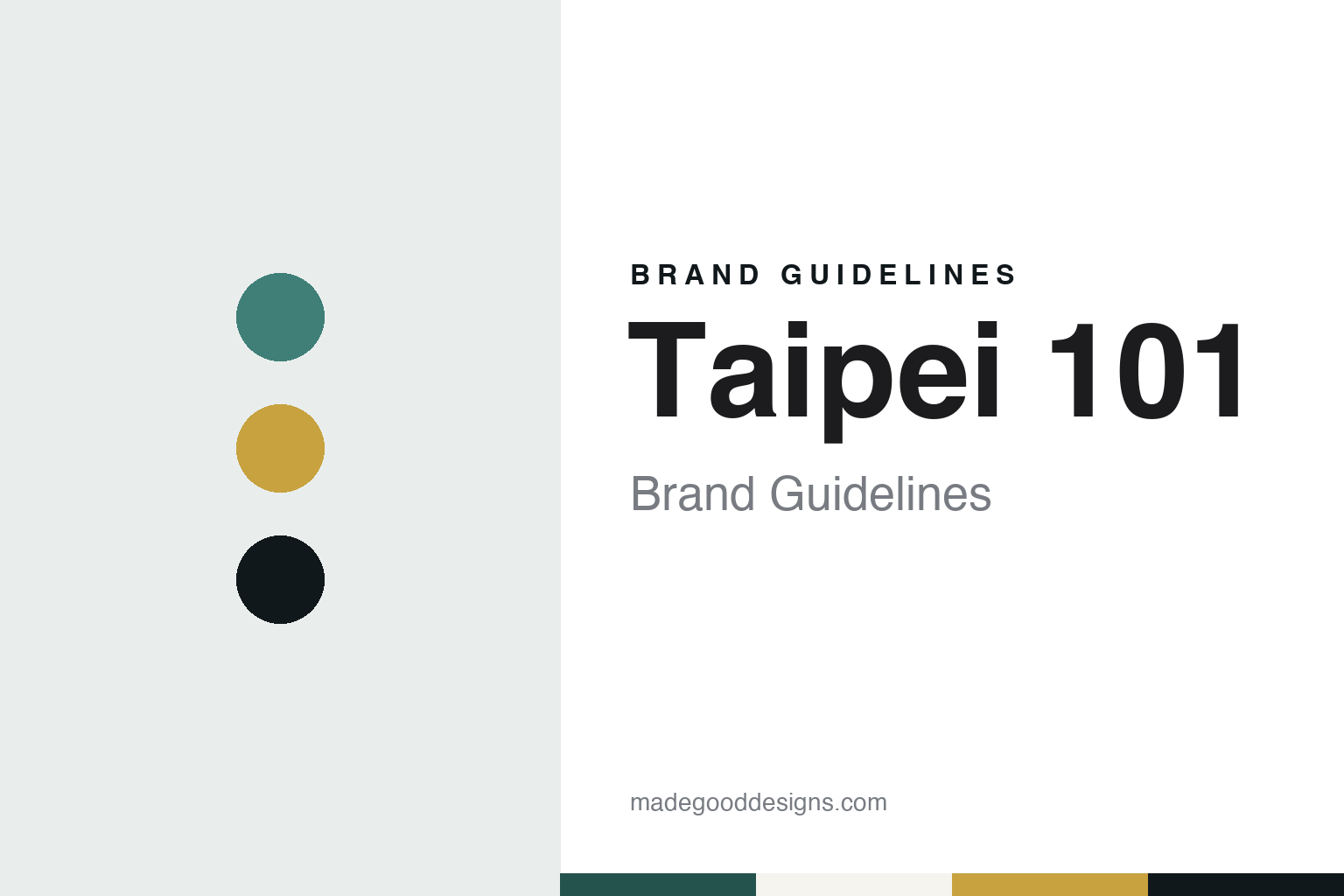
Taipei 101 Brand Guidelines
Eight-storey segments, coin emblems and a tuned mass damper.
Aa
Two constants: a Taipei 101 bamboo-glass green and ingot gold palette and a Classic serif register. Abstract homage — not a Taipei 101 product or mark; no logo, emblem, mascot or building image is reproduced.
Taipei World Financial Center
A bank-led consortium and a 101-floor tower.
Taipei 101 stands in Taipei’s Xinyi District and was originally known as the Taipei World Financial Center, English Wikipedia says. Its owner and developer is the Taipei Financial Center Corporation, according to the Skyscraper Center tall-building database; English Wikipedia describes the corporation as a team led by several Taiwanese banks and insurance companies, which won the right to lease the site and develop the building under a build-operate-transfer agreement with the city government.
The Skyscraper Center dates the proposal to 1997, the start of construction to 1999 and completion to 2004. English Wikipedia gives ground-breaking on 31 January 1999, the topping-out of the mall in June 2001 and of the tower on 1 July 2003, and the formal opening on 31 December 2004, when the public rode the elevators up to the observatory and the building staged its opening New Year fireworks a few hours later.
The design is credited to C.Y. Lee & Partners Architects/Planners, the practice of the architect C.Y. Lee; English Wikipedia names C.Y. Lee and C.P. Wang as the architects. The Skyscraper Center lists Evergreen Consulting Engineering and Thornton Tomasetti as structural engineers, Turner International as project manager, Samsung C&T as main contractor and Motioneering for the damping system. The owner’s corporate page credits building construction to the KTRT group, formed by Kumagai Gumi, Taiwan Kumagai, RSEA Engineering and Ta-Yo-Wei Construction, with construction management by Moh and Associates together with Turner.
The height figures depend on how they are measured. The Skyscraper Center gives 508 metres to the architectural top, 101 floors above ground and five below, and a highest occupied floor at 438 metres. Condé Nast Traveler wrote in March 2012 that Taipei 101 was the tallest building in the world from 2004 to 2010, when the Burj Khalifa in Dubai overtook it; the Skyscraper Center now ranks it eleventh in the world.
The building has been retrofitted rather than rebuilt. The Skyscraper Center records a retrofit from 2009 to 2011, and the Taipei Times reported on 29 July 2011 that Taipei 101 had received LEED Platinum certification from the US Green Building Council in the Existing Buildings: Operations and Maintenance category, after more than 20 months of changes with SL+A International, EcoTech International and Siemens. The outdoor observatory on the 101st floor opened to the public on 14 June 2019, English Wikipedia says.
Colour
Eight by eight.
The tower’s form is built from a repeated unit. The owner’s design-concept page, in Chinese, says the designers took the number eight — a homophone of the word for prosperity — as the design unit, so that each structural segment is eight floors high and the segments are stacked one upon another. It presents the idea under four headings, given in English on the site as “Prosperity Meets Nobility”, “Layers of Success”, “Enduring Fortitude” and “Full of Wealth”, and compares the segmented form to a stalk of bamboo rising joint by joint.
English Wikipedia lists further readings attached to the shape: the stacked segments recall a pagoda, bamboo and a pile of ancient ingots or money boxes; four discs on each face, where the base meets the tower, represent coins; and the emblem over the entrances shows three gold coins of ancient design whose central holes form the numerals 1-0-1. Curled ruyi figures, a traditional cloud-like motif, recur on the facade and inside the mall, and the curved roof of the adjoining mall ends in a large ruyi. The same article says the number 101 stands for the new century (100 plus 1) and for New Year’s Day (1-01).
The colour of the building is its glass. English Wikipedia describes the curtain walls as blue-green double-glazed glass and says the architect used the green tint to suggest slender bamboo, alongside eight outward-leaning upper tiers that recall a pagoda.
The engineering has become part of the visit. A steel pendulum hangs near the top of the tower as a tuned mass damper; Condé Nast Traveler described it in 2012 as a large yellow sphere between the 92nd and 87th floors that sways to offset the building’s movement in strong gusts. The damper has its own mascot, the Damper Baby. The magazine said four versions were sold in the gift shop as toys; English Wikipedia, which credits the design to Sanrio, lists five, named Rich Gold, Cool Black, Smart Silver, Happy Green and Lucky Red.
Typography
Towers, decks and their keepers.
Observation towers and decks across Asia-Pacific and the Gulf are owned and run by a wide mix of businesses: railway groups, broadcasters, property developers and listed leisure companies. Some are broadcasting towers in their own right; others are decks at the top of office or mixed-use buildings. This guide looks at how each one presents itself, in plain terms and with dates where sources give them.
The names, logos and mascots are usually published by the operators themselves. Tokyo Skytree, for example, introduced a mascot called Sorakara and staff uniforms designed by the textile designer Akira Minagawa, Monocle reported in 2012, while Tokyo Tower’s company history records each renaming of its decks and of the company itself. Where an architect or engineer is credited, this guide names them only as a dated source does.
Lighting is a large part of the identity for several of them. Tokyo Tower’s Landmark Light dates from 1989 and its LED Infinity Diamond Veil from 2019, according to the company, and Tokyo Skytree’s Iki, Miyabi and Nobori schemes draw on Edo-period ideas of style, Nippon.com reported in 2022. Tickets, wayfinding, deck names, souvenir shops and seasonal displays carry the same identity at a smaller scale, from deck signage to tower-shaped bottles and stamps.
Each guide sets out who opened the tower or deck and when, who owns and operates it now, how it has been renovated or renamed, and what its own corporate pages say about its history, marking clearly what rests on the operator’s word. The palettes and typefaces shown are unofficial interpretations; no logo, mascot or lighting design is reproduced.
Aa
A classic serif — eight floors to a segment. (Specimen set in Noto Serif, a serif STAND-IN; NOT the Taipei 101 logo.)
TAIPEI 101
A name set in capitals.
The building styles its name in capitals, TAIPEI 101, as both the owner’s website and the Skyscraper Center show; its Chinese name is 台北101. The website groups the visit into mall, dining and observatory pages, alongside a corporate section for office tenants, and lists the observatory on the 89th, 91st and 101st floors; copyright on the site is held by TAIPEI 101 Limited.
Light gives the tower a weekly rhythm. English Wikipedia says it is lit each evening in one of seven colours on a weekly schedule, from violet on Sunday through red, orange, yellow, green and blue to indigo on Saturday, and that the New Year’s Eve fireworks from the tower are a regular part of celebrations and broadcasts. The building also stages events on its own stairs: English Wikipedia dates the inaugural Taipei 101 Run Up, a race up the stairwell from the 1st to the 91st floor, to 20 November 2005.
Art is part of the identity too. English Wikipedia lists works in and around the building, including Rebecca Horn’s Dialog between Yin and Yang and Robert Indiana’s LOVE, and says the indoor observatory hosts a regular series of exhibitions. Inside the mall, the same article notes, the ruyi returns as a recurring motif.
For a design guide, Taipei 101 shows how one numeric idea — eight-floor units, coins and the 1-0-1 emblem — can run from structure to signage to souvenirs. Compare Burj Khalifa, the tower that overtook it in height according to Condé Nast Traveler, and N Seoul Tower, another observatory that uses lighting colour as part of its identity. For this guide we use a bamboo-glass green and an ingot gold with a serif, an unofficial interpretation; no product or logo is reproduced.
Explore & save
Keep Taipei 101’s identity on hand — save it to a board in the Made Good inspiration library.
Taipei 101 identity set
Pin the Taipei 101 bamboo-glass green and ingot gold palette and the Classic serif register to your own board.
Source & notes
Frequently Asked Questions
What font can I use to match the Taipei 101 look?
This guide describes Taipei 101’s type as “A classic serif — eight floors to a segment”. Its type specimen is set in Noto Serif from Google Fonts as a stand-in; Noto Serif is not Taipei 101’s own lettering.
What colours are in the Taipei 101 palette?
This guide’s Taipei 101 palette is Bamboo glass #3F7F78, Ingot gold #C7A23F, Night ink #11181B, Deep jade #24524D and Paper #F5F4EE. The tones are the guide’s own unofficial interpretation, not official Taipei 101 hex codes.
Who owns Taipei 101?
Taipei 101 is owned by Taipei Financial Center Corporation. This guide gives Xinyi District, Taipei as where Taipei 101 is based.
Where is Taipei 101 based?
Taipei 101 is based in Xinyi District, Taipei. This guide lists Taipei Financial Center Corporation as its owner.