Macau Tower Brand Guidelines
The 2001 tower by the Nam Van lakes, managed by Shun Tak.
Aa
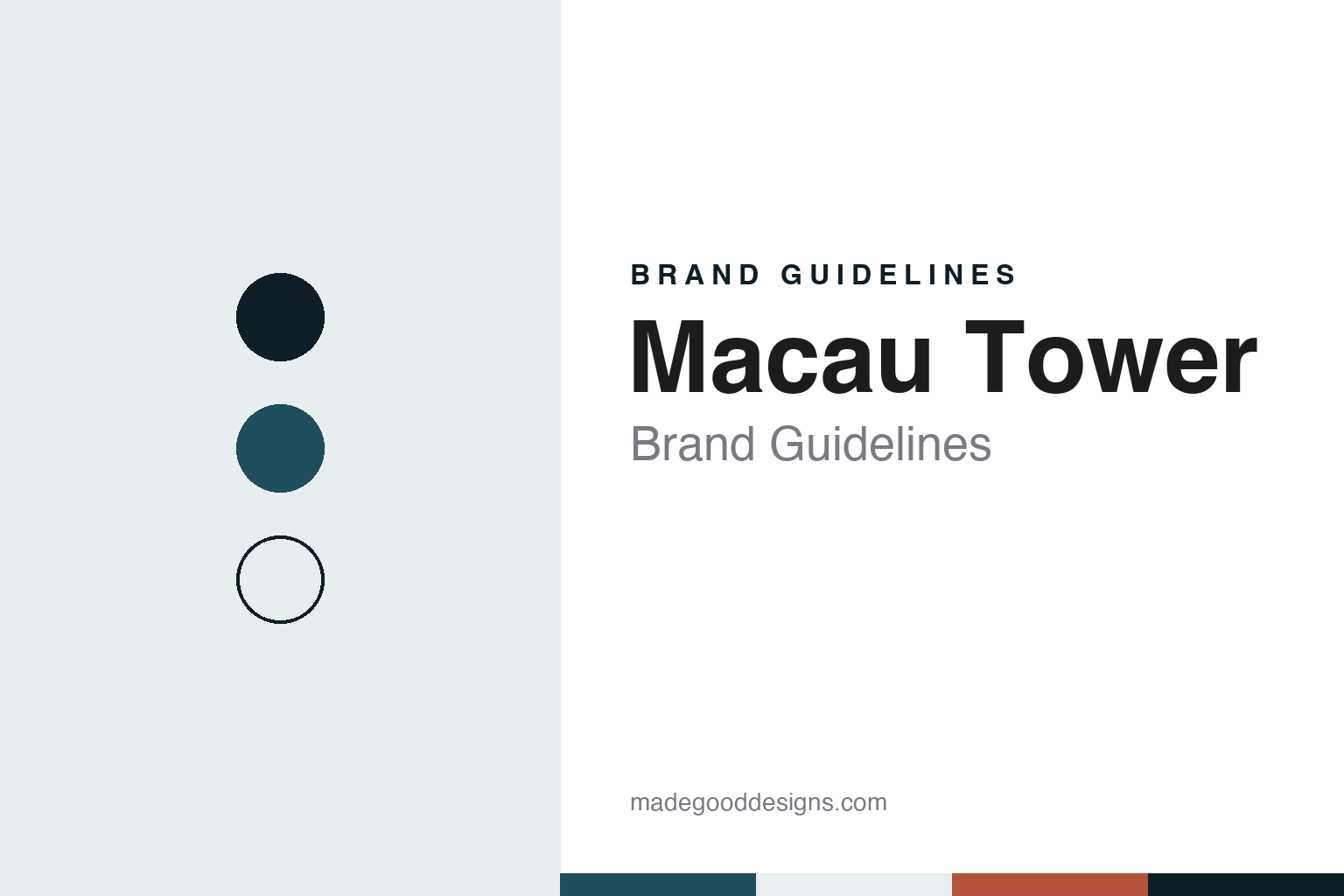
Two constants: a Macau Tower harbour teal and terracotta palette and an Engineered sans register. Abstract homage — not a Macau Tower asset or mark; no building image, logo or nameplate is reproduced.
A tower in the Nam Van reclamation
A New Zealand design for a Macau waterfront.
Macau Tower stands in Sé, on the southern edge of the Macau peninsula, and its full name is longer than most visitors use. English Wikipedia gives it as the Macau Tower Convention and Entertainment Center, in Chinese 澳門旅遊塔會展娛樂中心 and in Portuguese Centro de Convenções e Entretenimento da Torre de Macau; the tower’s own website signs itself the Macau Tower Convention & Entertainment Centre. The shorter names, Macau Tower and Torre de Macau, are what appear on most of its signs and pages.
The tower began with a visit to New Zealand. The company’s own history page says construction started in 1998, after the Macau businessman Stanley Ho visited the Sky Tower in Auckland and decided to build one like it in Macau. English Wikipedia, citing Tim Simpson’s 2023 book Betting on Macau, published by the University of Minnesota Press, tells the same story: the tower was designed by the New Zealand architect Gordon Moller and engineered by the New Zealand firm Beca for Sociedade de Turismo e Diversões de Macau. The same article names Les Dykstra as an architect on the project, and lists the Auckland practice Craig Craig Moller as architect in its summary panel.
Simpson’s book, as cited by Wikipedia, places the tower inside the larger Nam Van land reclamation project, which reshaped the old Praia Grande waterfront and added about 130 hectares of land to the peninsula. The tower was officially opened on 19 December 2001, Wikipedia says; the tower’s website gives the inauguration as December 2001, and in 2026 its promotions mark the tower’s 25th anniversary.
Colour
Decks, dining and a walkway around the rim.
English Wikipedia gives the tower’s height as 338 metres from ground level to the tip of the mast, with a roof height of 248 metres, and says the structure is also used for telecommunications and broadcasting. It also lists the tower as a member of the World Federation of Great Towers.
The visitor offer is organised by floor. The tower’s website describes an Observation Deck at 223 metres above ground, with glass windows three storeys high, and says a standard admission covers the Level 58 Observation Lounge and the Level 61 Adventure Deck; the 180 Lounge sits on level 59. Wikipedia describes the level 61 deck as an outdoor observation deck.
The outer rim is the tower’s second stage. At 233 metres, the website says, visitors can take the Skywalk, a 1.8-metre-wide walkway around the outside of the tower, and the operator lists a skyjump, a bungy jump and a tower climb, all run by the New Zealand adventure company AJ Hackett, whose guests book on that company’s own website. Wikipedia says the tower has been used for staged jumps by professional jumpers and for entertainment shows, and that it appeared in an episode of The Amazing Race: All-Stars originally aired on CBS on 22 April 2007.
Food is the third part of the offer. The website lists 360 Café, a buffet and high-tea room at the top of the tower, alongside Tromba Rija, a Portuguese restaurant, Lua Azul, a Chinese restaurant, a patisserie and Café on 4. Tromba Rija’s roasted suckling pig is sold for takeaway, and the tower’s shop sells souvenirs, plush toys and cakes shaped after the tower.
The convention centre in the name is a real part of the business. The tower’s meetings and events pages describe a banquet hall for more than 800 guests, an outdoor plaza and a fourth-floor terrace with the Sai Van Bridge as a backdrop, and two decades of weddings, some photographed on the Skywalk.
Typography
How the category presents itself.
Observation towers and decks across Asia-Pacific and the Gulf are owned and run by a wide mix of businesses: railway groups, broadcasters, property developers and listed leisure companies. Some are broadcasting towers in their own right; others are decks at the top of office or mixed-use buildings. This guide looks at how each one presents itself, in plain terms and with dates where sources give them.
The names, logos and mascots are usually published by the operators themselves. Tokyo Skytree, for example, introduced a mascot called Sorakara and staff uniforms designed by the textile designer Akira Minagawa, Monocle reported in 2012, while Tokyo Tower’s company history records each renaming of its decks and of the company itself. Where an architect or engineer is credited, this guide names them only as a dated source does.
Lighting is a large part of the identity for several of them. Tokyo Tower’s Landmark Light dates from 1989 and its LED Infinity Diamond Veil from 2019, according to the company, and Tokyo Skytree’s Iki, Miyabi and Nobori schemes draw on Edo-period ideas of style, Nippon.com reported in 2022. Tickets, wayfinding, deck names, souvenir shops and seasonal displays carry the same identity at a smaller scale, from deck signage to tower-shaped bottles and stamps.
Each guide sets out who opened the tower or deck and when, who owns and operates it now, how it has been renovated or renamed, and what its own corporate pages say about its history, marking clearly what rests on the operator’s word. The palettes and typefaces shown are unofficial interpretations; no logo, mascot or lighting design is reproduced.
Aa
An engineered sans — plain, wide and legible at signage scale. (Specimen set in Archivo, a sans STAND-IN; NOT the Macau Tower logo.)
Macau Tower
A tower that is also a convention centre.
Ownership and management are described differently in different places, so both are given here. English Wikipedia lists Sociedade de Turismo e Diversões de Macau, known as STDM, as the owner, and names Shun Tak as the operator. Shun Tak Holdings, the Hong Kong group whose interests include property, hospitality and the TurboJET ferry brand, describes the Macau Tower Convention & Entertainment Centre as “managed by the Group,” and its milestones page records the centre’s launch in 2001. Shun Tak calls the venue a meetings and events centre as well as a tourist destination, which matches the tower’s own website, where dining and events take up as much space as the observation decks.
The partnership with AJ Hackett goes back to the tower’s early years. Wikipedia says that on 17 December 2006 the company’s founder, Alan John Hackett, and the entertainer Edison Chen set two Guinness World Records with jumps from the tower; Shun Tak’s own milestones page dates its record entry to 2005. The two partners have since worked together beyond Macau: Shun Tak says it formed a consortium with a company in the AJ Hackett group to develop and run the Adventure Zone at Ocean Park in Hong Kong.
The tower’s public face is built in three languages. Its website runs in English, traditional Chinese and simplified Chinese, the Portuguese name survives in the official title, and the restaurants are named in Portuguese and English. The overview page dates the inauguration to December 2001, and the shop turns the silhouette into small objects: an LED tower light, plush toys and tower cakes.
For a design guide, Macau Tower shows how one structure can carry several brands at once — a public landmark, a convention venue, a set of restaurants and a partner’s adventure business — under a single long name. Compare the Sky Tower in Auckland, the tower that inspired it and shares its designer, and Taipei 101. For this guide we use a harbour teal, a night ink and a terracotta with a sans, an unofficial interpretation; no product or logo is reproduced.
Explore & save
Keep Macau Tower’s identity on hand — save it to a board in the Made Good inspiration library.
Macau Tower identity set
Pin the Macau Tower harbour teal and terracotta palette and the Engineered sans register to your own board.
Source & notes
Frequently Asked Questions
What font can I use to match the Macau Tower look?
This guide describes Macau Tower’s type as “An engineered sans — plain, wide and legible at signage scale”. Its type specimen is set in Archivo from Google Fonts as a stand-in; Archivo is not Macau Tower’s own lettering.
What colours are in the Macau Tower palette?
This guide’s Macau Tower palette is Harbour teal #1E4D5C, Night ink #0F1E26, Mist #E9EEF0, Terracotta #B5523B and Paper #F7F6F2. The tones are the guide’s own unofficial interpretation, not official Macau Tower hex codes.
When did Macau Tower open?
Macau Tower opened on 19 December 2001, in Sé, Macau.