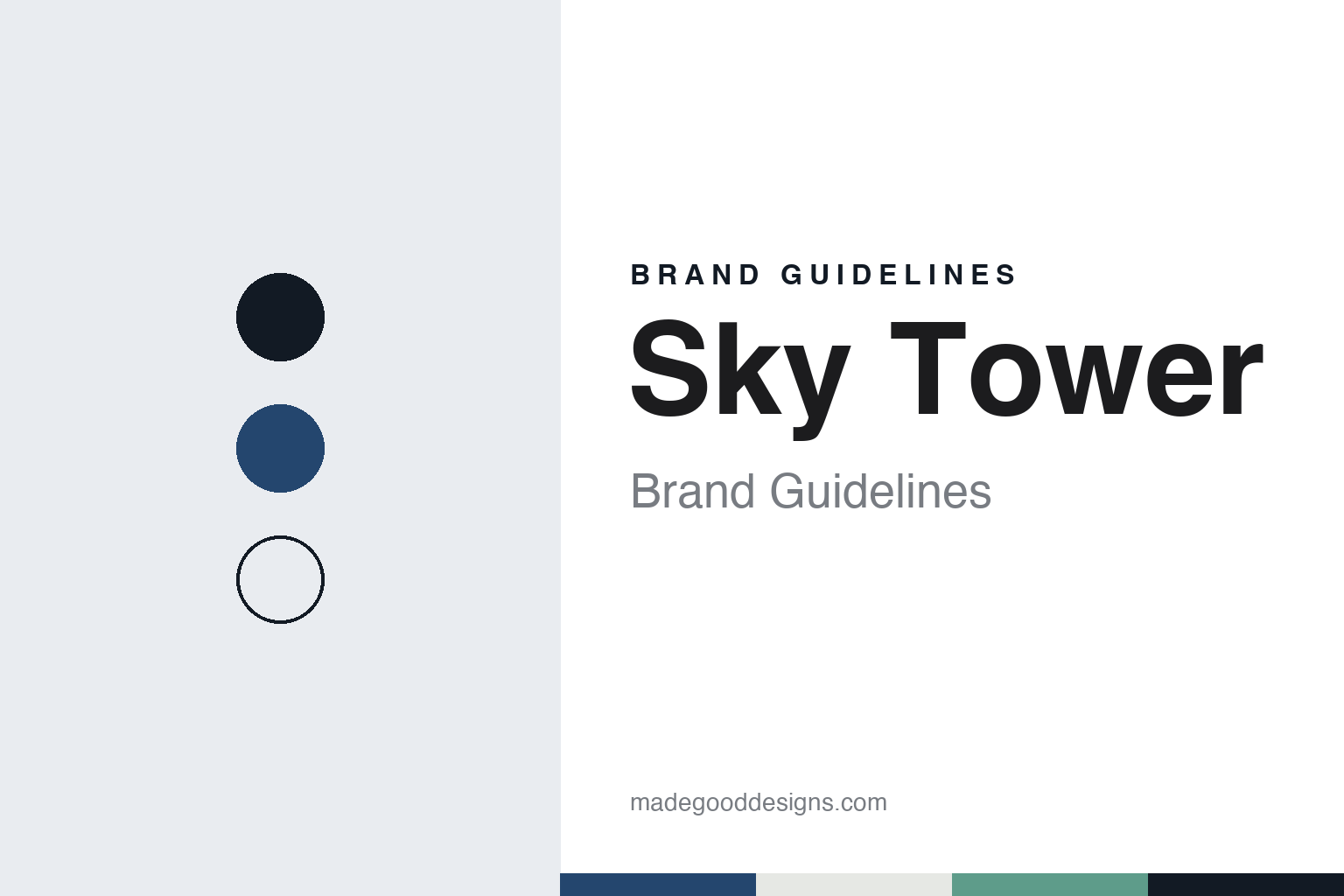
Sky Tower Brand Guidelines
Auckland’s 1997 concrete tower and its coloured lights.
Aa
Two constants: a Sky Tower harbour blue, concrete and glass green palette and a Condensed sans register. Abstract homage — not a Sky Tower or SkyCity asset or mark; no building image, logo or nameplate is reproduced.
A tower for Victoria and Federal Streets
Two years and nine months of concrete.
The Sky Tower stands at the corner of Victoria and Federal Streets in central Auckland. English Wikipedia describes it as a telecommunications and observation tower 328 metres tall from ground level to the top of the mast, built as part of the SkyCity Auckland complex between 1994 and 1997; citing The New York Times of October 1997, it says the complex was originally built for the American operator Harrah’s Entertainment. The tower’s owner today is SkyCity Entertainment Group, the company that, its website says, operates hotels, restaurants, bars and a convention centre across New Zealand and Australia.
Wikipedia says an early-1990s proposal to build a tower on Upper Symonds Street, in Eden Terrace, was rejected over viewshaft issues, and that an earlier version of the design would have been clad in stainless steel. The tower that was built was designed by Gordon Moller of the Auckland practice Craig Craig Moller, with Les Dykstra as project architect. Fletcher Construction was the builder, the engineers Beca handled design management and the structural and building-services engineering, and Harrison Grierson did the surveying.
Construction took two years and nine months, and the tower opened on 3 August 1997, according to Wikipedia; 1News repeated the same building time when it marked the tower’s 25th anniversary on 3 August 2022. Its report recalled that the tower rose with a crane fixed to the top, and replayed a 1996 interview with a sceptical passer-by. Writing in the New Zealand Herald the same week, Anne Gibson said many Aucklanders had baulked at the raw concrete design and critics had objected to its dominance over the landscape, while noting that the tower now seemed an inseparable part of the skyline.
Colour
Shaft, legs, pod and mast.
Wikipedia says the tower is built of high-performance reinforced concrete, with a 12-metre shaft containing four lifts and a stairwell, standing on eight legs over sixteen piles drilled into the local sandstone; the shaft was built with climbing formwork. The upper levels combine composite materials, structural steel and concrete, and the observation decks are clad in aluminium with blue-green reflective glass. A steel frame carries the mast, which was lifted into place by a crane attached to the tower itself.
The public levels are stacked in the pod. Wikipedia lists the Sky Bar on level 50, the Main Observation Deck on level 51, the Orbit 360° restaurant on level 52, The Lookout on level 53, where the SkyWalk and SkyJump start, and the Sky Deck on level 60. It describes the main observation level at 186 metres as having sections of glass floor, the Sky Deck just below the mast at 220 metres, and a revolving restaurant about 190 metres up that turns once an hour. The SkyJump is a guide-cable-controlled descent of 192 metres from the observation level, and tour groups can climb into the mast.
The tower also works as infrastructure. Wikipedia says the Auckland Peering Exchange sits on level 48, that the tower is Auckland’s main FM radio transmitter site, and that it is one of four infill transmitters for terrestrial television in the city, with twenty-three FM stations and six digital television multiplexes broadcasting from it.
Light is the tower’s most visible design element. The top half has been lit by LED lighting since May 2009, replacing metal halide floodlights, Wikipedia says, and the bottom half was converted to LED in 2019; the system is run by a DMX controller that can produce a wide range of colours. SkyCity has a lighting policy and invites the public to suggest occasions. Wikipedia’s list of regular schemes includes red and green for Christmas, red and gold for Chinese New Year, green for St Patrick’s Day and an orange base fading to yellow at the top for Matariki, the Māori new year.
Typography
How the category presents itself.
Observation towers and decks across Asia-Pacific and the Gulf are owned and run by a wide mix of businesses: railway groups, broadcasters, property developers and listed leisure companies. Some are broadcasting towers in their own right; others are decks at the top of office or mixed-use buildings. This guide looks at how each one presents itself, in plain terms and with dates where sources give them.
The names, logos and mascots are usually published by the operators themselves. Tokyo Skytree, for example, introduced a mascot called Sorakara and staff uniforms designed by the textile designer Akira Minagawa, Monocle reported in 2012, while Tokyo Tower’s company history records each renaming of its decks and of the company itself. Where an architect or engineer is credited, this guide names them only as a dated source does.
Lighting is a large part of the identity for several of them. Tokyo Tower’s Landmark Light dates from 1989 and its LED Infinity Diamond Veil from 2019, according to the company, and Tokyo Skytree’s Iki, Miyabi and Nobori schemes draw on Edo-period ideas of style, Nippon.com reported in 2022. Tickets, wayfinding, deck names, souvenir shops and seasonal displays carry the same identity at a smaller scale, from deck signage to tower-shaped bottles and stamps.
Each guide sets out who opened the tower or deck and when, who owns and operates it now, how it has been renovated or renamed, and what its own corporate pages say about its history, marking clearly what rests on the operator’s word. The palettes and typefaces shown are unofficial interpretations; no logo, mascot or lighting design is reproduced.
Aa
A condensed sans — tall, upright and economical, like the tower. (Specimen set in Barlow Semi Condensed, a sans STAND-IN; NOT the Sky Tower or SkyCity logo.)
Sky Tower
A landmark run as a visitor attraction.
The tower is marketed as one of SkyCity’s attractions rather than as a separate company. SkyCity Entertainment Group’s website lists Sky Tower as one of its news topics alongside its hotels, restaurants and the New Zealand International Convention Centre, and on 14 October 2026 it announced that Santa’s Magical Wonderland would return to the Sky Tower from 14 November to 24 December, with a snowy tunnel, a fairy garden and an “olde toy shop.” Seasonal programming of this kind sits alongside the year-round decks, the SkyWalk and SkyJump, and New Year’s Eve displays launched from the tower.
Anniversaries have been used to put the public in charge of the light. For the 25th birthday in August 2022, Concrete Playground reported, SkyCity ran a month of events; on 4, 5 and 6 August people at the base of the tower could choose its colour from options including pink, blue, green, gold and a scheme called “pastel party,” and a small exhibition of images on the main observation deck told the tower’s history. 1News marked the same date with its interview with a crane driver who had worked on the build.
The tower’s design also travelled. Macau Tower, opened in 2001, was designed by Gordon Moller and engineered by Beca after the Macau businessman Stanley Ho visited the Sky Tower, according to Macau Tower’s own history page and English Wikipedia, which calls it a tower “inspired by the Sky Tower, designed by the same company.” The two towers also share a structural idea, a single concrete shaft carrying a pod of public levels and a mast.
For a design guide, Sky Tower shows how a single concrete silhouette, criticised as it rose, can become a city’s changeable light sign, its colours set by calendar, policy and public choice. Compare Macau Tower, its sibling design, and Sydney Tower Eye across the Tasman. For this guide we use a harbour blue, a raw concrete and a glass green with a condensed sans, an unofficial interpretation; no product or logo is reproduced.
Explore & save
Keep Sky Tower’s identity on hand — save it to a board in the Made Good inspiration library.
Sky Tower identity set
Pin the Sky Tower harbour blue, concrete and glass green palette and the Condensed sans register to your own board.
Source & notes
Frequently Asked Questions
What font can I use to match the Sky Tower look?
This guide describes Sky Tower’s type as “A condensed sans — tall, upright and economical, like the tower”. Its type specimen is set in Barlow Semi Condensed from Google Fonts as a stand-in; Barlow Semi Condensed is not Sky Tower’s own lettering.
What colours are in the Sky Tower palette?
This guide’s Sky Tower palette is Harbour blue #24466E, Night slate #121A24, Raw concrete #E6E8E4, Glass green #5E9C8A and Paper #F8F7F4. The tones are the guide’s own unofficial interpretation, not official Sky Tower hex codes.
When did Sky Tower open?
Sky Tower opened on 3 August 1997, in Auckland CBD, New Zealand.
Who owns Sky Tower?
Sky Tower is owned by SkyCity Entertainment Group. This guide dates Sky Tower to 3 August 1997, in Auckland CBD, New Zealand.