Sydney Tower Eye Brand Guidelines
The Merlin-run deck in the golden turret above Sydney’s city centre.
Aa
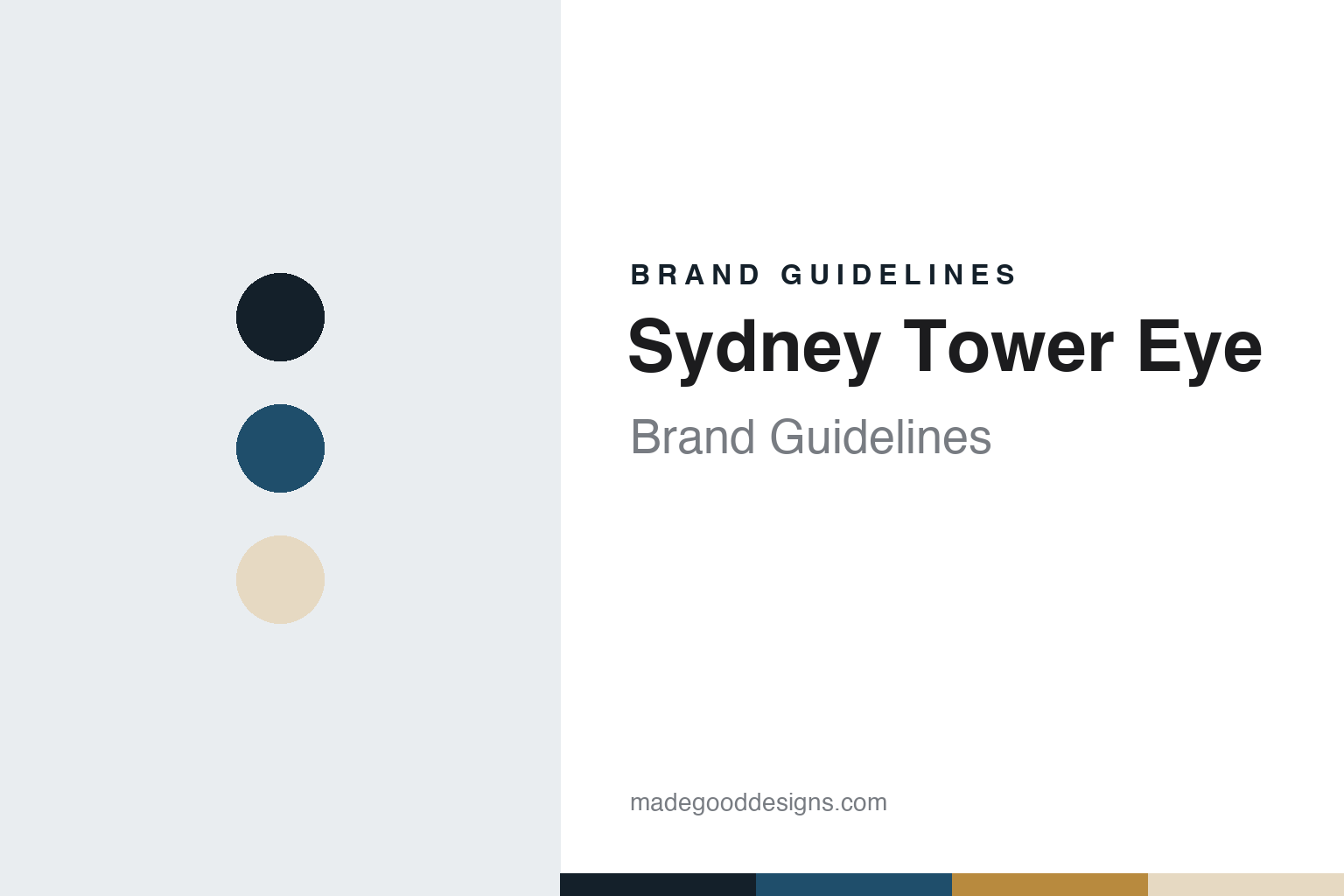
Two constants: a harbour blue, turret gold and sandstone palette and a geometric sans register. Abstract homage — not a Sydney Tower Eye asset; no logo, photograph or signage is reproduced.
From Centrepoint to Sydney Tower
A tower drawn in 1968 and opened in 1981.
The Sydney Tower Eye is the name of the observation deck at the top of Sydney Tower, the shaft-and-turret structure that rises above the Westfield Sydney shopping centre between Pitt Street Mall, Market Street and Castlereagh Street. The tower itself is older than its current name by three decades. According to the historian Mark Dunn, writing in the Dictionary of Sydney in 2008, it was conceived in 1968 by the architect Donald Crone, whose first designs were reputedly sketched on the back of a napkin. Work on the tower and the retail and office centre beneath it began in 1970, and the first shops opened in 1972.
English Wikipedia says the first plans were unveiled in March 1968, that the project was developed by AMP, with Concrete Constructions as main contractor, and that tower construction began in 1975. Public access began on 25 September 1981. A lightning rod added in 1998 took the overall height from 305 to 309 metres, the figure the operator gives today.
Dunn describes the construction as a piece of engineering as much as architecture. The turret was assembled from 46 prefabricated tubes erected one on top of another, while the tower head was jacked up the shaft hydraulically as it grew, and the whole structure is held by 56 steel cables anchored through the building below into bedrock. The operator’s own history page adds that each of the 46 barrel units weighed 27 tonnes and was fitted with lift rails and stairwells before it was hoisted, and that the spire went up in two halves, lifted from the side.
The design was argued over from the start. Dunn records Crone calling it an “incredible design concept,” the architect Anthony Gaskell calling it an “engineer’s folly,” and the columnist Leo Schofield criticising it in 1987. In 2004, he notes, the tower was nominated for the New South Wales State Heritage Register for rare technical achievement.
Colour
Four names on one skyline.
Locals have long called it Centrepoint Tower, after the shopping centre at its base; while AMP managed Centrepoint it was officially the AMP Tower; and after the Westfield Group took over ownership of Centrepoint in December 2001, the name was changed to Sydney Tower, both Dunn and English Wikipedia say. The operator’s website lists Westfield Centrepoint Tower and Sydney Skytower among the other names visitors use, and says the structure was never officially named Centrepoint Tower: it remains simply Sydney Tower, with the Sydney Tower Eye being the name of the viewing attraction on its upper level.
The current name came with a change of operator. In December 2010, the attractions trade journal blooloop reported that Merlin Entertainments had agreed to buy the Sydney Attractions Group from Village Roadshow, a package that included Sydney Aquarium, Sydney Wildlife World and the Sydney Tower Observatory and Skywalk. Merlin’s announcement named its “Eye” brand, then used only in the UK, for the observatory. English Wikipedia says Merlin acquired the rights to operate the deck in 2011 and renamed it the Sydney Tower Eye; a 4D cinema opened on the fourth floor on 23 September 2011.
The base changed too. In 2009 the centre below was closed for a refurbishment and reopened in stages from 2010 as Westfield Sydney, and in June 2011 the AMP banner on the tower was removed by helicopter and replaced with a large illuminated Westfield logo, English Wikipedia says. The shopping centre is now run by Scentre Group, the company created in June 2014 when the Westfield Group separated its Australian and New Zealand operations from its American and European businesses.
Typography
How towers and decks present themselves.
Observation towers and decks across Asia-Pacific and the Gulf are owned and run by a wide mix of businesses: railway groups, broadcasters, property developers and listed leisure companies. Some are broadcasting towers in their own right; others are decks at the top of office or mixed-use buildings. This guide looks at how each one presents itself, in plain terms and with dates where sources give them.
The names, logos and mascots are usually published by the operators themselves. Tokyo Skytree, for example, introduced a mascot called Sorakara and staff uniforms designed by the textile designer Akira Minagawa, Monocle reported in 2012, while Tokyo Tower’s company history records each renaming of its decks and of the company itself. Where an architect or engineer is credited, this guide names them only as a dated source does.
Lighting is a large part of the identity for several of them. Tokyo Tower’s Landmark Light dates from 1989 and its LED Infinity Diamond Veil from 2019, according to the company, and Tokyo Skytree’s Iki, Miyabi and Nobori schemes draw on Edo-period ideas of style, Nippon.com reported in 2022. Tickets, wayfinding, deck names, souvenir shops and seasonal displays carry the same identity at a smaller scale, from deck signage to tower-shaped bottles and stamps.
Each guide sets out who opened the tower or deck and when, who owns and operates it now, how it has been renovated or renamed, and what its own corporate pages say about its history, marking clearly what rests on the operator’s word. The palettes and typefaces shown are unofficial interpretations; no logo, mascot or lighting design is reproduced.
Aa
A clean geometric sans for a deck name set above a city. (Specimen set in Josefin Sans, a sans STAND-IN; NOT the Sydney Tower Eye logo.)
Sydney Tower Eye
A golden turret, a glass-floored walk and a new interior.
The visitor offer sits inside the golden turret, which the operator says holds two restaurant levels, the observation deck, two telecommunications levels and three plant levels. English Wikipedia places the enclosed deck on level four, about 250 metres above the ground, reached by three double-deck lifts, with the restaurants of Sydney Tower Dining, run by Trippas White Group, on the levels below. SKYWALK, written in capitals on the operator’s pages, is an open-air, glass-floored platform around the outside of the deck at 268 metres; it opened on 18 October 2005 and is visited only on booked tours. In November 2026 the operator’s website listed SKYWALK as temporarily unavailable, with general admission to the deck unaffected.
The deck itself was redesigned recently. In September 2025 blooloop reported that Merlin had reopened a reimagined observation deck with new interiors, seating zones and a café, and quoted Merlin’s description of a design that blends “warm, earthy tones reflecting sandstone cliffs and bushland with ocean-inspired hues and airy textures.” The same report noted views reaching about 80 kilometres to the Blue Mountains on clear days.
The tower has also served as a stage. During the 2000 Sydney Olympic Games it carried three giant steel sculptures of a sprinter, a gymnast and a wheelchair basketball player, set in place by an S-64 heavy-lift helicopter; Dunn dates their removal to 2003 and English Wikipedia to 2002, and both say they went to Sydney Olympic Park. The tower has been lit in coloured light and used to launch fireworks for New Year’s Eve, and English Wikipedia notes its appearance in the animated films The Rescuers Down Under (1990) and Finding Nemo (2003).
For a design guide, Sydney Tower Eye shows how an operator’s attraction brand can sit on top of a building with its own name and history. Compare Sky Tower in Auckland, another observation tower in the region, and Tokyo Tower. For this guide we use a harbour blue, a turret gold and sandstone with a sans, an unofficial interpretation; no product or logo is reproduced.
Explore & save
Keep Sydney Tower Eye’s identity on hand — save it to a board in the Made Good inspiration library.
Sydney Tower Eye identity set
Pin the Sydney Tower Eye harbour blue, turret gold and sandstone palette and the geometric sans register to your own board.
Source & notes
Frequently Asked Questions
What font can I use to match the Sydney Tower Eye look?
This guide describes Sydney Tower Eye’s type as “A clean geometric sans for a deck name set above a city”. Its type specimen is set in Josefin Sans from Google Fonts as a stand-in; Josefin Sans is not Sydney Tower Eye’s own lettering.
What colours are in the Sydney Tower Eye palette?
This guide’s Sydney Tower Eye palette is Harbour night #14202A, Harbour blue #1F4E6B, Turret gold #B88A3E, Sandstone #E6D9C2 and Paper #F8F5EF. The tones are the guide’s own unofficial interpretation, not official Sydney Tower Eye hex codes.