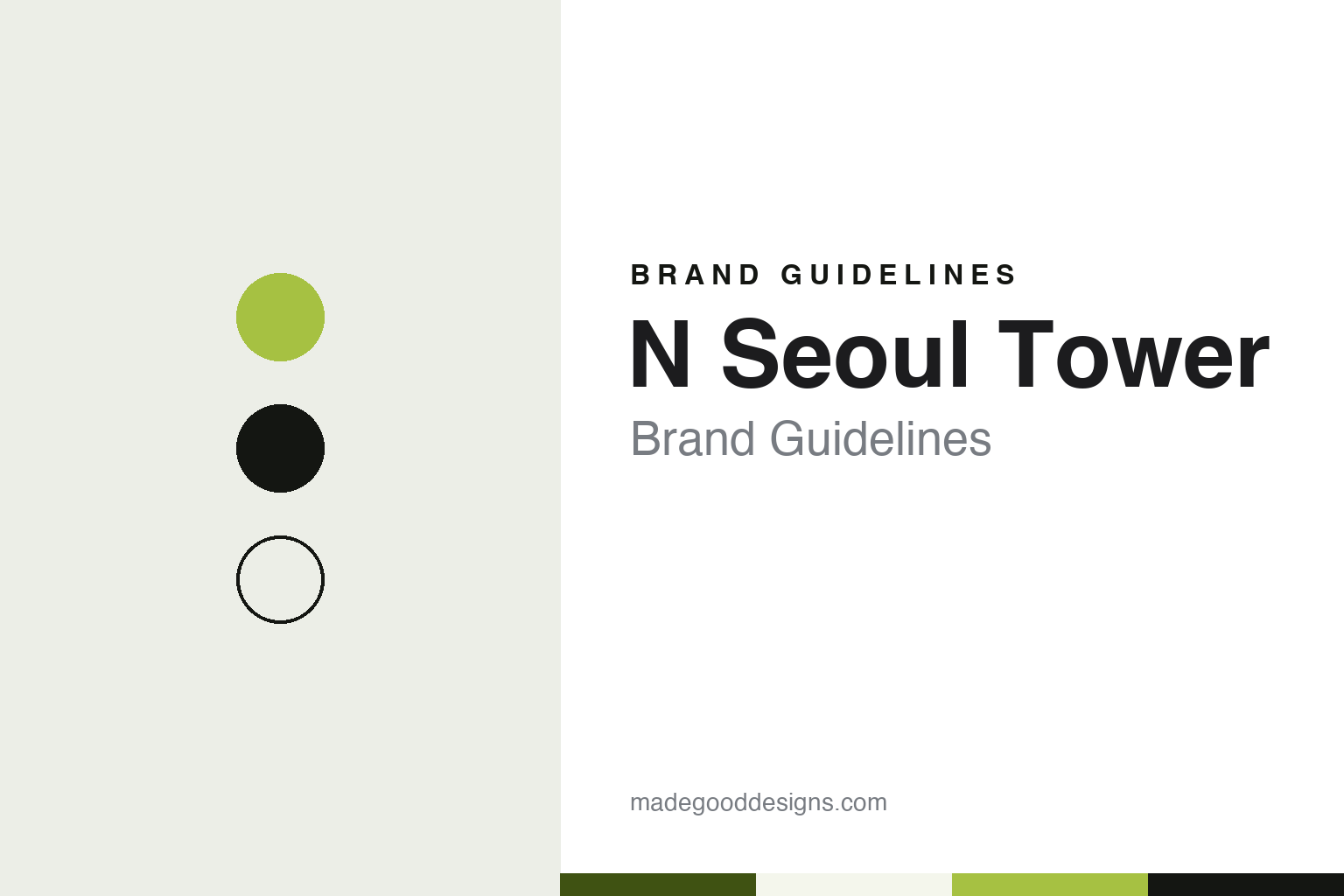
N Seoul Tower Brand Guidelines
The Namsan broadcast tower and its “N” for New and Namsan.
Aa
Two constants: an N Seoul Tower yellow-green and ink palette and a Geometric sans register. Abstract homage — not an N Seoul Tower product or mark; no logo, light display or building image is reproduced.
A broadcast tower on Namsan
From transmitter to observatory.
The tower on the summit of Namsan, the mountain in the middle of Seoul, began as a shared broadcast mast. The Encyclopedia of Korean Culture, published by the Academy of Korean Studies, says three private broadcasters — Tongyang Broadcasting, Dong-A Broadcasting and MBC — jointly received a permit in August 1969 for a combined transmission and observation facility. Construction started in December 1969, according to the history page of the N Seoul Tower website, which dates the concrete body to August 1971, the steel transmission mast to October 1971 and the completion of the observatory to July 1975; the encyclopedia and English Wikipedia give August 1975 for completion.
The tower did not open to visitors at once. The Korea Times reported in January 2019 that the tower was built in 1975 as a general broadcast tower for the city and that its cylinder-shaped observation deck opened to the public in 1980; the operator’s timeline puts the public opening in October 1980. MBC and KBS began television transmission from its antennas in 1972, and SBS followed in 1991, the same timeline says. YTN, the owner, says the tower still serves as a transmission site for KBS, SBS and terrestrial DMB services.
Ownership changed at the end of the 1990s. English Wikipedia says the Postal Mutual Aid Association owned the tower from 1980 until 1999. The business daily Maeil Business Newspaper reported on 16 December 1999 that the news broadcaster YTN had won a competitive tender for Namsan Seoul Tower, ahead of bids from SK Telecom and E-Land, with a plan to upgrade the observatory; the encyclopedia dates YTN’s acquisition to 2000, and the operator’s timeline to April 2000.
The name most visitors now see came five years later. In April 2005 YTN signed a renovation contract with CJ, the operator’s timeline says; design and building work ran from April to November, and in December 2005 the tower was renamed from Seoul Tower to N Seoul Tower. YTN’s own website says the N Seoul Tower section has been leased and operated by CJ Foodville, the CJ group’s restaurant company, since 2005. In December 2015 YTN opened the renovated lower levels of the base building as Seoul Tower Plaza, according to English Wikipedia. The Seoul Metropolitan Government named the tower a Seoul Future Heritage site in 2018, a listing reported by The Korea Times in January 2019.
Colour
One tower, several names.
The tower carries more than one name, and each belongs to a different party. English Wikipedia, whose article is titled Namsan Seoul Tower, says the national and city governments use Namsan Seoul Tower for the whole structure; the owner, YTN, uses YTN Seoul Tower; CJ Foodville, as concessionaire of the observation levels and their shops and restaurants, markets those under the name N Seoul Tower; and residents and popular culture tend to say Namsan Tower or Seoul Tower. YTN’s current website follows the same split: its brand page describes YTN Seoul Tower as made up of Seoul Tower Plaza and N Seoul Tower, the part run by CJ Foodville.
The “N” has a stated meaning. The brand-identity page on the N Seoul Tower website says the letter stands for “New” and “Namsan”, and the Encyclopedia of Korean Culture describes the initial as shorthand for “New Namsan”, adopted to signal a renewed tower and a younger, more dynamic image in step with the city’s changing cultural trends. The same brand page names two colours for the identity: a yellow-green and a black.
The figures the two operators publish differ by measuring point. YTN gives the tower as 237 metres including the turret and steel mast, standing on a summit 243 metres high, for a total of 480 metres above sea level; the N Seoul Tower site gives 236.7 metres, made up of a 135.7-metre tower body and a 101-metre steel mast. Maeil Business Newspaper gave 479.7 metres above sea level in its 1999 report.
Inside, the operator’s pages and English Wikipedia describe observation decks on the upper “T” levels, a rotating restaurant, n.Grill, and other restaurants such as Hancook and The Place Dining. The operator dates the reopening of n.Grill and The Place Dining after a renewal to August 2010, and a renewed observatory floor to April 2011. Seoul Tower Plaza, below, has shops, cafés and curved OLED display walls, including a panorama and a tunnel on its ground floor, English Wikipedia says.
Typography
Towers, decks and their keepers.
Observation towers and decks across Asia-Pacific and the Gulf are owned and run by a wide mix of businesses: railway groups, broadcasters, property developers and listed leisure companies. Some are broadcasting towers in their own right; others are decks at the top of office or mixed-use buildings. This guide looks at how each one presents itself, in plain terms and with dates where sources give them.
The names, logos and mascots are usually published by the operators themselves. Tokyo Skytree, for example, introduced a mascot called Sorakara and staff uniforms designed by the textile designer Akira Minagawa, Monocle reported in 2012, while Tokyo Tower’s company history records each renaming of its decks and of the company itself. Where an architect or engineer is credited, this guide names them only as a dated source does.
Lighting is a large part of the identity for several of them. Tokyo Tower’s Landmark Light dates from 1989 and its LED Infinity Diamond Veil from 2019, according to the company, and Tokyo Skytree’s Iki, Miyabi and Nobori schemes draw on Edo-period ideas of style, Nippon.com reported in 2022. Tickets, wayfinding, deck names, souvenir shops and seasonal displays carry the same identity at a smaller scale, from deck signage to tower-shaped bottles and stamps.
Each guide sets out who opened the tower or deck and when, who owns and operates it now, how it has been renovated or renamed, and what its own corporate pages say about its history, marking clearly what rests on the operator’s word. The palettes and typefaces shown are unofficial interpretations; no logo, mascot or lighting design is reproduced.
Aa
A geometric sans — one letter, two names. (Specimen set in Outfit, a geometric sans STAND-IN; NOT the N Seoul Tower logo.)
Light and locks
A tower read from across the city.
Much of the tower’s identity is carried by light. The N Seoul Tower timeline says that from January 2011 the colour of the tower’s lighting began to show the concentration of fine dust in Seoul’s air; English Wikipedia describes a scheme of four colours — blue for good air quality, green for average, yellow for bad and red for very bad — shown from sunset until late evening. The operator’s overview page also describes LED lighting that changes colour and pattern, which it presents as a form of light art.
A second visual signature is the padlock. English Wikipedia says love locks appeared at the tower in 2006 and were officially promoted as an attraction from 2007, and that they are fixed at designated photo zones and on the roof terrace. The operator’s timeline also records that the tower was listed among 51 Seoul Design Assets in July 2009, and the Encyclopedia of Korean Culture notes a Teddy Bear Museum among the attractions added after the 2005 renovation.
The tower also turns up on screen. English Wikipedia says the 2025 animated film KPop Demon Hunters sets its climax in a fictional stadium at the base of the tower, which the film calls Namsan Tower, and that the tower appears in scenes of the Netflix series Sense8. Walking trails, a cable car and shuttle buses lead up the mountain, so the tower is approached as part of Namsan Park rather than from a city street.
For a design guide, N Seoul Tower shows how one structure can carry layered names — an owner’s name for the whole, an operator’s brand for the observation floors and a popular name used by everyone else — and how a single letter and a two-colour pairing can carry a renaming. Compare Tokyo Tower, another broadcast and observation tower in East Asia, and Taipei 101, a skyscraper observatory with its own night-lighting scheme. For this guide we use a Namsan yellow-green and a tower ink with a geometric sans, an unofficial interpretation; no product or logo is reproduced.
Explore & save
Keep N Seoul Tower’s identity on hand — save it to a board in the Made Good inspiration library.
N Seoul Tower identity set
Pin the N Seoul Tower yellow-green and ink palette and the Geometric sans register to your own board.
Source & notes
Frequently Asked Questions
What font can I use to match the N Seoul Tower look?
This guide describes N Seoul Tower’s type as “A geometric sans — one letter, two names”. Its type specimen is set in Outfit from Google Fonts as a stand-in; Outfit is not N Seoul Tower’s own lettering.
What colours are in the N Seoul Tower palette?
This guide’s N Seoul Tower palette is Namsan yellow-green #A6C142, Tower ink #141612, Moss #3F5212, Han dusk blue #3A6683 and Paper #F4F6EC. The tones are the guide’s own unofficial interpretation, not official N Seoul Tower hex codes.
Where is N Seoul Tower based?
N Seoul Tower is based in Namsan, central Seoul.